Spy Alarm Switch NSP
Report Link Error
Select the broken download file, then submit the report.
Screenshots
About Game
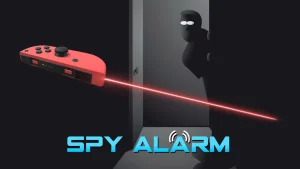
Spy Alarm Switch NSP is a Nintendo Switch utility and lifestyle release from Sabec, built around a playful stealth-puzzle setup. Released on May 27, 2021, it places a capable but accident-prone agent in guarded spaces where careful movement, timing, and observation are more useful than rushing ahead.
Spy Alarm on Nintendo Switch: Verified Release Details
Published by Sabec, Spy Alarm arrived on Nintendo Switch on May 27, 2021. Its verified genre classification is Utility and Lifestyle, a label that fits the title’s compact, challenge-focused design rather than a large-scale action format. The release supports English and carries a Region Free designation.
The premise leans into light-hearted espionage. Rather than presenting secret-agent work as a grim or high-stakes military operation, the game frames it as a series of sneaky challenges involving gadgets, hazards, and narrow opportunities to move safely. The player’s agent may be talented, but a clumsy streak gives the missions a more playful tone.
That setup gives each assignment a clear purpose: enter a protected location, reach the required point, and leave the alarm systems untouched. The pressure comes from the environments themselves, which are designed to punish careless movement rather than reward brute force.
A Light-Hearted Espionage Premise Built Around Alarms
In Spy Alarm Switch NSP, the player takes control of a secret agent sent into heavily guarded locations. Missions involve retrieving valuable objects or disabling important systems while avoiding detection. The challenge is not simply getting from one side of a room to the other. It is doing so without setting off the defenses positioned along the route.
The supplied mission descriptions point to varied settings, including an old museum and a high-tech laboratory. These locations support the game’s contrast between comic-book espionage and practical puzzle design: one room may suggest dusty displays and concealed valuables, while another may emphasize advanced sensors and tightly controlled security.
The agent’s objective remains consistent even as the surroundings change. Every assignment asks for discretion. Alarm systems create the boundaries of each puzzle, and a successful run depends on getting through those boundaries with deliberate, controlled actions. The result is a stealth theme expressed through manageable rooms and immediate hazards rather than sprawling infiltration maps.
How Spy Alarm’s Stealth Puzzle Gameplay Works
Spy Alarm gameplay centers on navigating rooms filled with detection systems and reaching a designated objective point. Players guide a small spy character through obstacles that demand route planning and precise movement. A room is effectively a miniature stealth puzzle: first identify what is dangerous, then work out where and when it is safe to travel.
The game’s structure emphasizes a gradual introduction of mechanics. New hazards and more complicated arrangements appear as progress is made, allowing earlier lessons about spacing, movement, and timing to remain useful. The increasing complexity comes from the combination of threats, not merely from making a path longer.
Special items may also matter to a route. Collecting certain items can open new paths, while environmental elements such as shadows can be used to the player’s advantage. This gives the rooms more than one kind of consideration: a player must watch the alarms, but also account for access points and the tools available inside the space.
- Scan first: Study the room before committing to a route.
- Read the rhythm: Track moving lasers, spotlights, patrols, and other repeating hazards.
- Choose a path: Look beyond the most direct route when alarms cover the obvious option.
- Wait calmly: Hold position until a safe opening appears.
- Move cleanly: Make quick, accurate movements when timing matters.
Laser Grids, Pressure Plates, and Cameras as Core Hazards
Laser grids are among the clearest examples of how the game turns security into a puzzle. A beam is not simply an obstacle to walk around; when it moves or scans across part of a room, it creates changing windows of opportunity. The player must judge when a gap is truly open and act before it closes.
Pressure-sensitive floors add a different kind of threat. Instead of focusing on a visible beam, these sections make the floor itself part of the problem. They encourage careful route selection and can force the player to think about where each step lands. A safe-looking corridor may still be dangerous if its surface is monitored.
Cameras, moving spotlights, patrols, and broader security systems expand the room’s field of detection. Their presence makes awareness important in every direction. A player may successfully avoid one laser grid only to enter the view of a camera or move into the path of a patrol. The hazards are therefore connected by the same central question: what can the agent do now without triggering an alarm?
Why Observation and Timing Matter in Every Room
Observation is the most useful habit encouraged by Spy Alarm’s design. Before moving, players can survey the room, identify the placement of hazards, and recognize movement patterns. This is particularly important when several systems operate at once. A safe route may exist, but only during a brief interval when a scanning beam has moved away, a spotlight has shifted, or a patrol has passed.
Timing follows naturally from that observation. Some moments call for patience, while others require a quick dash across a monitored area. The game’s challenge comes from switching between those two responses without panicking: wait when the room is unsafe, then move decisively when the opening appears.
Experimentation also has a role. The most obvious route is not always the safest, especially where alarms, floor sensors, and cameras overlap. Trying a different path may reveal a better use of cover, an alternate opening, or a way to approach an objective from another side. This makes spatial awareness and restraint more valuable than speed alone.
What the Verified Technical Profile Says About Spy Alarm
The verified Nintendo Switch title ID for Spy Alarm is 01000E6015350000. The listed firmware requirement is 12.0.0, and the recorded file size is 56 MB. English is the confirmed language, while the Region Free designation indicates the release is not assigned to a single regional market.
These details describe a small, focused Switch release whose documented identity is closely tied to its stealth-puzzle premise. Its suitable audience is best defined by the play style presented: players who enjoy patient room-by-room challenges, pattern recognition, and light espionage scenarios have the clearest reason to explore its alarm-filled missions.