Townscaper Switch NSP XCI
Report Link Error
Select the broken download file, then submit the report.
Screenshots
About Game
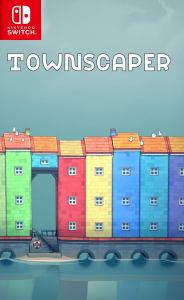
Townscaper Switch NSP XCI presents town building as a calm, tactile act of play rather than a test of planning, speed, or survival. Developed by Oskar Stålberg and published by Raw Fury, this Nintendo Switch release invites players to shape colorful settlements across open water, one placement at a time. Its appeal lies in how little it demands: there are no battles, budgets, or campaign milestones standing between an idea and a newly formed island town.
Townscaper on Nintendo Switch: A Creative Building Toy Without Objectives
Townscaper is best understood as a creative building game with simulation, puzzle, lifestyle, and other genre elements. It does not frame building around a mission structure. Players are not asked to satisfy residents, complete contracts, gather materials, or reach a designated final town layout. Instead, the focus remains on placing blocks and observing how a settlement changes.
That approach gives Townscaper Nintendo Switch a notably relaxed character. A small cluster can remain a tiny waterfront village, or it can become the foundation for a denser network of structures rising above the sea. There is no requirement to build efficiently, and no penalty for removing a piece or changing direction. The town is not a problem to solve so much as a space to explore visually.
The lack of formal objectives also changes the meaning of progression. Progress is measured through the player’s own creation: a new island connection, a taller district, a more varied silhouette, or a color combination that gives one part of town a different mood. Each session can be brief and playful or extended into a larger architectural experiment.
No Set Storyline: How Player-Built Towns Create Their Own Visual Tales
The Townscaper story is not supplied through named characters, dialogue, quests, or a predefined narrative. There is no required path through a campaign and no established cast whose adventures direct the player forward. The game instead leaves room for personal interpretation.
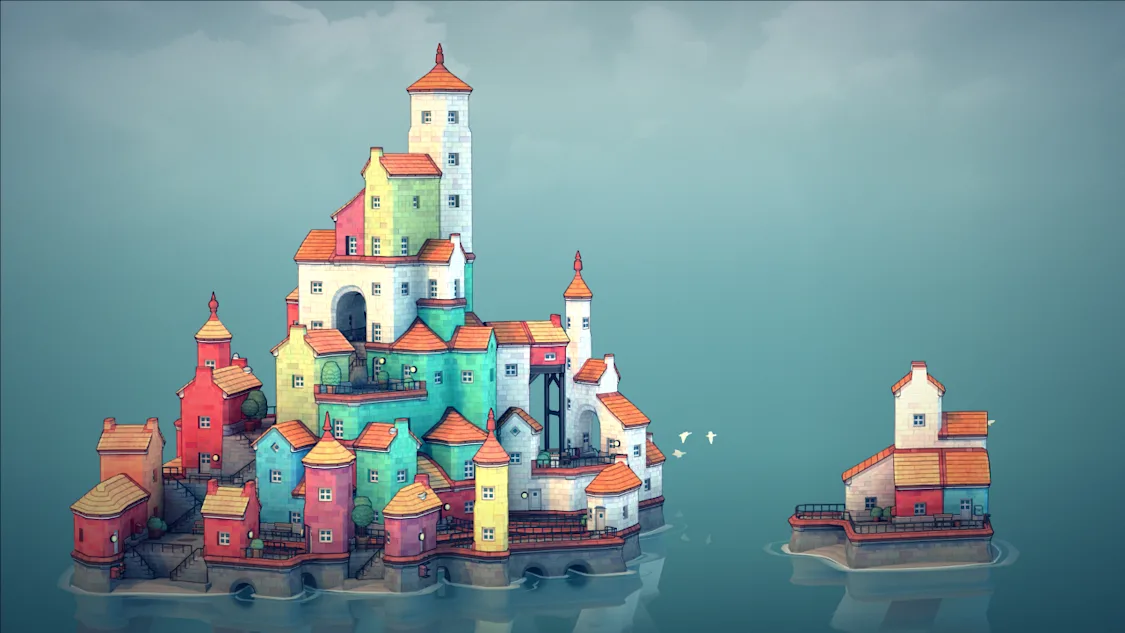
A compact row of buildings beside the water may suggest a quiet harbor. A tall arrangement of structures can look like a landmark overlooking smaller homes. Connected islands can imply routes between different neighborhoods, while isolated sections may feel like separate outposts. None of these readings are imposed, yet the layout of a town can encourage players to imagine its history and purpose.
This is where Townscaper gameplay becomes quietly expressive. The player creates a visual tale through shape, scale, spacing, color, and connection. A town can grow organically from a few experimental placements, and the resulting scene may look very different from another player’s work even when both begin with the same empty ocean. That open-ended creation gives the game lasting room for individual ideas.
From Empty Water to Whimsical Settlements
Townscaper begins with an expanse of water. From there, players place blocks that become the basis for buildings and island settlements. The basic loop is deliberately simple: add a piece, examine the result, then continue building outward, upward, or across the water.
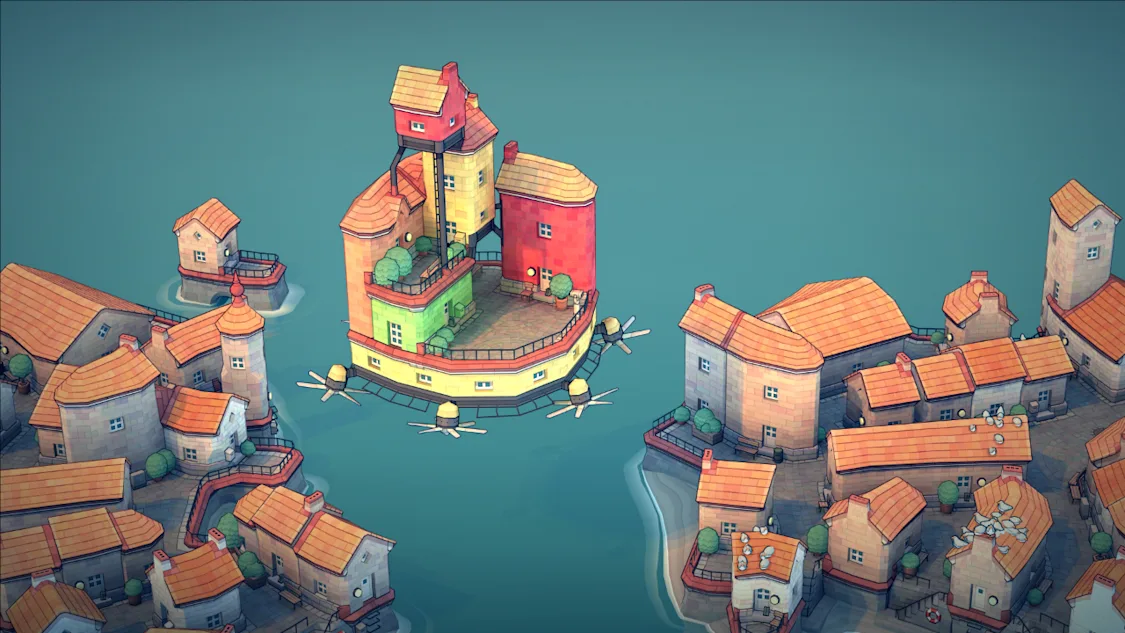
Those early placements can develop into Townscaper islands with winding shapes and interconnected sections. A single foundation may become a small group of houses, while further additions can create a larger town with varied heights and pathways. The game’s water setting is important to its visual identity because every expansion appears to rise from or sit beside the sea.
- Begin small: Start with a single foundation and let the first few placements suggest a direction.
- Expand outward: Build across the water to form separate islands or connected sections of a settlement.
- Build upward: Add height to create more visual variety within Townscaper towns.
- Test connections: Observe how adjacent blocks reshape the spaces between buildings.
- Adjust the palette: Use color choices to give districts distinct visual moods.
- Change the view: Zoom and rotate the camera to inspect details from different angles.
Because blocks can also be removed, experimentation remains approachable. An unusual idea does not have to become a permanent commitment. Players can revise a shoreline, break up a dense cluster, or redirect a town’s growth whenever they want.
The Responsive Architecture Behind Every Block Placement
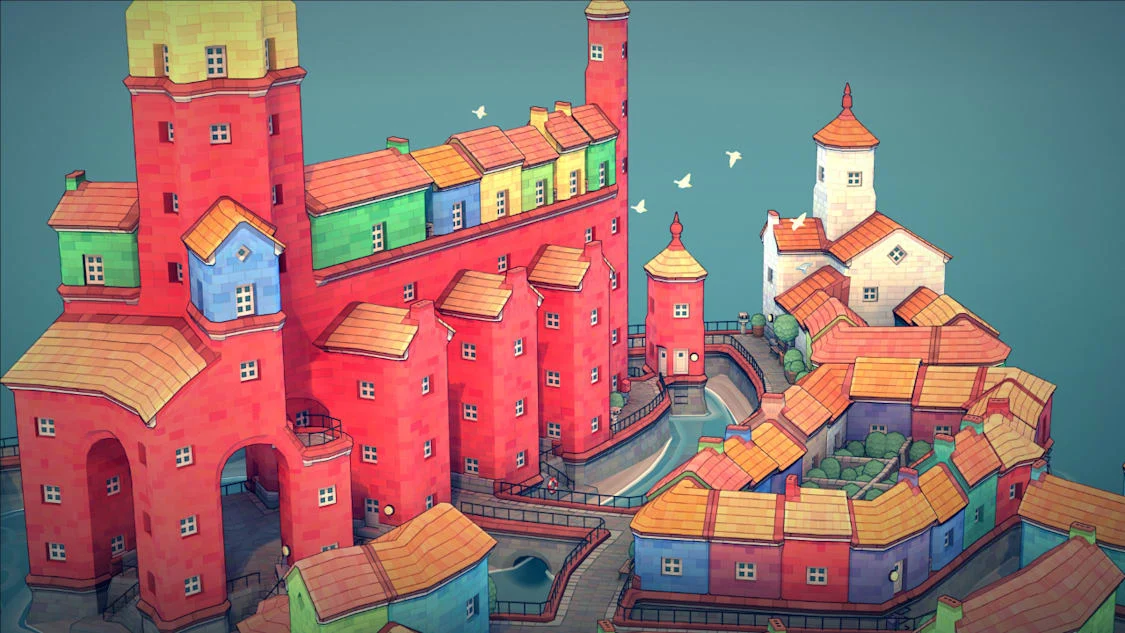
The most distinctive part of Townscaper architecture is its automatic visual response to placement. Rather than asking players to manually assemble every wall, roof, stair, or decorative feature, the game transforms block arrangements into appealing structures. A placement can contribute to houses, taller forms, arches, gardens, windows, and stairs depending on how it relates to nearby pieces.
This procedural building behavior makes each addition feel more substantial than a simple cube placed on a grid. The player still decides where a town grows, how its sections connect, and how tall it becomes, but the game helps convert those decisions into a cohesive visual result. The process encourages curiosity: a slightly different position may produce a noticeably different architectural detail.
That responsiveness also gives Townscaper blocks a puzzle-adjacent quality. There is no mandatory answer and no score for finding the best arrangement. Still, players can experiment with configurations to see how the architecture adapts. The pleasure comes from discovery rather than mastery of a fixed ruleset. A bridge-like connection, a towered cluster, or an arched passage can emerge from trying another placement and seeing what the system does with it.
Presentation supports that sense of discovery through vibrant colors and intricate-looking structures. The camera’s zoom and rotation options make it possible to look closely at a favorite section or step back to appreciate a complete island network. Screenshots can preserve a finished creation or capture a detail that might disappear after the next round of experimentation.
Building Freely Without Resources, Enemies, or Time Pressure
Townscaper has no resources to manage, no enemies to fight, and no mandatory objectives to complete. Those absences are central rather than incidental. They remove the usual pressures associated with many construction and simulation games, leaving building as the primary activity.
For players seeking a relaxing simulation game, that design can be especially inviting. There is no rush to optimize a settlement before a timer expires, and no threat that a town will fail because of a missed requirement. A player can spend time on a modest waterfront scene, experiment with a single tall formation, or simply place and remove blocks to watch the architecture shift.
Townscaper relaxation comes from that freedom to pause, reconsider, and continue at a personal pace. The experience treats mistakes as part of the creative process because no arrangement has to satisfy an external goal. Its replay value follows naturally: each new session begins with open water and a different idea, even if that idea is only to see what a new shape might become.
Why Townscaper Appeals to Simulation, Puzzle, and Lifestyle Players
As a Townscaper simulation, the game is concerned with shaping the appearance and growth of settlements, though it avoids the management systems often associated with the genre. Players influence the form of a town directly, deciding where it spreads and how its districts relate to one another.
As a Townscaper puzzle game, it offers experimentation rather than prescribed challenges. Block placement has consequences, and the automatic architectural transformations reward attention to patterns, spacing, and connections. Yet there is no pressure to solve a level correctly.
Its lifestyle appeal comes from its low-stakes routine of building, observing, adjusting, and admiring. Townscaper Switch NSP XCI is suited to players who enjoy visual creativity, calm construction, and open-ended experimentation without combat or resource systems. Available in English, Japanese, French, German, Italian, Spanish, Korean, Dutch, Portuguese, Russian, and Chinese, version 1.01 keeps the focus where it belongs: on making small, whimsical towns feel personal.