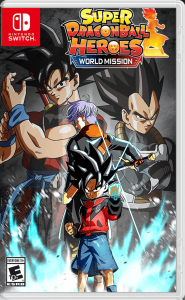
SUPER DRAGON BALL HEROES WORLD MISSION Switch NSP XCI
Report Link Error
Select the broken download file, then submit the report.
Screenshots
About Game
SUPER DRAGON BALL HEROES WORLD MISSION Switch NSP XCI brings Dragon Ball into a card-driven format built around planning, team selection, and fast action phases. Set in the lively setting of Hero Town, it turns the appeal of collecting familiar characters into a series of battles where timing, abilities, transformations, and Hero Energy can all change the result.
Hero Town and the Original Story Setup
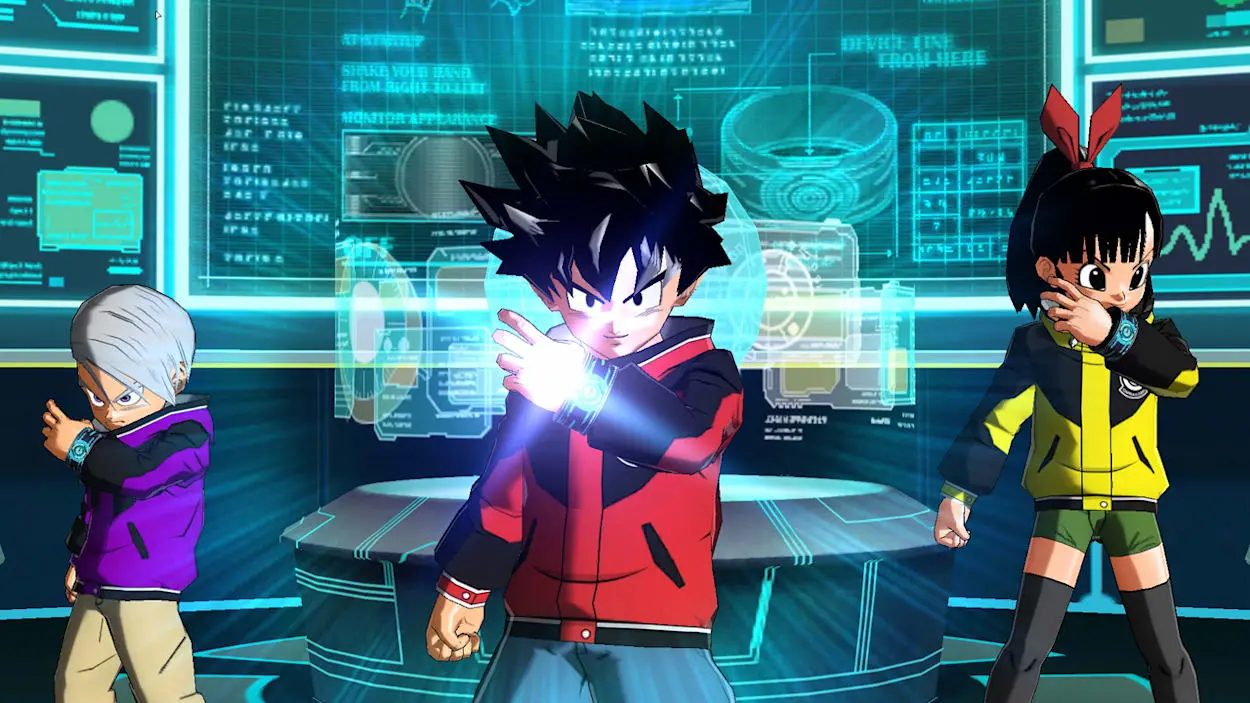
Hero Town is a place where the Super Dragon Ball Heroes arcade game has become a major part of everyday life. Players follow Beat, a young competitor with ambitions of becoming a leading player. That straightforward goal becomes more serious when the separation between the game world and reality begins to collapse.
Characters from the Super Dragon Ball Heroes universe start appearing outside the game, and an ominous force threatens both sides of this growing conflict. Beat and his friends are drawn into an original story that uses Hero Town as its central setting while sending players toward battles against powerful opponents. The premise gives the card matches a purpose beyond simple competition: building a capable team becomes part of restoring peace to both realities.
The tone remains rooted in Dragon Ball’s larger-than-life confrontations, but the player’s role is shaped by decision-making. Beat’s journey asks players to learn how the game’s cards work together, respond to challenges, and gradually assemble a group equipped for the chaos surrounding Hero Town. A custom avatar can also represent the player in the town and in battle.
How Strategic Card Battles Work
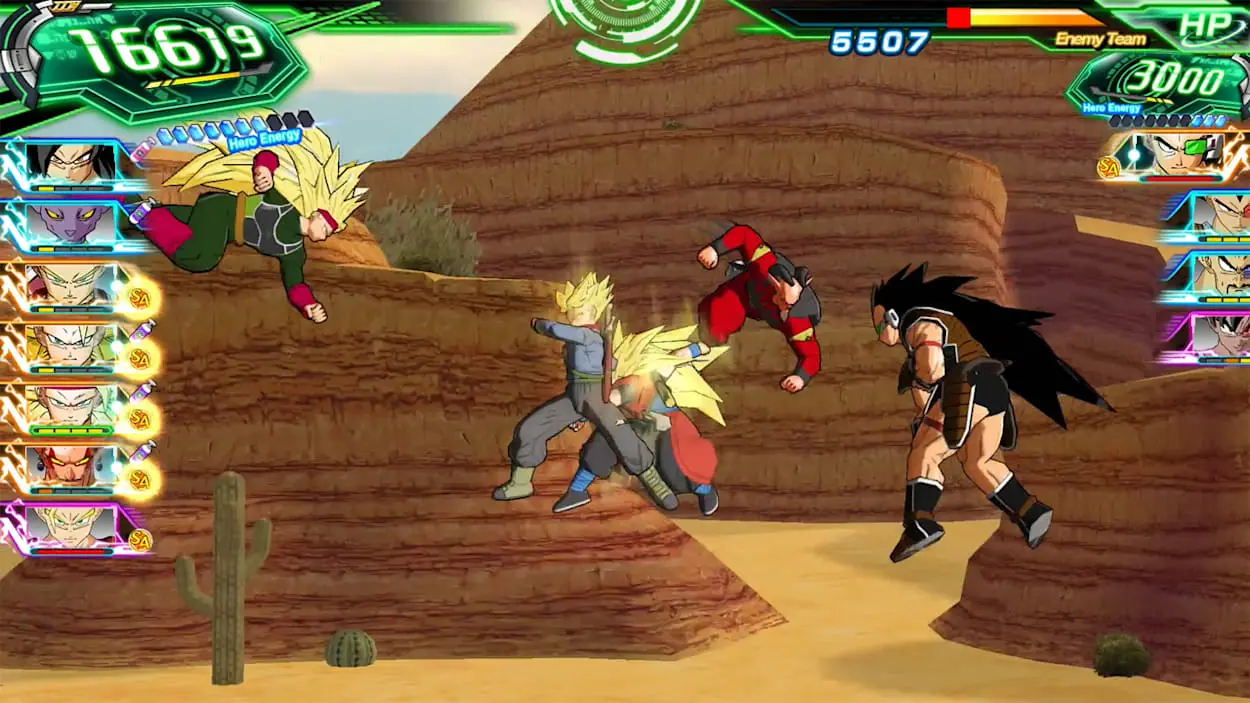
The card battles combine strategic gameplay with active battle moments. Before a match, players select Dragon Ball cards representing characters with distinct abilities and transformations. The important choices are not limited to choosing strong individual cards. A useful team needs cards whose roles and abilities support one another during a fight.
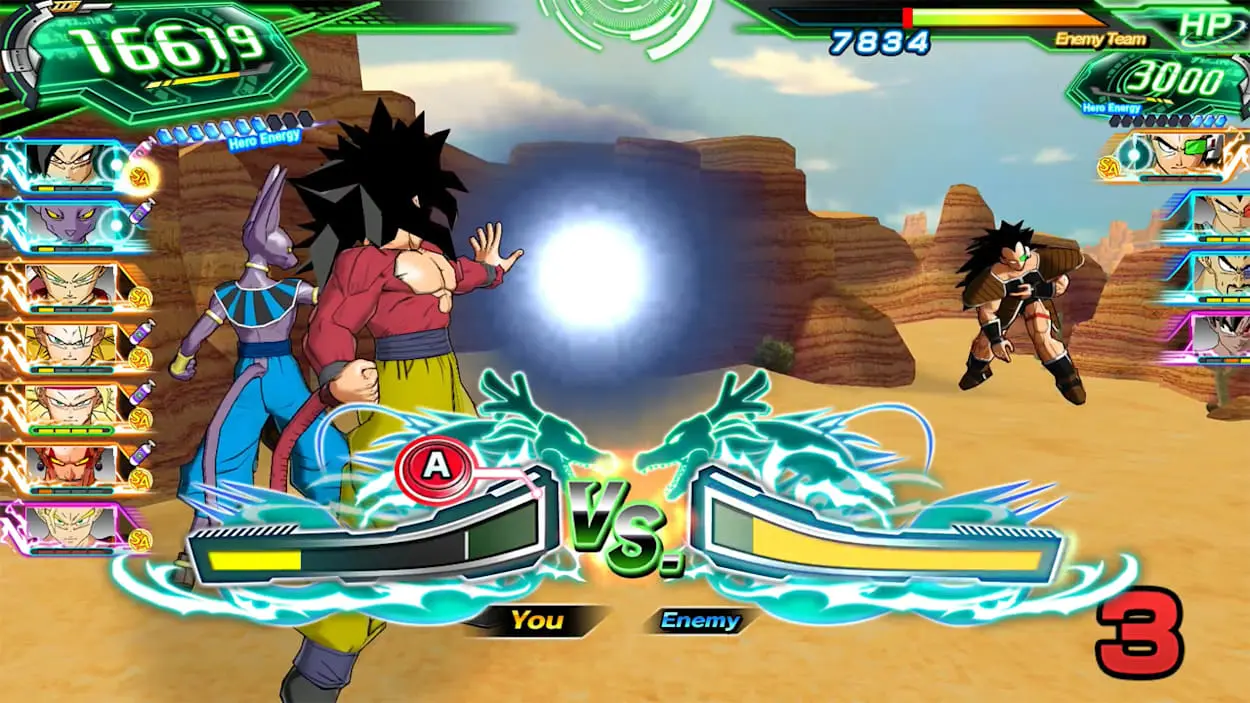
Combat mixes turn-based planning with real-time button prompts tied to special moves and defensive moments. This means preparation matters, but so does performance during the action phases. A well-timed input can strengthen an attack or help protect the team, giving battles a more immediate feel than a purely menu-based card game.
Hero Energy is another major part of the structure. Energy is used to access powerful special attacks and transformations, so players need to consider not only what a card can do, but also when it is worth spending resources. Saving energy for a key moment may be more valuable than using it at the first opportunity. The result is a system where card collection feeds into tactical choices rather than replacing them.
Building a Seven-Card Team
A team can be built from a deck of up to seven character cards. That limit makes composition important: every slot should contribute something useful, whether it is direct power, an ability that supports another character, or access to a transformation when conditions are right.
Team building begins with character types and develops through character synergies. Some cards may be more effective when paired with abilities that complement their strengths. Others can provide a needed response to an opponent’s plan. Instead of treating a seven-card deck as a list of favorites, players are encouraged to consider how the full lineup operates across a match.
Hundreds of cards give the game room for experimentation. A player can revise a deck after a difficult mission, adjust its balance for a different challenge, or search for combinations that make better use of Hero Energy. Awakenings and transformations add further potential during combat, rewarding attention to the conditions that allow a character to become more powerful.
This structure supports gradual progression. New cards and a clearer understanding of their interactions can lead to different team ideas, while difficult encounters test whether a deck has been built with a coherent plan. The most satisfying victories are likely to come from recognizing why a combination works, not simply from filling every slot with powerful names.
Story Mode, Arcade Challenges, and Online Battles
Story Mode provides the original Hero Town narrative, following Beat as the game and real worlds become entangled. It is the main place to experience the setting, its mystery, and the threat that drives the adventure forward. The story also gives players a steady context for learning the battle systems and refining a team.
Arcade Mode shifts attention toward classic Super Dragon Ball Heroes arcade missions. These missions come with defined challenges, making them a focused option for players who want to approach particular objectives and revisit battle scenarios with a revised deck.
Online battles offer another test for a carefully constructed team. Facing players worldwide changes the emphasis from preset missions to competition against other deck choices and approaches. Together, these activities give the game replay value through story progression, challenge-based arcade play, and repeated opportunities to test card strategies against other players.
5 Strategic Tips for New Hero Town Players
- Learn each card’s role. Characters have unique abilities and transformations, so take time to understand how a card contributes to a battle before placing it in a deck.
- Build for balance. Use the seven-card deck limit to create a team with complementary character types and abilities rather than relying only on individual strength.
- Protect Hero Energy. Special attacks and transformations require Hero Energy. Consider the timing of an energy spend, especially when a stronger opportunity may arrive later in the match.
- Practice action phases. Real-time button prompts can boost attacks or improve defense. Becoming comfortable with these moments helps turn a sound plan into a stronger result.
- Use transformations with intent. Awakenings and transformations can increase a character’s power, but they are most valuable when they fit the team’s immediate battle plan.
Nintendo Switch Release and Supported Regions
SUPER DRAGON BALL HEROES WORLD MISSION Switch NSP XCI was released for Nintendo Switch on April 5, 2019. Bandai Namco published the game, while Dimps Corporatio developed it. Its listed genre is Puzzle Game, though its central play is presented through strategic card battles and action phases.
The release is supported in Europe, the USA, and Japan. Available languages are English, French, Portuguese, Italian, German, Spanish, and Japanese. This broad language selection suits players who want to follow Beat’s Hero Town story while spending substantial time on deck strategy, arcade challenges, and online competition.
For Dragon Ball players drawn to collecting character cards and considering their interactions, the game’s appeal lies in that steady exchange between planning and execution. Hero Town supplies the atmosphere and story framework; the seven-card teams, Hero Energy decisions, and active battle prompts provide the reason to keep refining a strategy.