Terraformers Switch NSP

Report Link Error
Select the broken download file, then submit the report.
Screenshots
About Game
Terraformers Switch NSP brings a turn-based vision of Mars colonization to Nintendo Switch, asking players to guide humanity’s effort to establish a sustainable new home on the red planet. The challenge is not simply to place buildings: each decision contributes to a larger attempt to support population growth, secure vital supplies, explore an unfamiliar landscape, and gradually reshape Mars into a more habitable world.
Terraformers on Nintendo Switch: Mars Colonization at a Glance
Terraformers is a simulation and strategy game centred on the difficult work of building a human future on Mars. Earth’s declining sustainability provides the premise for a bold colonization initiative, with the player taking responsibility for the first stages of a settlement and its longer-term planetary ambitions.
The Nintendo Switch version frames that mission through turn-based planning. A campaign develops through choices about where to go, what to construct, which resources to prioritize, and how quickly to commit to more ambitious terraforming work. Mars begins as a demanding environment rather than a blank canvas, so expansion depends on reading the opportunities offered by different regions and building a network capable of sustaining itself.
That makes this Mars strategy game a measured experience rather than a rush for immediate growth. Colonies need infrastructure, people need support, and major environmental projects require a foundation strong enough to carry them. The appeal lies in watching individual decisions connect: a newly explored location can influence future construction, while a research choice can open a different route toward planetary transformation.
Turn-Based Strategy and City-Building Foundations
The central rhythm of Terraformers gameplay combines turn-based choices with city-building and resource management. Each turn presents opportunities that can affect the direction of the colony, from expanding into new territory to developing the systems needed to keep existing settlements productive.
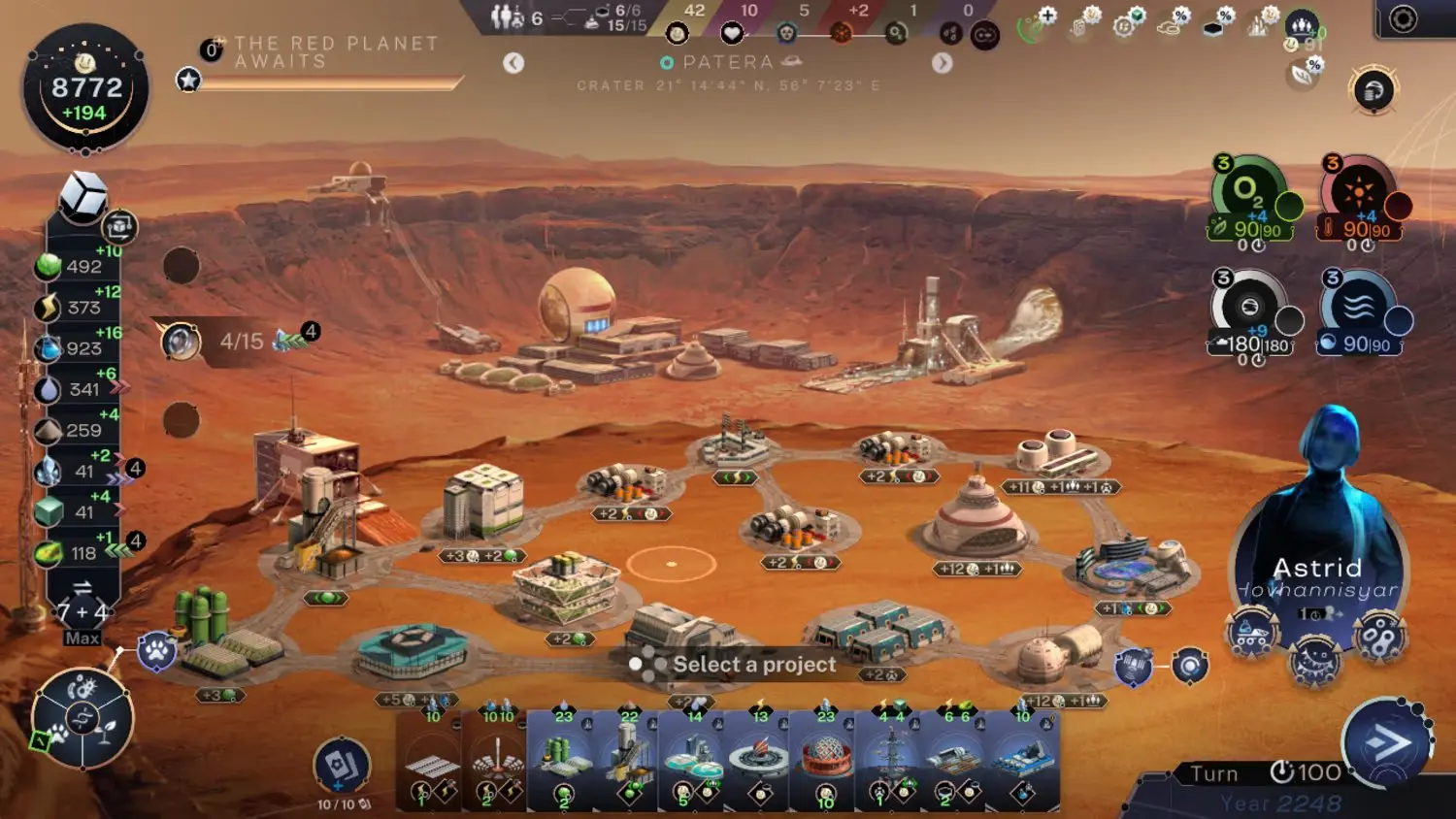
Construction is closely tied to strategic planning. Players can build facilities such as research labs, power plants, and residential domes, but placing them is only one part of the process. A growing colony must balance power, water, food, minerals, energy, and the needs of its population. A decision that helps in the short term may create pressure elsewhere if resource production or infrastructure cannot keep pace.
This turn-based city builder approach gives each project a practical role. Power production supports a broader network, research labs contribute to technological progress, and residential construction helps accommodate a larger population. The colony is therefore shaped by priorities rather than by construction alone. Players are continually deciding which needs require immediate attention and which investments can prepare Mars for the future.
As a strategy simulation Switch release, the game’s emphasis is on connected systems. Expansion, building efficiency, research, and terraforming are not separate activities; they influence one another throughout the campaign. The result is a colonization game built around planning ahead while responding to the conditions of the developing settlement.
Exploration, Expansion, and Martian Resource Planning
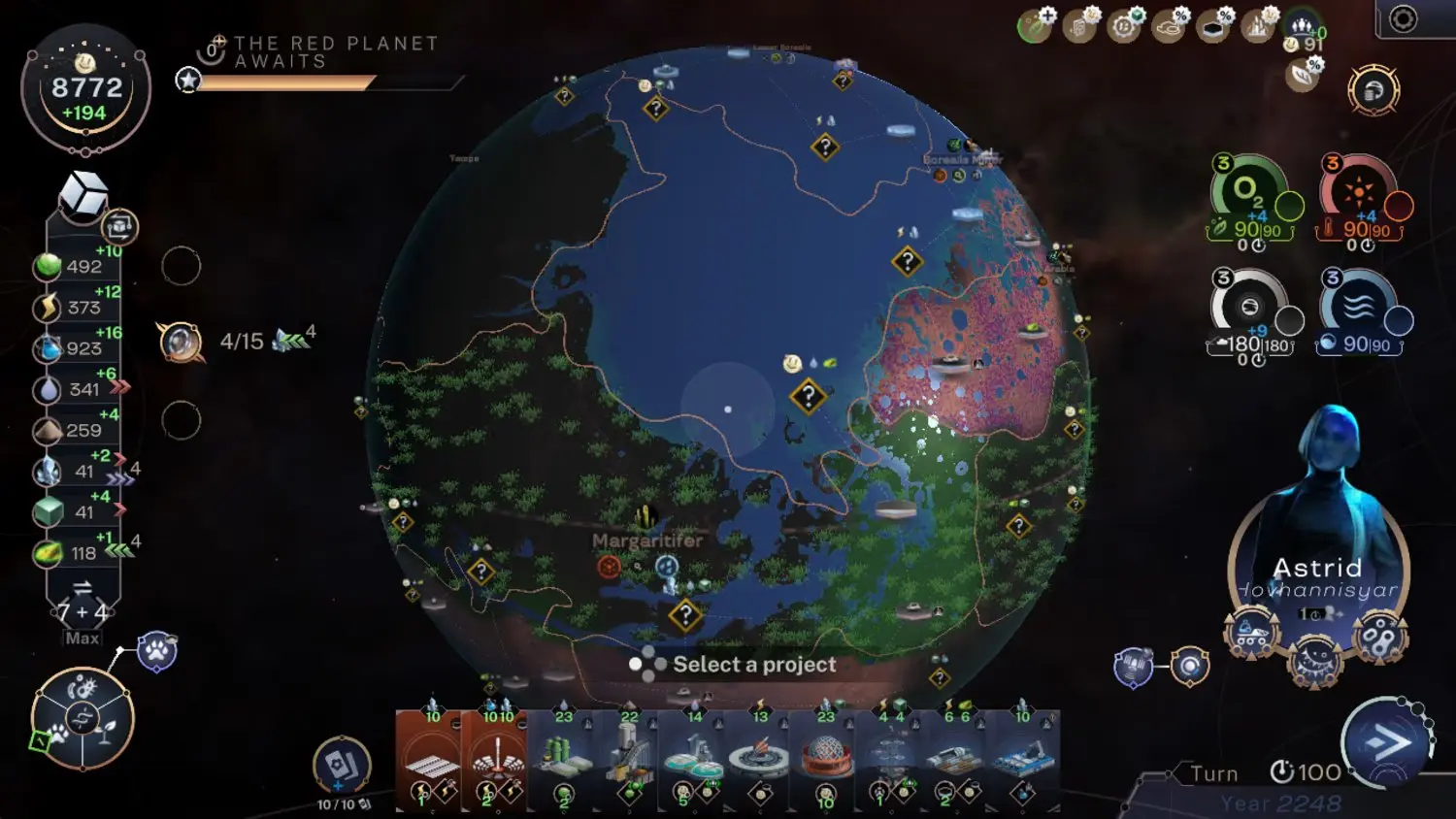
Exploration is essential because the Martian landscape contains both resources and possible sites for future infrastructure. Moving into new regions can reveal useful locations, but expansion also introduces fresh demands. New areas must fit into the wider plan for resource extraction, construction, and population support.
Mars resources include minerals, energy, and water, all of which have a place in sustaining colonies and larger projects. The choice of where to establish infrastructure can therefore shape the efficiency of the entire settlement. A useful location may be worth pursuing, but only if the colony can support the cost of reaching it and integrating it into its growing network.
Careful colony expansion strategy matters because rapid growth without preparation can strain basic production. A settlement that spreads too far before securing power or essential supplies may face avoidable difficulties. Conversely, delaying exploration for too long can limit access to resources and strategic locations. The most effective approach is likely to balance immediate stability with a clear path toward the next region.
Building placement also invites experimentation. The game encourages players to consider adjacency bonuses and efficiency, making the arrangement of structures part of the larger planning exercise. Infrastructure is not only about having the right building; it is also about positioning it in a way that supports the colony’s wider goals.
Research and the Route to Advanced Terraforming
The research tree provides a route from early settlement needs to more advanced capabilities. Research can unlock improved buildings, new projects, and technologies that raise efficiency. This gives development a sense of progression: early infrastructure establishes a foothold, while later discoveries make more substantial change possible.
Terraforming technology is the long-term expression of that progress. Advanced projects can alter Mars’s climate, atmosphere, and surface, shifting the focus from survival on a barren planet toward the creation of a more supportive environment. The available projects include orbital mirrors and genetically engineered plant life, illustrating how research connects colony management with planetary-scale ambitions.
The research tree also creates meaningful priorities. A technology that improves present efficiency may be valuable when resources are tight, while another may bring a major terraforming project closer. These choices give the campaign room for different planning routes, since the colony’s current needs can influence which research feels most urgent.
This is where Terraformers Switch NSP gains much of its strategic character. Progress is not limited to constructing more buildings or reaching more territory; it also comes from choosing the technologies that can change what the colony is capable of accomplishing.
5 Early Priorities for a Strong Terraformers Colony
- Secure basic output. Establish reliable power and essential resource production early. A stable supply of core resources helps prevent shortages as the colony begins to expand.
- Expand with purpose. Explore new regions for resources and useful locations, but avoid treating every available area as an immediate priority. Growth should remain manageable.
- Test building placement. Experiment with the placement of structures to make use of adjacency bonuses and improve efficiency across the settlement.
- Plan the network. Think beyond a single building or region. Infrastructure should support future extraction, population needs, research, and larger projects.
- Choose research carefully. Use the research tree to unlock buildings, technologies, and projects that address current pressures while preparing for later terraforming goals.
Terraformers Switch Release Details and Supported Languages
Terraformers released on Nintendo Switch on November 21, 2023. It is published and developed by Goblinz Studio, and its listed genres are Simulation and Strategy.
The Switch release is available for Europe, USA, Asia, and Japan. Supported languages are English, French, German, Japanese, Korean, Russian, Simplified Chinese, Spanish, and Traditional Chinese. The base firmware requirement is version 17.0.0.
For players drawn to deliberate management games, colony construction, and long-range planetary projects, Terraformers offers a Mars-focused strategy framework built around exploration, resource planning, research, and the gradual transformation of an inhospitable world.