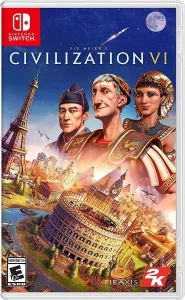
Sid Meier’s Civilization VI Switch NSP XCI
Report Link Error
Select the broken download file, then submit the report.


Screenshots
About Game
Sid Meier’s Civilization VI Switch NSP XCI turns the long history of a civilization into a sequence of personal decisions. Its campaign is not a fixed tale with prescribed heroes and turning points. Instead, each match begins with a historical leader, an early settlement, and a map waiting to be explored, then grows into a record of discoveries, alliances, rivalries, wars, and ambitions pursued across centuries.
A Civilization Story Written Through Player Decisions
The game’s narrative strength comes from its emergent narrative. There is no linear plot to follow from one mission to the next. Players select from historical leaders with their own abilities and units, then determine how their society develops. A peaceful relationship with a neighboring ruler may become a useful alliance, a tense border may turn into conflict, or an early focus on culture may redirect the entire civilization’s future.
Those choices give each session a different historical character. One civilization may become a scientific power through careful research and city development. Another may spread religion across the map, build cultural influence, or rely on military force to secure land and remove rivals. The story is shaped by outcomes rather than scripted scenes: a hard-won city, a diplomatic agreement, a new technological milestone, or the consequences of a war fought over territory.
That approach also supports replay value. Different leaders, procedurally generated maps, neighboring civilizations, resource locations, and victory goals mean that the same broad journey from early settlement to later-era advancement can unfold in markedly different ways.
From First Settlement to Global Empire
The core of this turn-based strategy game is a steady cycle of planning and response. Players establish cities, claim territory, improve useful tiles, research technologies, develop civics, and direct military units across land and sea. Every turn offers immediate tasks, but the larger challenge is deciding which short-term gains serve a long-term plan.
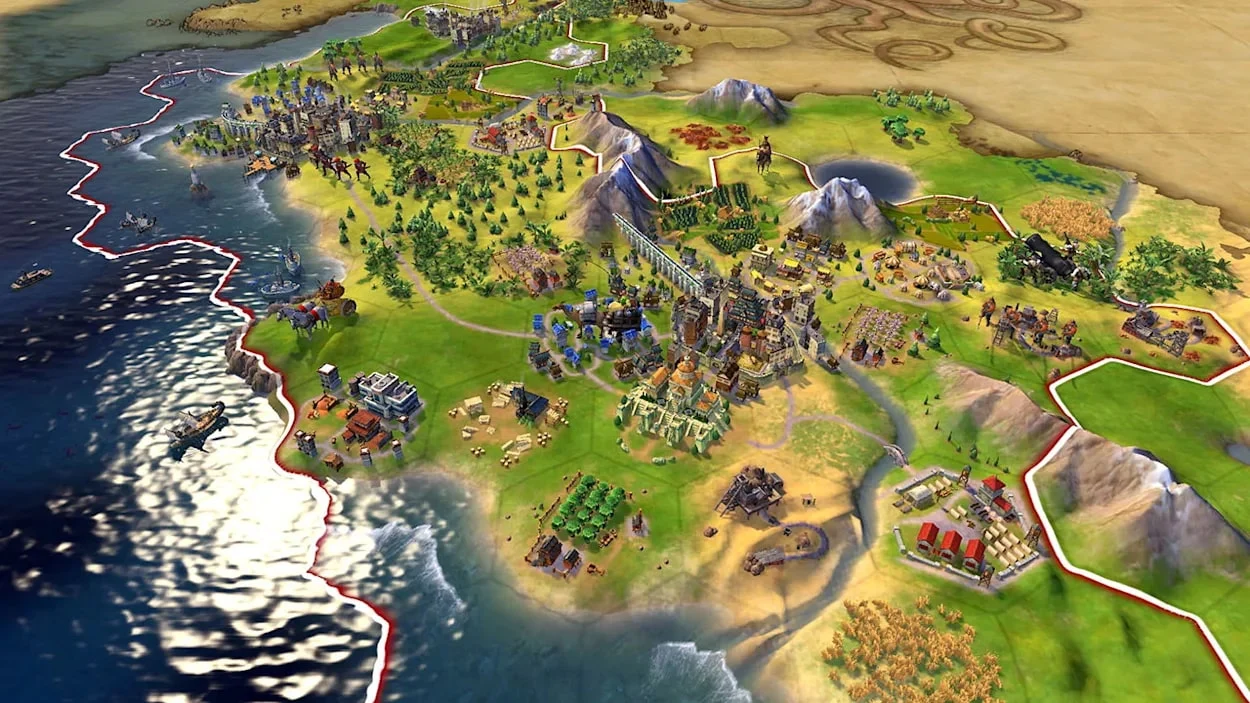
City founding is especially important because a city’s location affects access to terrain, resources, and future district sites. Builders improve tiles to support a growing population and stronger economy, while expansion opens new locations for settlements and extends a civilization’s influence. Resources discovered through exploration can change priorities, making the map an active part of the decision-making process rather than a simple backdrop.
Progression moves through both technology and civics. The technology tree carries a civilization from early developments toward later achievements such as spaceflight, while the civics tree helps shape government and cultural policies. Research can also be boosted by completing certain actions in play, encouraging players to connect their goals with what is happening on the map. The result is an empire-building rhythm that rewards flexible planning instead of a single rigid route.
District Planning Makes Every City a Strategic Puzzle
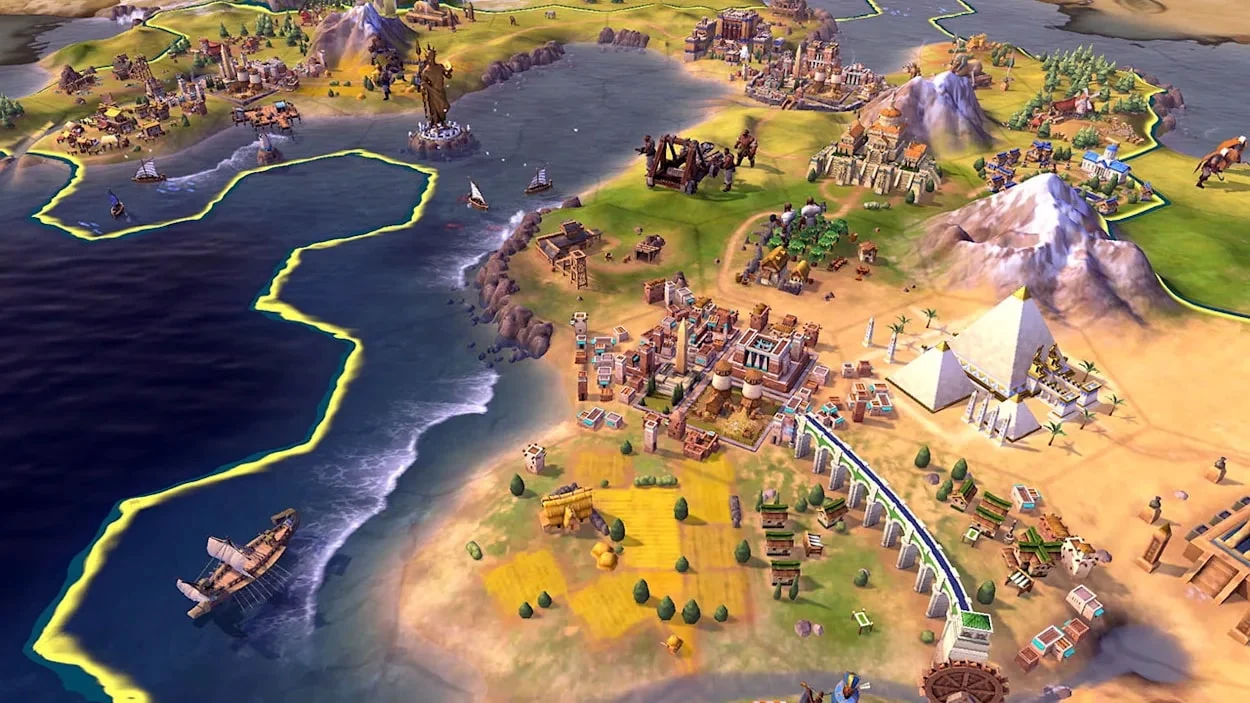
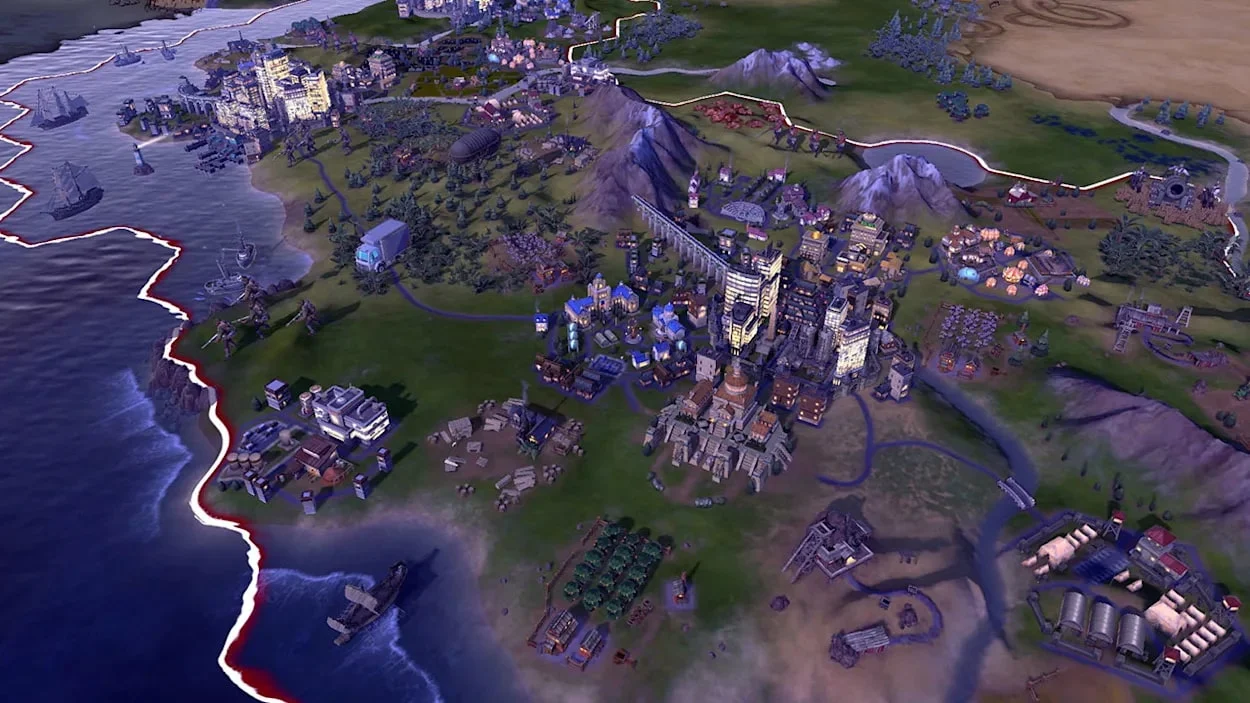
Civilization VI separates a city’s functions across the surrounding map through its unstacked-city design. Rather than keeping every improvement within one city tile, players place specialized districts on individual tiles. This makes district placement a central part of city strategy, because land that looks ordinary at the beginning of a match may become valuable once a city’s future role comes into focus.
Districts can support outputs such as science or culture, and their effectiveness is influenced by adjacency bonuses. Mountains and certain resources can improve the value of nearby districts, giving terrain a practical strategic purpose. A player planning a research-focused city may preserve suitable spaces for science-oriented development, while another city may be positioned to support cultural growth.
These choices create meaningful trade-offs. A tile may be useful for a builder improvement now, yet more valuable later as a district location. A city with access to strong terrain combinations can become highly specialized, while another may need a broader role. The presentation of cities spreading across tiles makes that planning legible: growth is visible not only in menus, but in the changing footprint of an empire on the map.
Four Paths to Shaping Civilization’s Legacy
The game offers four stated victory goals: Science victory, Culture victory, Domination victory, and Religion victory. Each asks players to prioritize different parts of the same strategic toolkit.
A Science victory places special weight on research, technological advancement, and the development needed to pursue late-game achievements. A Culture victory shifts attention toward cultural progress and the policies that grow from the civics tree. Both routes benefit from thoughtful cities and effective district planning, though their priorities may differ.
Domination victory brings military planning to the foreground. Unit movement across varied terrain, control of land, and the timing of conflict all matter when dealing with rival civilizations. Diplomacy remains relevant even in a more aggressive game, since relationships can influence the wider political situation.
Religion victory offers another way to define a civilization’s influence. It encourages players to consider religious development alongside expansion and interactions with other leaders. None of these routes exists in isolation: research can support military power, culture can shape policy decisions, and diplomacy can matter throughout. The victory conditions give a match direction while leaving room to adapt as the world changes.
7 Opening Priorities for a Strong Civilization VI Start
- Scout early. Explore nearby terrain to find resources, useful city locations, ancient wonders, and neighboring civilizations.
- Settle with purpose. Choose a first-city location with future growth, workable tiles, and space for expansion in mind.
- Use builders well. Improve tiles to strengthen development and make better use of the land around each city.
- Reserve district sites. Look ahead before filling valuable tiles, especially where terrain or resources may support stronger district placement.
- Chase adjacency. Use mountains and relevant nearby features to gain district adjacency bonuses for science, culture, and other outputs.
- Match research to action. Select technology and civic directions that fit current needs, while watching for actions that can boost progress.
- Expand at a measured pace. New cities create opportunities, but each should fit a wider plan and make effective use of its surroundings.
Nintendo Switch Edition Details: Languages, Version, and Platform Context
Editorial reference box
- Title: Sid Meier’s Civilization VI Switch NSP XCI
- Genre: Adventure
- Publisher: 2K Games
- Developers: Aspyr and Firaxis Games
- Region: Region Free
- Version: 1.2.14
- File size: 4.8GB
- Firmware: 11.0.1, Atmosphere & SXOS
- Civilization VI Switch languages: Japanese, French, German, Italian, Spanish, Korean, Portuguese, Russian, Chinese, and English
On Nintendo Switch, the game’s structure suits players who enjoy deliberate, map-based planning and the satisfaction of seeing many small decisions accumulate into a civilization’s identity. Its atmosphere comes less from a single authored storyline than from the sense of guiding a society through changing eras—one settlement, district, policy, alliance, or campaign at a time.