Portal 2 Switch NSP

Report Link Error
Select the broken download file, then submit the report.
Screenshots
About Game
Portal 2 Switch NSP brings Valve Corporation’s celebrated puzzle adventure to Nintendo Switch with the same distinctive mix of first-person problem-solving, science-fiction comedy, and increasingly elaborate test chambers. Released on June 28, 2022, this English-language version is available in Europe and the USA. Valve Corporation serves as both publisher and developer, placing the game across Action, Adventure, and Puzzle genres.
Portal 2 on Nintendo Switch: Release and Game Details
Portal 2 Switch places players inside the strange, decaying world of Aperture Science, where an apparently simple device can turn walls, floors, and distant platforms into routes through a chamber. The Nintendo Switch release preserves the game’s central appeal: its puzzles ask players to reconsider distance, direction, gravity, and momentum rather than simply find an obvious path forward.
Valve Portal 2 is built around a campaign that mixes quiet exploration with sharp dialogue and sudden mechanical surprises. Its environments shift from broken test rooms to older areas of the facility, giving the adventure a clear sense of progression through Aperture Science’s long-abandoned spaces. The action is rarely about direct combat; instead, tension comes from hazards, timing, spatial awareness, and the need to understand the tools placed in each room.
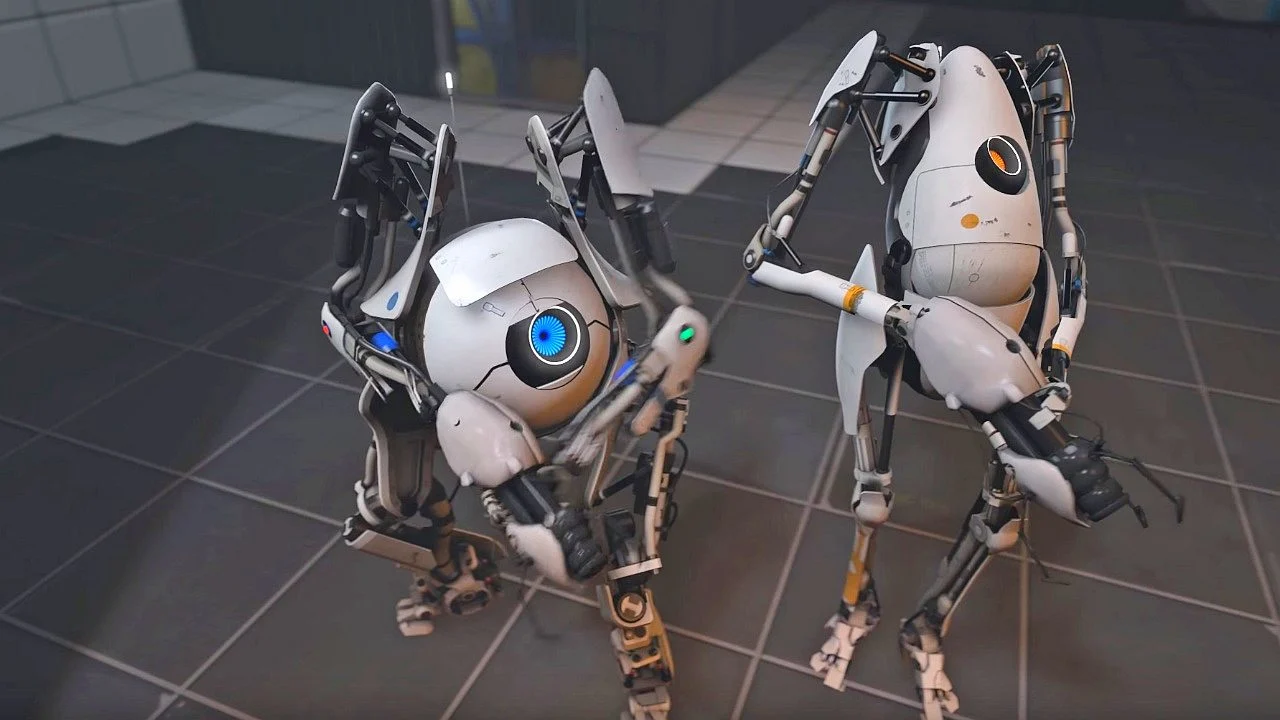
The game also includes a dedicated cooperative campaign. It follows the robotic test subjects Atlas and P-Body on a separate mission for GLaDOS, giving two players challenges designed around coordination. That distinction adds replay value beyond Chell’s single-player journey, because the co-op chambers require ideas and actions that cannot be completed by one participant alone.
Chell’s Return to the Ruined Aperture Science Laboratories
The Portal 2 story begins many years after the events of the first game. Chell awakens from stasis inside Aperture Science Laboratories and finds a research complex that has fallen into ruin. The facility is no longer a clean sequence of controlled experiments. Its chambers are damaged, overgrown by decay, or buried beneath the remains of an older Aperture Science operation.
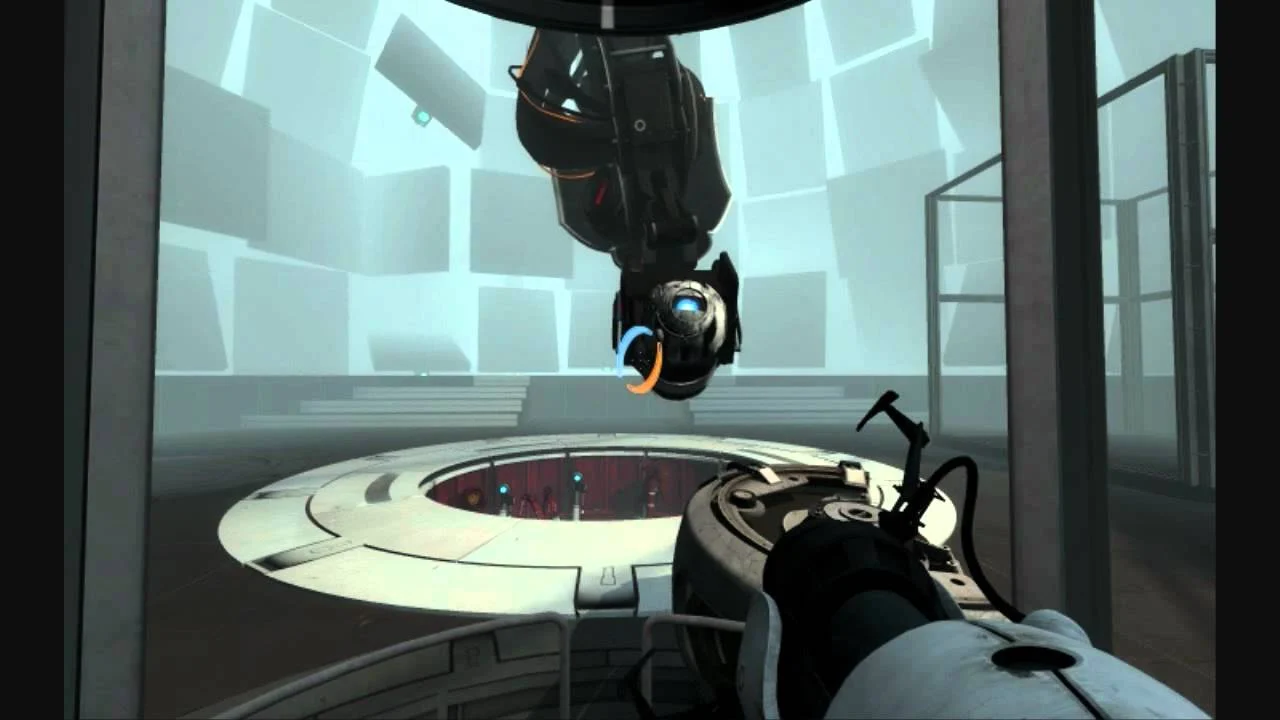
Early on, Chell is aided by Wheatley, a clumsy personality core attempting to guide her out. His efforts instead contribute to the return of GLaDOS, the sardonic artificial intelligence whose testing program once again places Chell in a succession of increasingly complex chambers. The familiar testing structure gives the game direction, but its narrative does not remain static. Chell’s route eventually leads into Aperture Science’s past, where archival recordings from former CEO Cave Johnson reveal more about the company and its unsettling history.
This setting gives the adventure its atmosphere. The abandoned laboratories feel both enormous and enclosed: a place built for experimentation, then left to collapse around the systems still operating inside it. Portal 2 Chell is not presented as a conventional action hero; her progress is defined by persistence, observation, and an ability to turn the laboratory’s own machinery into an escape route.
How the Portal Gun Shapes Every Puzzle
The Portal Gun creates two connected portals on suitable surfaces. Walking into one portal brings Chell out of the other, allowing a wall across a chamber or a floor below a ledge to become part of the route forward. That basic rule is easy to understand, yet Portal 2 puzzles repeatedly expand its possibilities.
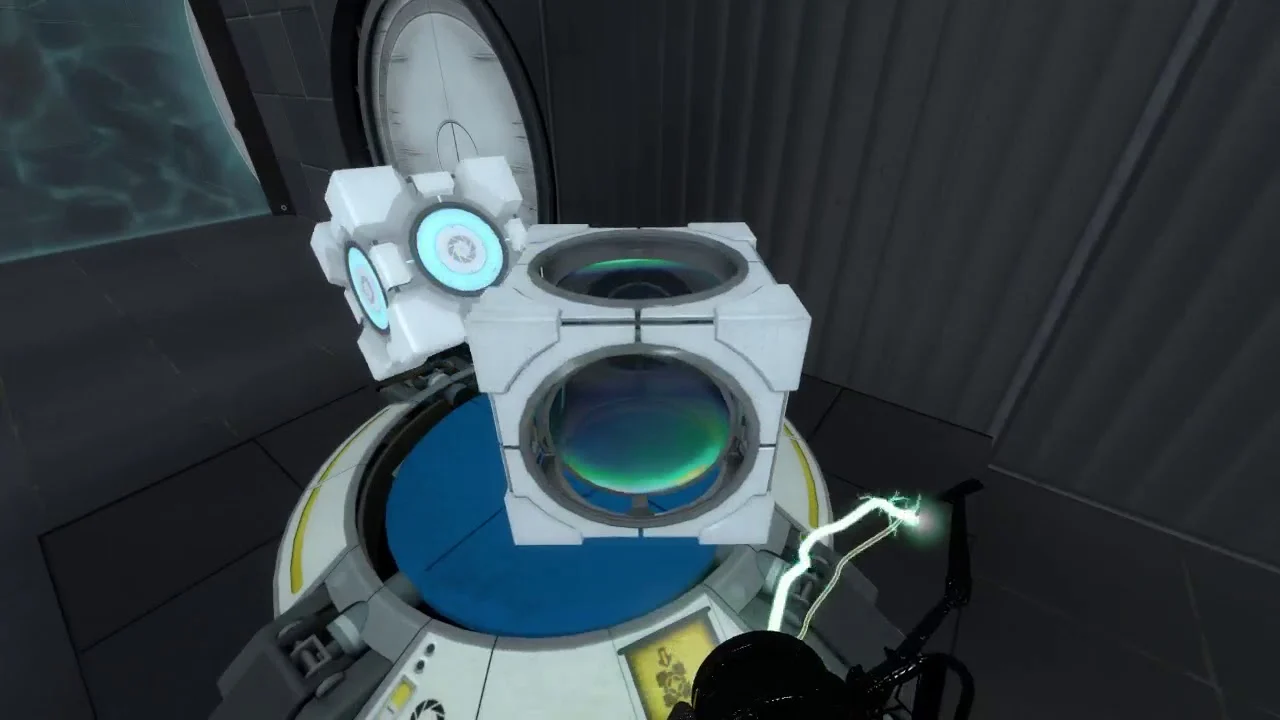
Portals can be used to cross large gaps, reach raised platforms, redirect projectiles, and reposition objects. A player may need to place an entrance below a drop and an exit on a distant wall, carrying momentum through the connection to launch across a space. In another chamber, portals can create a new viewing angle that reveals a switch, a pressure plate, or the correct place for a weighted cube.
As a physics puzzle game, Portal 2 relies on experimentation rather than a single repeated solution. The important question is often not merely where a portal can go, but what will happen once Chell, an object, a beam, or another environmental element passes through it. The chambers reward deliberate testing of those relationships.
The Three Gels That Expand Portal 2’s Challenges
Later challenges introduce three gels that change how surfaces and movement behave. Each one broadens the Portal Gun’s uses without replacing its central role.
Portal 2 Propulsion Gel gives a surface speed, allowing Chell to build momentum before a jump or a portal launch. Long lanes coated with the gel can turn an ordinary run into the force needed to clear a gap or reach a higher route.
Portal 2 Repulsion Gel makes surfaces bounceable. It can send Chell or objects upward and across spaces that would otherwise be inaccessible. Its use often depends on judging where a bounce will lead, particularly when portals can redirect the landing path.
Portal 2 Conversion Gel changes previously unsuitable surfaces so portals can be placed on them. This is a major shift in puzzle design: a wall that once acted only as a barrier can become an entrance or exit point. Together, the gels encourage players to look beyond fixed chamber layouts and consider how the environment can be altered.
Beams, Vents, and Excursion Funnels in Aperture Science
Portal 2 adds further systems that make its test chambers feel less like isolated rooms and more like interconnected mechanical problems. Thermal Discouragement Beams can be redirected as part of a solution, often working alongside portals, cubes, or other chamber equipment. Their paths matter, turning line-of-sight into another puzzle variable.
Pneumatic Diversity Vents move objects through the facility, sending items along routes that may need to be intercepted or used elsewhere. They create a useful contrast with portals: rather than moving Chell directly, they can reposition the tools required to open the next path.
Excursion Funnels provide another way to travel and transport objects. These systems add controlled movement through space, but they still invite portal-based thinking. A funnel’s direction, its destination, and its relation to a portal surface can all change how a chamber is approached. Along with weighted cubes, pressure plates, turrets, and other hazards, these devices ensure that later rooms ask for more than one trick at a time.
7 Observation-First Tips for Solving Portal 2 Chambers
- Scan the surfaces. Before placing portals, identify which walls, floors, or panels can accept them and consider where an entrance and exit would create the greatest advantage.
- Find the triggers. Look for switches, pressure plates, weighted cubes, and other mechanisms that may control doors, platforms, or chamber equipment.
- Read the room. Beams, vents, funnels, and hazards are often part of the route rather than background machinery, so observe where they begin and where they lead.
- Test the gels. Use Propulsion Gel for speed, Repulsion Gel for bouncing, and Conversion Gel to create portal-friendly surfaces where none existed before.
- Keep momentum in mind. A fall through one portal can become the speed needed to leave another portal and cross a seemingly impossible distance.
- Respect the hazards. Turrets and dangerous chamber elements can interrupt an otherwise correct plan, making route timing and safe positioning important.
- Talk through co-op. In the Atlas and P-Body campaign, clear communication helps two players coordinate portal placement, movement, and shared objectives.
For players drawn to thoughtful environmental puzzles, darkly comic science-fiction settings, and cooperative challenges built around communication, Portal 2 Switch NSP offers a substantial journey through the broken machinery of Aperture Science. Its progression works because every new tool changes the meaning of the rooms that came before it.