Overcooked! All You Can Eat Switch NSP XCI
Report Link Error
Select the broken download file, then submit the report.


Screenshots
About Game
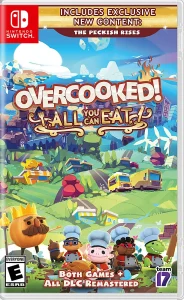
Overcooked! All You Can Eat Switch NSP XCI gathers the series’ fast, cooperative cooking challenges into one Nintendo Switch edition. Built around quick decisions and constant coordination, it combines familiar kitchens with additional content while keeping the focus on the simple problem that drives every round: get the right meal to the customer before the clock and the kitchen get away from the team.
What Overcooked! All You Can Eat Includes on Nintendo Switch
Overcooked! All You Can Eat brings together Overcooked!, Overcooked! 2, and their previously released DLC in a single collection. It also includes additional kitchens, giving players a large run of levels built around increasingly unusual culinary workplaces.
The package follows the series’ lighthearted, deliberately silly world. Players work alongside the Onion King and Kevin the dog through food-focused crises: the original game sends chefs on a time-travelling effort to prepare for the Everpeckish, while Overcooked! 2 introduces the Unbread, a threat made up of zombie toast. The premise is playful rather than dramatic, serving mainly as a route into the next set of kitchens and challenges.
Its progression comes from moving through new environments, learning their rules, and improving performance for stronger star ratings. With hundreds of levels across the games, the DLC collection, and the added kitchens, there is room for groups to revisit earlier stages, sharpen routines, and chase more efficient service.
The Core Cooking Loop: Prep, Cook, Plate, and Serve
The cooking gameplay is easy to understand and difficult to keep orderly. A team receives orders, then must collect the needed ingredients, chop them, cook them where required, assemble the finished dish, and deliver it before customer patience runs out. Sushi, pasta, burritos, cakes, and other dishes demand different combinations of those actions.
That basic loop becomes tense because every job competes for limited space, equipment, and time. One player may be chopping ingredients while another watches pans, and a third handles plating meals and delivery. Meanwhile, used plates return to the kitchen and need attention. Washing dishes is not a side task for long; ignore it and the service line can stall because there is nothing clean on which to serve the next order.
The appeal lies in how quickly a workable plan can unravel. A missed ingredient, an overworked cooking station, or a stack of dirty plates can force everyone to change priorities. The game rewards teams that can react without losing sight of the order queue.
Dynamic Kitchens That Turn Simple Orders into Chaos
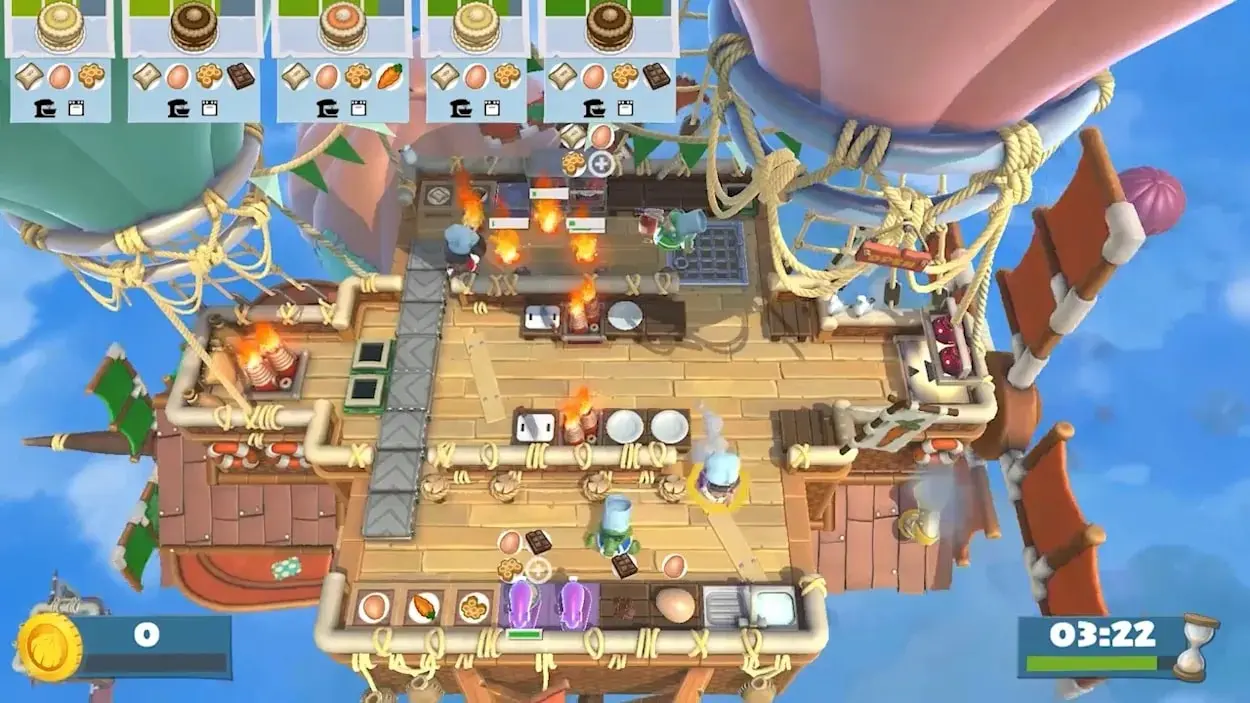
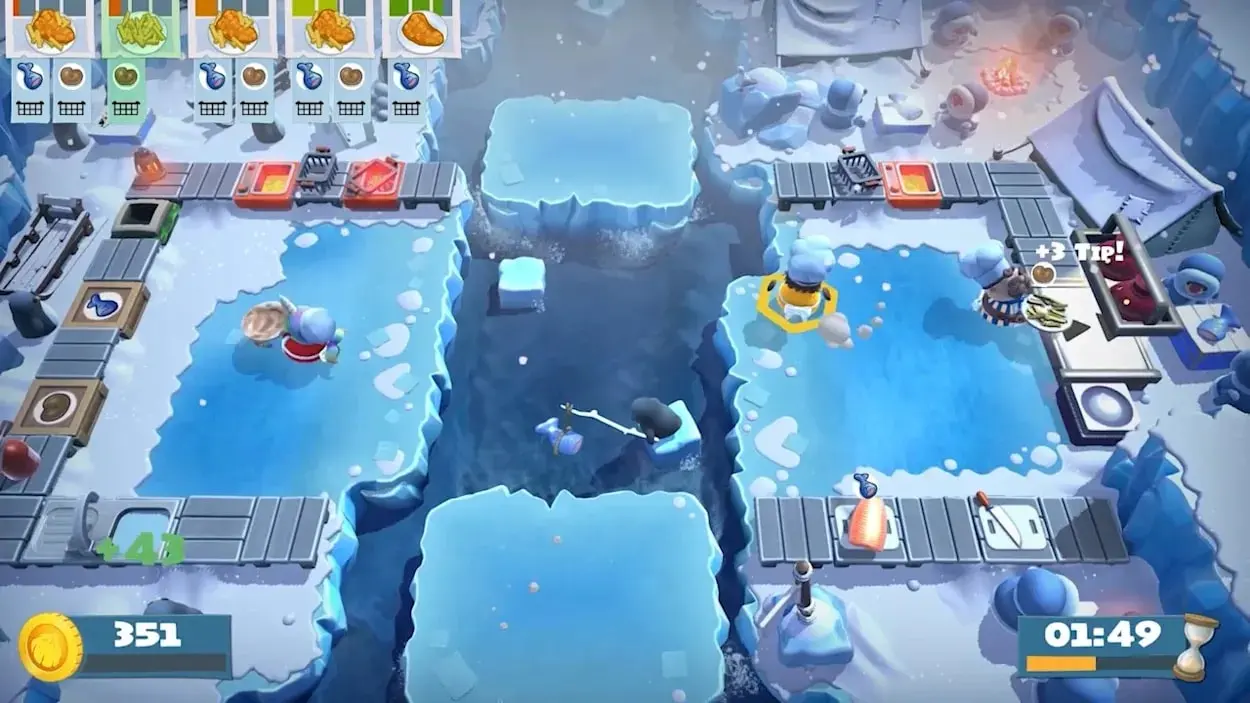
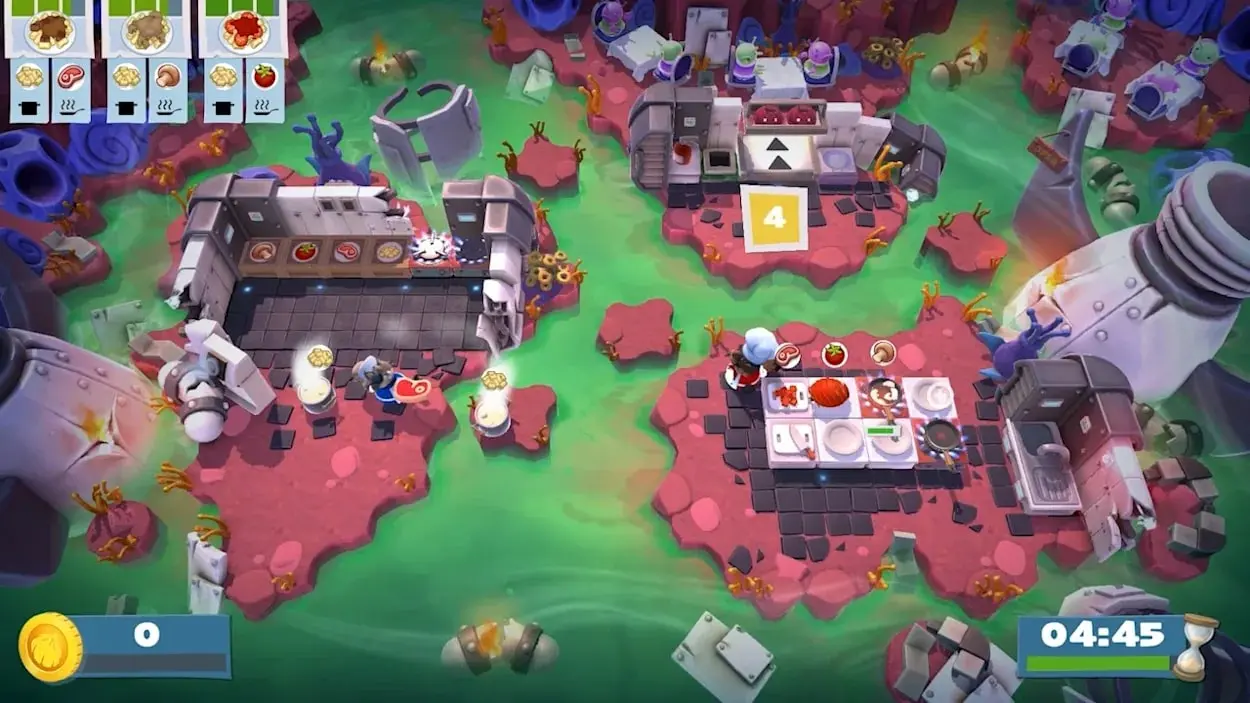
The kitchens are more than visual backdrops. Their changing layouts reshape how every task is performed. Dynamic kitchens can divide teammates across separate workspaces, shift access to ingredients, or require players to account for moving platforms while carrying food from one station to another.
Some levels introduce portals, turning a short walk into a route that needs to be learned. Others add environmental hazards that interfere with movement and timing. These features make an otherwise straightforward recipe feel like a logistical puzzle: ingredients may be on one side, cooking equipment on another, and the serving counter somewhere inconveniently distant.
This is where the collection’s chaotic atmosphere is most effective. The pressure is cartoonish and energetic, but the decisions remain practical. Who crosses first? Who stays near the stove? Is it worth carrying a clean plate across the kitchen now, or should the team finish the current order? As layouts evolve, old habits stop working, pushing players to adapt rather than simply repeat the same routine.
The presentation supports that pace with enhanced visuals and faster loading times. The collection also offers 4K and 60 FPS where supported, helping the busy kitchens remain readable even when several chefs, ingredients, appliances, and orders are competing for attention.
Local and Online Co-op for Up to Four Players
Local multiplayer and online multiplayer allow groups to approach the kitchens together in different ways. Up to four players can share the workload, turning each level into a small team exercise in task assignment, timing, and recovery from mistakes. Nintendo Switch co-op suits a group in the same room, while online play keeps the shared kitchen available when teammates are apart.
More players do not automatically make a kitchen easier. Four-player co-op creates more hands for prep, cooking, delivery, and cleaning, but it also increases the need for clear calls. Two people reaching for the same ingredient or leaving the same pan unattended can lose more time than it saves.
The emote wheel provides another means of communication, though the most useful teamwork often comes from short, direct signals: a needed ingredient, a finished dish, a dirty plate, or a blocked route. The game is well suited to players who enjoy cooperative problem-solving with a lively, humorous edge, especially groups willing to treat mistakes as part of the round rather than a reason to stop.
7 Teamwork Habits for Better Star Ratings
- Inspect first. Before committing to a routine, look over the kitchen layout, ingredient locations, cooking stations, serving area, and any moving sections.
- Find choke points. Notice narrow routes, shared appliances, split workspaces, and other places where teammates are likely to block one another.
- Assign team roles. Give players clear initial jobs such as chopping, cooking, serving, or cleaning, then adjust when the order flow changes.
- Call out orders. Communicate what is needed next, what is already cooking, and which dish is ready to plate so effort is not duplicated.
- Respect dirty plates. Keep washing dishes in the team’s plan. A clean plate is part of completing an order, not something to handle only after a crisis.
- Plan the route. Carry ingredients and finished meals along efficient paths, especially in kitchens with moving platforms, portals, or separated stations.
- Practice tough rooms. Difficult kitchens become more manageable when the group repeats them, learns the timing, and refines its kitchen strategy for better star ratings.
Switch Release Details, Regions, and Language Support
Overcooked! All You Can Eat Switch NSP XCI was released on March 23, 2021. It is listed as a Simulation Game, published by Team17 and developed by Team17 and Ghost Town Game. The listed regions are USA, EUR, JPN, and Asia.
Language support includes English, Japanese, German, Spanish, French, Italian, and Russian. The listed file size is 10GB. Its base firmware is listed as v9.2.0, with the update listed as v15.0.0.
For players drawn to cooperative games that turn communication into part of the challenge, this collection offers a substantial run of kitchens and a clear reason to return: there is always another route to improve, another role to refine, and another order queue threatening to become a disaster.