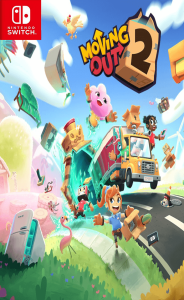
Moving Out 2 Switch NSP
Report Link Error
Select the broken download file, then submit the report.
Screenshots
About Game
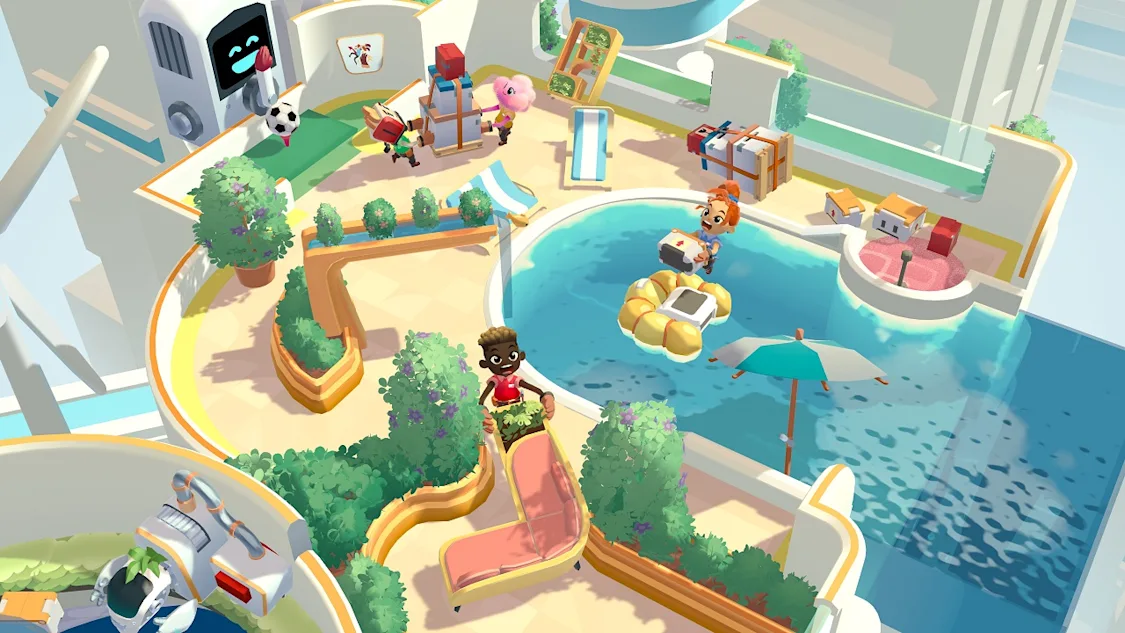
Moving Out 2 Switch NSP frames the ordinary work of clearing a house as a fast, deliberately unruly cooperative challenge. Developed by SMG Studio and published by Team17, this strategy game turns furniture removal into a succession of physical problems, time-sensitive decisions, and comic mishaps. Its appeal lies in the contrast: the goal is simple, but the route to the moving truck rarely is.
Moving Out 2 on Nintendo Switch: A Chaotic Co-op Moving Adventure
SMG Studio’s moving-game formula asks players to become Furniture Arrangement and Relocation Technicians, or F.A.R.T. members, charged with emptying locations and loading their contents into a truck. That task quickly becomes more complicated than carrying boxes through a front door. Large objects need careful handling, awkward layouts demand quick thinking, and the game’s loose physics can turn a clean plan into a scramble.
The tone is humorous rather than severe. Furniture can be tossed, windows can become shortcuts, and an ill-timed lift can send an item toward a hazard. This combination of slapstick and strategy gives each stage a lively, unpredictable rhythm. Players are not merely racing a clock; they are working out how to move through a space efficiently while adapting to the unexpected.
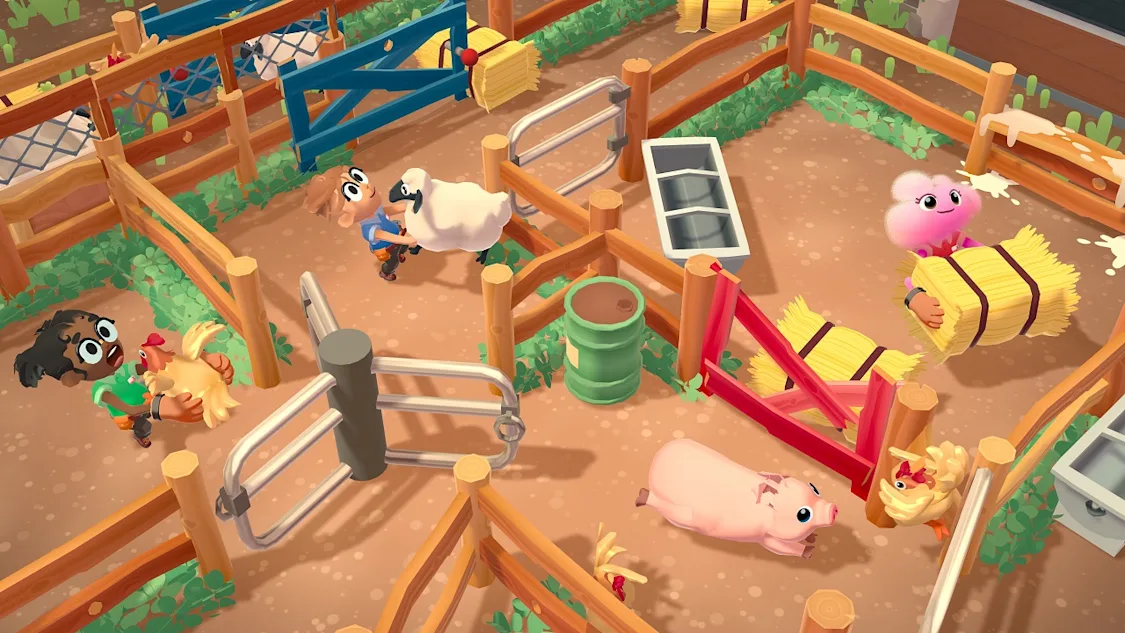
Cooperative play supports up to four players locally or online, making communication part of the action. A team can divide tasks, pair up on bulky items, and search for better routes, but poor coordination can also create delays. The result is a strategy game built around immediate, visible consequences: every carried sofa, blocked doorway, and improvised shortcut affects the next few seconds.
Packmore and the Interdimensional Journey
The Moving Out 2 story begins with the familiar setting of Packmore before sending the F.A.R.T. team beyond it. Portals carry the movers into a series of unusual dimensions, giving the game a playful reason to push its relocation work into increasingly strange environments.
These destinations include alien landscapes, haunted mansions, and futuristic facilities. Each setting brings its own environmental challenges and rules, so the team cannot rely on one routine for every job. A route that makes sense in one location may be ineffective in another, especially when unusual hazards or world elements change how furniture can be moved.
The interdimensional journey also supports the game’s bright, quirky presentation. New characters and lighthearted mysteries accompany the trips between dimensions, but the narrative remains a framework for the moving challenges. Packmore provides the starting point; the portals provide variety; the real focus remains the hectic work of getting every required item loaded.
How Furniture Moving Becomes a Physics Puzzle
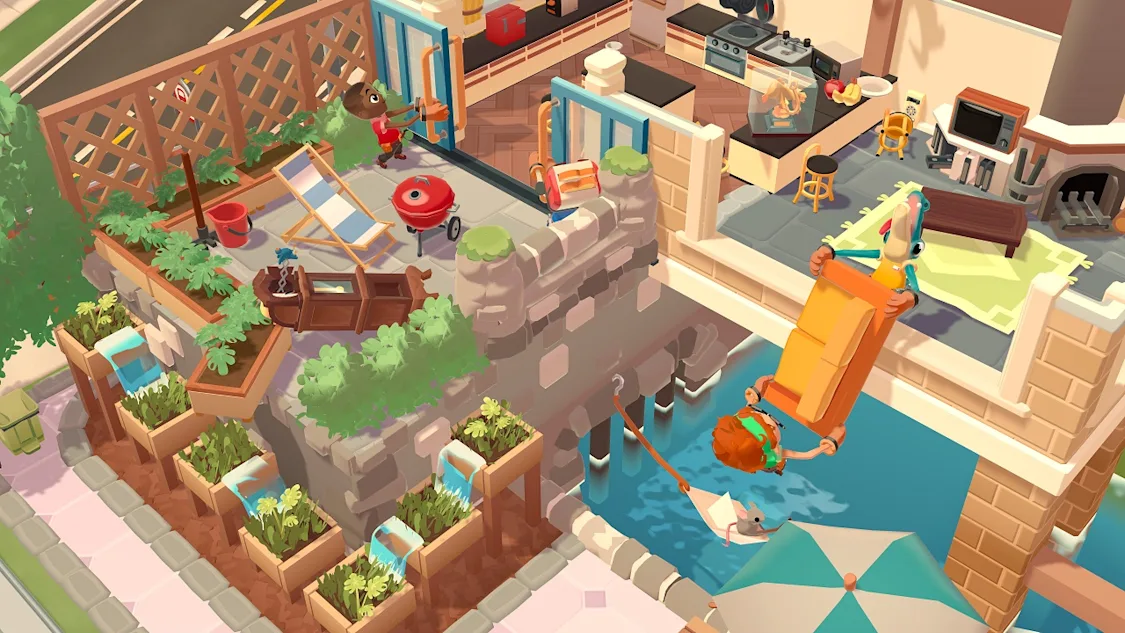
Each level centres on clearing a location and transporting furniture to the moving truck, often under time pressure. That straightforward objective becomes a physics puzzle because objects have weight, shape, and momentum. A small item may be easy to carry but slow to transport one at a time. A large object may save time if two players move it together, yet it can be difficult to guide through narrow spaces.
Environmental challenges force players to read each area before committing to a route. Obstacles, hazards, and layout puzzles can make a direct path impractical. The most efficient answer may involve changing direction, finding an opening, using a strange piece of the world, or taking a less tidy route through a level.
The game encourages a practical kind of experimentation. Players can use physics to their advantage instead of treating every piece of furniture delicately. A reckless approach can create problems, but a controlled shortcut can save valuable time. That balance gives the action its character: success comes from moving quickly without losing sight of what the environment allows.
Five Practical Teamwork Tips for Faster Moves
- Call the route early. Co-op communication helps the team avoid carrying two items toward the same bottleneck or leaving one player without a clear task.
- Pair up on heavy furniture. Larger items require two players to lift and carry, so agree on the destination before picking them up to reduce wasted movement.
- Test the layout. Environmental challenges differ between stages. A brief attempt at a new route can reveal a faster path to the moving truck.
- Throw with a purpose. Throwing objects can be useful when distance or obstacles make ordinary carrying inefficient, but it works best when the landing area is clear.
- Replay for refinement. A completed level can be revisited for higher scores and bonus objectives, giving the team a chance to replace improvised solutions with more efficient ones.
Throwing, Bouncing, and Creative Furniture Transport
New movement possibilities broaden the ways a team can solve a job. Objects can be thrown farther, bounced, or moved with the help of unusual world elements. These mechanics do not replace carrying, but they make the transport process more flexible when a level’s design invites a creative solution.
A throw can turn distance into an advantage, particularly when players are trying to keep furniture moving toward the truck instead of repeatedly walking the same stretch of ground. Bouncing items introduces another way to interact with the game’s physics, while strange environmental features can alter the expected path through an area.
This is where Moving Out 2 Switch NSP gets much of its comic energy. The team may plan a clean handoff, then discover that a thrown object, a bounce, or an unexpected interaction creates a better route. The best solutions can look chaotic from the outside, yet they still depend on timing, positioning, and a shared understanding of the goal.
Replay Goals, Scores, and Bonus Objectives
Level replay gives the game a longer life beyond a first clear. Players can return to completed stages to pursue higher scores and unlock bonus objectives. That structure rewards teams that learn a location’s layout, recognise where time was lost, and develop smoother ways to handle its furniture and hazards.
Improvement does not have to mean repeating the same plan more precisely. A later attempt may reveal that a different route, a better division of labour, or a more confident use of throwing mechanics changes the pace of the whole move. The score chase therefore fits the game’s central idea: efficiency is something players discover through trial, coordination, and a willingness to embrace a little disorder.
Its accessible controls and broad comic tone make it suited to groups looking for cooperative problem-solving with a playful edge. Players who enjoy physics-driven puzzles, shared time pressure, and the satisfaction of refining a chaotic run will find plenty of reasons to keep returning to Packmore and its stranger destinations.