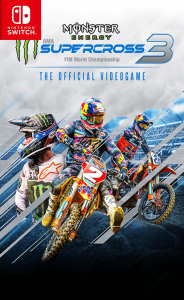
Monster Energy Supercross – The Official Videogame 3 Switch NSP
Report Link Error
Select the broken download file, then submit the report.


Screenshots


About Game
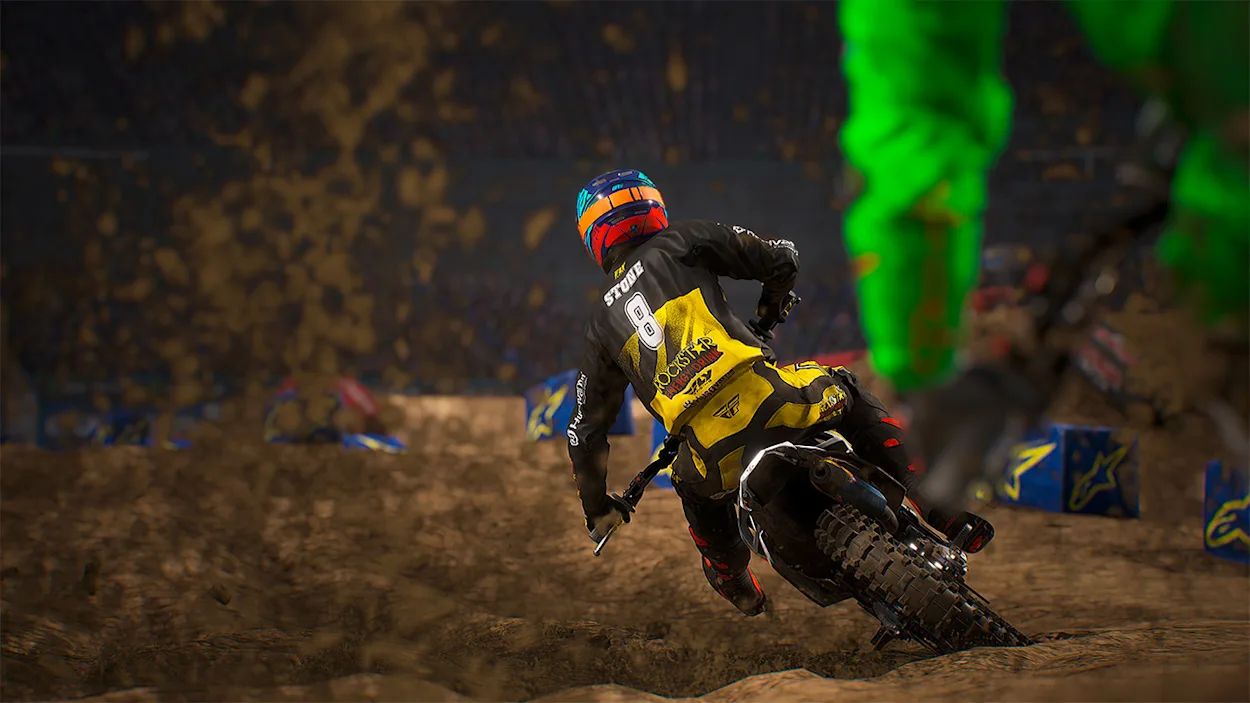
Monster Energy Supercross – The Official Videogame 3 Switch NSP frames professional indoor motocross as a demanding season-long pursuit rather than a series of isolated races. Milestone’s sports simulation brings together licensed 2019 Supercross content, a career path, evolving tracks, bike and rider personalization, and multiplayer competition. The result is a game built around learning how a circuit changes, how a bike responds, and how quickly a promising lap can disappear after one poorly judged jump.
A Supercross Career Built From Rookie to Champion
The career mode supplies the game’s central sense of progression. Players begin as a rookie, join official teams, line up against professional riders, and work through championships in pursuit of champion status. There is no need for a conventional story when the structure of a racing season can provide its own momentum: each event is another chance to improve results, meet new demands, and build a place in the competitive order.
That progression gives individual races more weight than a one-off exhibition. A difficult finish is not simply a failed session; it is a reminder that cleaner corners, more controlled landings, or a better understanding of the circuit may be needed at the next round. Seasonal challenges and the presence of official teams help the mode maintain the feeling of working within the Supercross world rather than merely sampling its tracks.
The format also suits players who enjoy measurable improvement. Early success may come from simply staying upright and completing a rhythm section without losing too much speed. Later, the focus can shift toward consistency, racecraft, and making decisions while the surface changes beneath the bike. The rookie-to-champion arc makes room for both approaches.
Official 2019 Supercross Season: Stadiums, Tracks, and Riders
The licensed Monster Energy Supercross 2019 season provides the setting for that climb. The game includes 15 official stadiums and 17 tracks, with Oakland and Seattle among the named locations. These are enclosed, purpose-built race environments where tight sections, jumps, and repeated laps place a premium on precision instead of pure top speed.
A roster of 100 official riders spans the 250SX and 450SX classes, giving the season a broad professional field. The use of official riders and venues matters because Supercross relies heavily on the character of particular layouts. A stadium track is not just a backdrop; it is the source of the race’s rhythm, forcing riders to assess turns, jumps, and developing lines in a confined space.
Presentation is therefore tied closely to the sport’s recognizable staging. Stadium settings, licensed riders, and official tracks establish a clear competitive atmosphere, while the racing itself asks players to deal with the exact demands those environments create. For players interested in the real 2019 season framework, the game offers a defined selection of places and competitors rather than an abstract motocross fantasy.
How Dynamic Track Conditions Change Every Race
Track knowledge is valuable, but it is not permanent. Dynamic terrain deformation means the dirt can evolve over successive laps, changing the behavior of sections that may have felt predictable at the start. A line that worked early in a race can require a more careful approach later, especially when maintaining control through turns and preparing for the next jump.
Dynamic weather conditions add another factor to race outcomes. Together, weather and deformation encourage adaptation instead of repetition. The target is not merely memorizing a perfect route; it is recognizing when the circuit has become less forgiving and adjusting pace, positioning, and jump execution accordingly.
This is where the simulation side of the game is most visible. Advanced physics support realistic jumps and bike handling, while the evolving surface makes those systems meaningful over time. A clean landing and a controlled approach can preserve momentum. An overcommitted move can compromise the next section. The changing state of the track helps make multiple-lap races feel less static.
Rider and Bike Customization for a Personal Racing Identity
Customization gives players room to shape both appearance and approach. Rider, gear, and bike options allow for a more individual look, while bike setup experimentation offers a practical reason to revisit the garage before returning to the track. The game does not ask every player to pursue the same visual identity or identical handling preferences.
That flexibility is especially useful across the official circuits. Different tracks can invite different choices, and testing setups becomes part of the preparation rather than a cosmetic afterthought. Riders can refine their presentation through equipment and gear, then see how changes to the bike feel when corners, jumps, and deteriorating terrain begin to demand attention.
For a personal race experience that extends beyond the career leaderboard, Monster Energy Supercross – The Official Videogame 3 Switch NSP makes rider and machine customization a natural part of its repeatable racing loop. A player can develop a recognizable rider, make setup changes, and return to familiar venues with a new plan.
Competitive Racing in Local and Online Multiplayer
Career racing offers long-term progression, but local and online multiplayer bring a different kind of pressure. Competing directly against friends or other players shifts the emphasis from steady advancement to immediate execution. There is less room to treat a mistake as a lesson for a future season when another rider is already taking advantage of it.
These modes complement solo play well. Practice and career events can help establish track familiarity, while multiplayer tests how reliably that knowledge holds up in a contested race. The same concerns remain relevant—cornering, jump control, bike behavior, and changing conditions—but the presence of human competition makes every opening and error more noticeable.
Replay value also comes from the track editor, which allows players to create and share circuits. Alongside the official stadium selection, customization, career progression, and multiplayer, that tool gives the game several ways to continue after a first set of championship goals has been completed.
5 Priorities for Improving Your Supercross Race Results
- Learn the corners. Study where speed can be carried through turns and where a more controlled approach will better set up the next section.
- Read the surface. Terrain deformation and weather conditions can alter the track over time, so avoid assuming that an early-lap line will remain dependable.
- Refine jump control. Focus on stable takeoffs and landings. Advanced physics and bike handling make controlled jumps important to maintaining a clean run.
- Test bike setups. Experiment with the available bike options to find an approach that feels suitable for a given track and your riding style.
- Use the Compound. The dedicated free-roaming practice area is a place to work on riding skills before bringing those adjustments into races.
The game is best suited to players who want Supercross racing with a licensed seasonal setting and a willingness to practice. Its accessible controls can welcome newcomers, while terrain changes, weather, physics, career advancement, and direct multiplayer competition provide reasons to keep refining each lap.
Recommended Similar Games
 Super Robot Wars V Switch NSP XCIView Game
 EA SPORTS FC 24 Switch NSP XCIView Game
 Dynasty Warriors 9 Empires Switch NSPView Game
 Tomodachi Life: Living the Dream Switch NSPView Game
 ROMANCE OF THE THREE KINGDOMS XIV: Diplomacy and Strategy Expansion Pack Bundle Switch NSP XCIView Game
 Pocket Fishing Switch NSPView Game