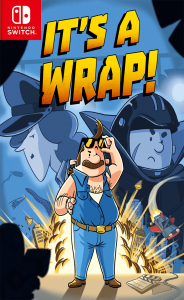
It’s a Wrap! Switch NSP
Report Link Error
Select the broken download file, then submit the report.
Screenshots
About Game
It’s a Wrap! Switch NSP frames its action-puzzle platforming around the controlled chaos of a movie production. Set in a vibrant, film-inspired world, the game asks players to balance careful planning with quick execution as a troubled 1980s director attempts to keep an ambitious project from falling apart. Precision matters, but so does the willingness to stop, study a scene, and find a better sequence of events.
A Film-Set Puzzle Platformer Built Around Timing
The central idea is immediately clear: every level functions like a movie set, and every apparent disaster can become part of the solution. Finn is a director whose attempt to make an epic action film is complicated by technical problems, clumsy performers, and the practical hazards of a production that never seems to run smoothly. The resulting adventure treats filmmaking as both its setting and its puzzle language.
As a puzzle platformer, the game combines two demands that do not always appear together. Players need to read the layout of a scene, understand how its moving parts interact, and decide when an action should happen. They also need to guide a character through jumps and hazards with accuracy. This creates timing challenges that are not limited to fast reactions; the best answer can involve preparing the set before attempting a difficult section.
The film theme gives the action a playful frame. Scenes are not simply abstract obstacle courses. They are productions in progress, with disruptions and mishaps shaping the routes forward. That setup supports a quirky atmosphere while giving environmental puzzles a practical sense of purpose: the crew may be trying to finish a scene, but players are trying to turn the scene’s disorder into a path.
How Finn and Wrap Work Together
The game divides its challenges between Finn and Wrap, two characters with very different responsibilities. Finn handles the director’s side of the process, looking at the scene as a planned sequence that can be adjusted. Wrap, his stunt double, takes on the immediate physical work: moving through the set, making daring jumps, and carrying out action sequences in real time.
This structure gives the game a useful tension between strategy and execution. Finn’s perspective encourages patience, observation, and planning. Wrap’s sections ask for movement that is responsive and controlled. Neither approach is sufficient alone. A route that looks impossible during active play may become manageable once Finn has changed the conditions of the scene, while a carefully arranged plan still needs Wrap to perform it successfully.
Character switching is therefore more than a thematic novelty. It is the basis of progression through complex levels. The two roles also reinforce the game’s movie-making premise: Finn must orchestrate what happens, while Wrap has to survive the resulting stunt work. Their partnership turns a production problem into a playable back-and-forth.
- Observe first: Study the set and its moving elements before committing Wrap to a risky route.
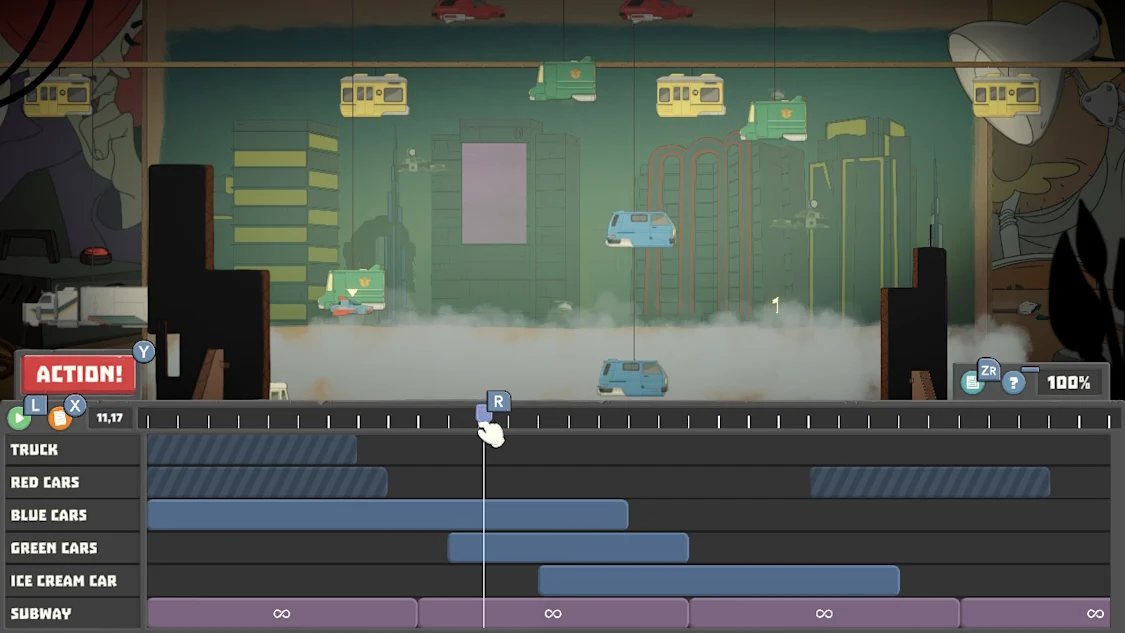
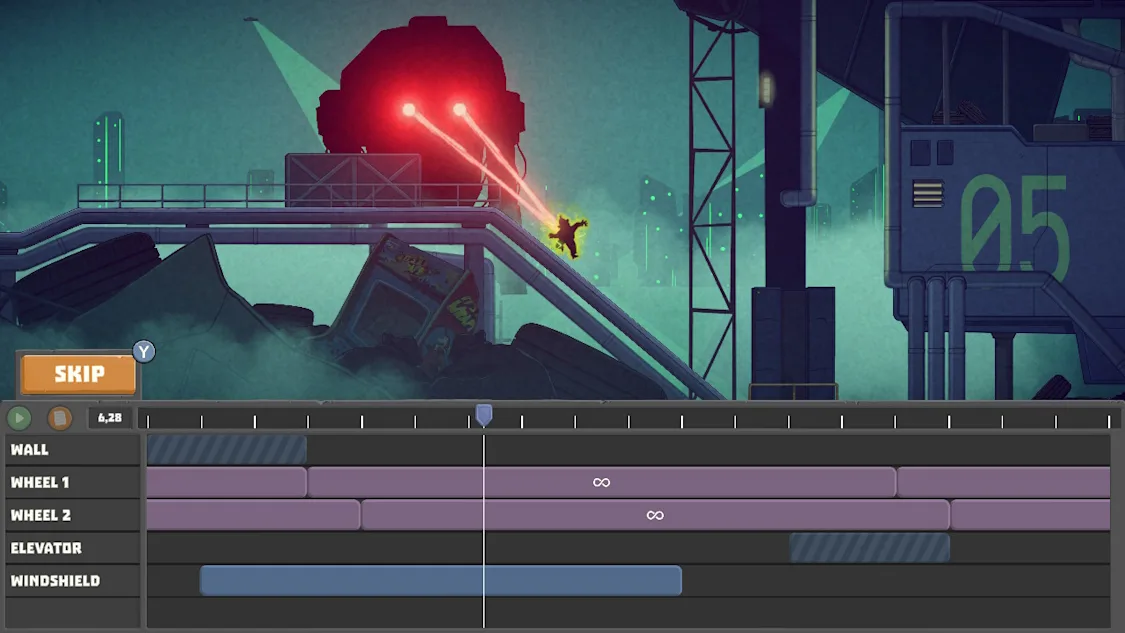
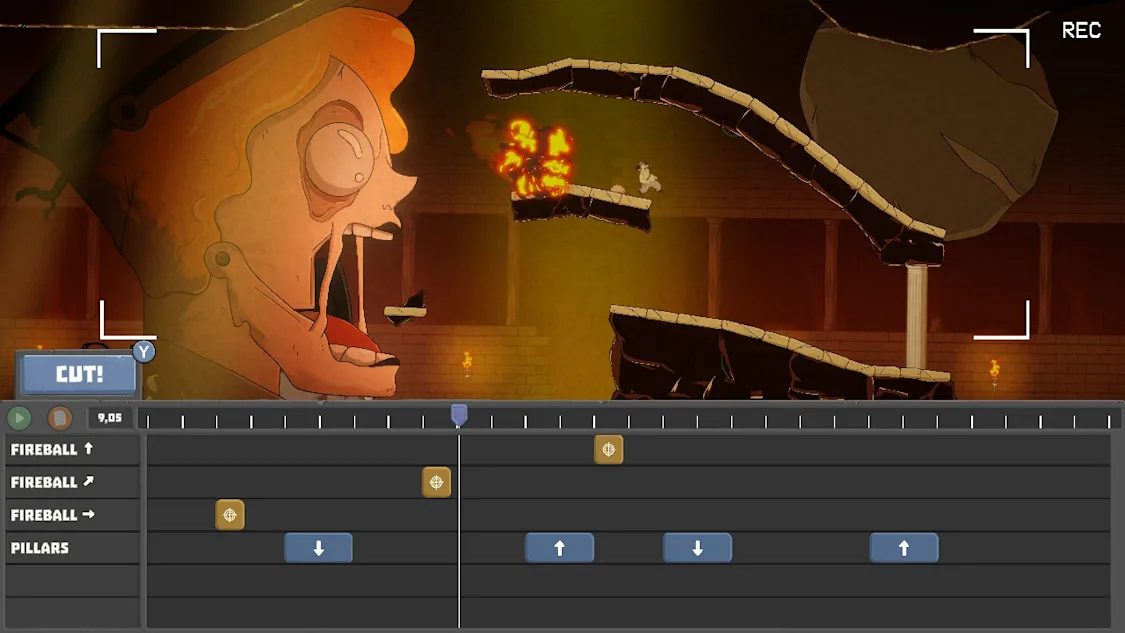
- Use the timeline: Pause or rewind actions when a scene’s current arrangement blocks progress.
- Plan the handoff: Set up the route with Finn, then switch to Wrap when the moment is right.
- Respect the timing: Precise jumps and split-second actions remain important after the puzzle is solved.
- Search the set: Collectible film reels and hidden bonuses reward exploration and level mastery.
Pausing and Rewinding Scenes to Solve Puzzles
Finn’s timeline control is the game’s most distinctive tool. He can pause or rewind scene actions, allowing players to reconsider an unfolding situation rather than treating every mistake as final. This form of time manipulation supports a more deliberate style of puzzle-solving, especially when an obstacle depends on the order in which several events occur.
Rewind mechanics can be used to create a new route through the environment or to undo a bad moment before it becomes costly. A few seconds may be enough to change the timing of a hazard, restore an opportunity, or give Wrap a safer opening for a jump. The mechanic is not presented as a replacement for careful play; it is part of the planning process, inviting players to test ideas and refine their approach.
That makes the environmental puzzles feel closely connected to the fiction. Finn is not merely activating switches from outside the action. He is treating the scene itself as editable material. Pausing an event can help establish a useful arrangement, while rewinding can reveal that the first version of a sequence was not the only possible one. The emphasis remains on understanding cause and effect within each set.
Precision Platforming on Hazardous Movie Sets
Wrap brings the game back to immediate movement. Once the scene has been arranged, the stunt double must navigate its hazards through real-time platforming and action. The sets demand careful jumps, responsive control, and an awareness of the dangers placed around the route. A plan can open the door, but it does not make the traversal automatic.
This is where the game’s two-part design becomes most demanding. Players may need to switch from a measured puzzle mindset to a quick, exact performance. Timing remains essential because Wrap’s movement has to fit the scene Finn has prepared. The result is a rhythm of observation, adjustment, and action rather than a simple run from one platform to the next.
The movie-set setting helps each hazard feel tied to a production environment instead of appearing as a detached challenge. Technical trouble and on-set chaos are part of Finn’s ongoing struggle, and Wrap is the character who has to deal with the consequences directly. The platforming therefore carries a stunt-like quality: every successful sequence feels like getting a difficult shot completed under pressure.
Film Genres Shape the Levels’ Obstacles
The adventure moves through different film genres, including action sets and horror sets. This gives the progression a changing visual and mechanical context while keeping the larger production story intact. Each location reflects the kind of cinematic scene Finn is trying to complete, along with the distinct complications that arise when that scene goes wrong.
Action-oriented areas naturally suit the game’s emphasis on daring movement and carefully coordinated sequences. Horror-inspired sets add a more mysterious tone to the production, presenting obstacles through a different genre lens. The source of the difficulty remains the same broad idea—an unruly set that needs to be controlled—but the changing genres keep the challenges from feeling locked into one visual routine.
This variety also supports the game’s presentation. Finn’s effort to salvage his movie is humorous, and the shifting genres give that comedy room to play out through quirky situations and characters. The game does not treat filmmaking as polished glamour. It treats it as a process full of interruptions, imperfect performances, and inventive recovery.
Why Switching Characters Is Central to Progress
It’s a Wrap! Switch NSP depends on seamless switching because its puzzles are built around the relationship between strategic planning and real-time action. Finn can alter the circumstances of a scene, but Wrap is the one who must use those circumstances. Wrap can reach places and perform stunts, but Finn’s tools are often needed to make those routes viable in the first place.
Later challenges are therefore likely to reward players who understand both sides of the system rather than relying only on reflexes or only on experimentation. The strongest solutions come from noticing how a paused or rewound event changes the environment, then carrying that insight into Wrap’s movement. Coordination is the real challenge: not simply switching characters, but switching at the right moment for the right reason.
Collectible film reels and hidden bonuses add a reason to revisit scenes with a sharper understanding of their layouts. Players interested in mastering routes, uncovering extras, and improving their timing have room to explore beyond basic progress. The game is well suited to players who enjoy platforming with a puzzle focus, especially those who like solving a scene methodically before attempting its most hazardous stunt.