Arcaea Switch NSP

Report Link Error
Select the broken download file, then submit the report.


Screenshots
About Game
Arcaea Switch NSP brings lowiro’s Arcade/Music rhythm game to Nintendo Switch in the USA region, with a release date of May 18, 2021. Supporting Japanese, English, Korean, Chinese, and Traditional Chinese language options, this version places its music-driven story and demanding note charts on a platform built for focused play sessions.
Arcaea on Nintendo Switch: Release and Platform Details
Arcaea Switch is published by lowiro and carries the title ID 0100E680149DC000. Its verified release date is May 18, 2021, while its listed genre combination of Arcade and Music accurately reflects the experience: songs are not merely a backdrop, but the structure through which both challenge and narrative unfold.
The Nintendo Switch release is listed for the USA region and supports Ja, En, Ko, Zh, and Tw language options. Its 841 MB file size and 11.0.1 firmware listing are part of the release metadata, but the more meaningful detail is the game’s focus: quick reactions, rhythmic precision, and increasingly complex musical patterns. Arcaea Nintendo Switch presents a compact but layered rhythm-game format, one that asks players to read timing, movement, and space at the same time.
A Shattered World Seen Through Music
The Arcaea story takes place in a desolate, forgotten realm, a world whose past survives in incomplete form. Its remnants are not delivered through ordinary historical records. Instead, musical memory fragments known as Arcaea carry pieces of what came before.
That premise gives the game’s song progression a narrative purpose. Each completed track can reveal another part of the setting’s mystery, allowing its lore to emerge gradually rather than all at once. The shattered world is therefore more than a dramatic backdrop: it is the reason the music matters within the fiction. These Arcaea memory fragments preserve emotional and historical traces, inviting players to assemble meaning from what remains.
The atmosphere is closely tied to this structure. Music, visual effects, and the fragmented setting work together to create a sense of distance from a lost past. Arcaea lore is revealed in pieces, making progression feel like an act of discovery as well as a test of rhythm-game skill.
Hikari and Tairitsu’s Intertwined Narrative
At the center of this world are Hikari and Tairitsu, two young girls whose perspectives shape the narrative. Their relationship is not presented as a simple, static contrast. Conflict, emotional struggle, and different ways of seeing their world are gradually expressed through the songs players advance through.
The game’s structure makes the two Arcaea characters feel tied to the wider setting. As more songs are completed, the player learns more about Hikari and Tairitsu’s intertwined destinies, as well as the tension between their perspectives. That slow release of information suits a story built around recovered memories. Rather than separating story from performance, Arcaea connects its emotional material to the act of mastering a chart.
This approach also gives replay value a narrative edge. Returning to songs is primarily about improving timing and scores, but the larger context of the protagonists’ conflict adds weight to progression. The music tracks carry both gameplay demands and pieces of the game’s emotional language.
Why Arc Notes Define Arcaea’s Challenge
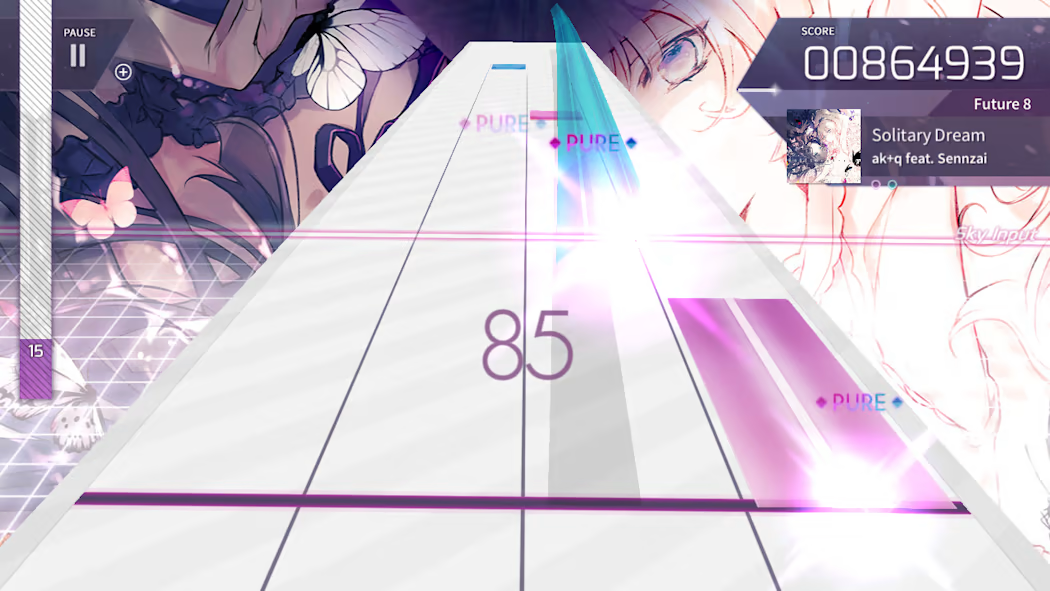
Arcaea’s rhythm action takes place across a three-dimensional playfield. Notes descend from above, demanding precise timing and quick reactions, but the game is not limited to straightforward taps. Its three main note types are ground notes, air notes, and arc notes, each contributing to layered patterns that can become increasingly difficult to read.
Arc notes are the mechanic that most clearly defines the game’s distinctive feel. They move through three-dimensional space and require directional holds and slides rather than a single conventional input. Reading an arc means tracking where it travels while remaining prepared for other notes that may arrive around it.
This creates a coordination challenge beyond simple beat matching. Ground, air, and arc inputs can interact in the same sequence, asking players to recognize note relationships rather than treating each object in isolation. The result is a style of charting that can appear visually elaborate while still being grounded in rhythm and timing. Arcaea slide notes reward control and anticipation, especially when their paths overlap with more familiar note patterns.
World Mode, Partners, and Song Progression
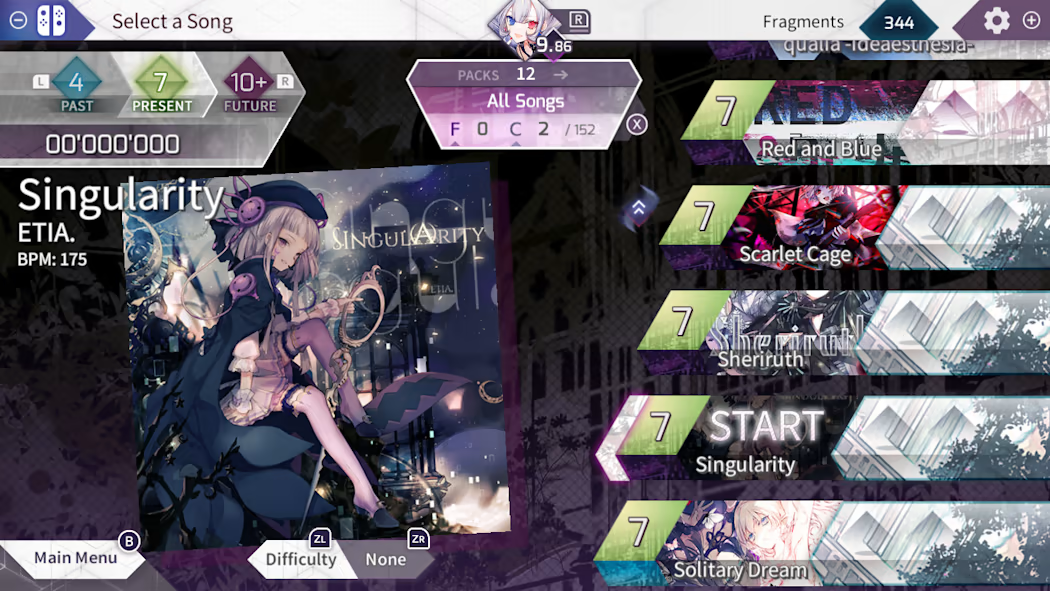
For players looking for structured advancement, Arcaea World Mode provides map-based progression. It offers a route through which new songs can be unlocked, giving play sessions an objective beyond chasing a better result on a single track. That progression system fits the game’s broader emphasis on uncovering more music and more of its fractured world.
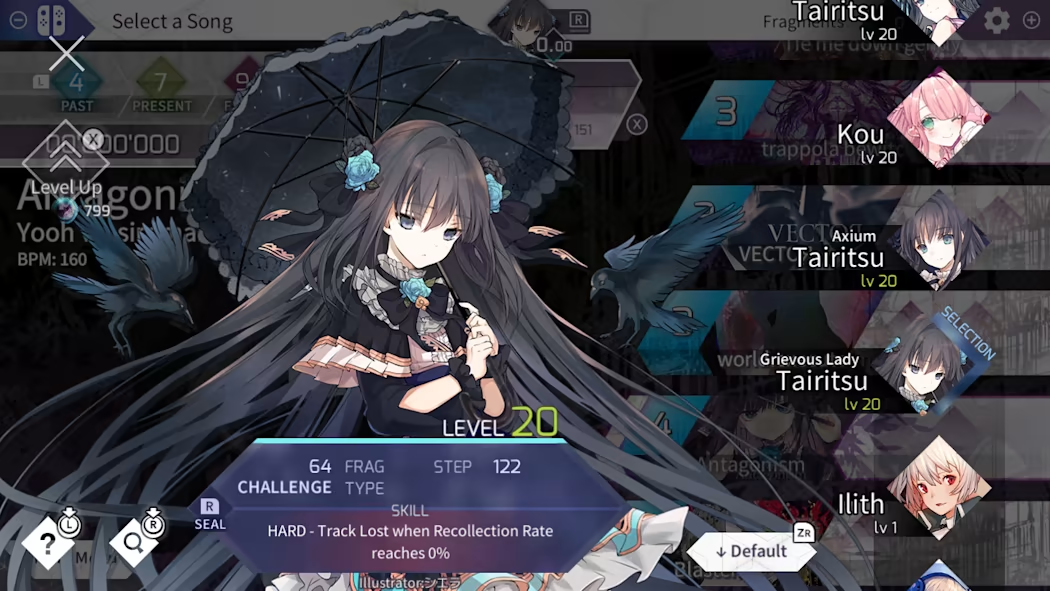
Partner characters add another layer to how players approach challenges. Their abilities can influence gameplay and scoring, with some providing score bonuses and others offering safeguards. These effects do not replace practice, but they can help players choose an approach that better suits their current needs.
The combination of World Mode, song unlocks, varied difficulty levels, and score tracking supports repeated play. Easier charts can establish fundamentals, while harder material pushes timing, reading, and coordination further. For rhythm-game players who enjoy measurable improvement, that steady escalation gives the library a useful sense of direction.
Later in a session, Arcaea Switch NSP remains most engaging when its systems are allowed to work together: a new chart to learn, a World Mode goal to pursue, and a partner ability that may slightly alter the path forward.
5 Practice Priorities for Improving Arcaea Accuracy
- Build gradually. Start with charts that establish the fundamentals before moving into the more demanding difficulty levels. Consistent timing on simpler patterns provides a stronger base for complex sequences.
- Listen for the rhythm. The music is essential to timing. Paying attention to its pulse and phrasing can make note placement easier to understand than relying on visual reaction alone.
- Watch interactions. Study how ground, air, and arc notes appear together. Recognizing their relationships is important when multiple input types occupy the playfield at once.
- Anticipate sequences. Do not focus only on the next note. Looking ahead helps prepare for incoming Arc paths, directional slides, and combinations that demand quick transitions.
- Choose partners thoughtfully. Experiment with Arcaea partners to find abilities that fit the immediate goal, such as a score bonus for a stronger run or a safeguard while learning a difficult chart.
Arcaea is best suited to players who want a rhythm game with a demanding spatial mechanic, a broad range of difficulty, and a story revealed through musical progress. Its challenge comes from more than speed: it comes from learning to see the entire playfield, hear the structure of a track, and respond with confidence when the patterns begin to overlap.