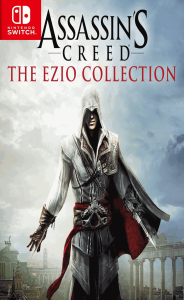
ASSASSIN’S CREED THE EZIO COLLECTION Switch NSP
Report Link Error
Select the broken download file, then submit the report.
Screenshots
About Game
ASSASSIN’S CREED THE EZIO COLLECTION Switch NSP brings Ubisoft’s remastered Ezio Auditore adventures to Nintendo Switch in a single action-adventure collection. Across three connected games, it follows one assassin through Renaissance Italy and Constantinople, pairing historical settings with rooftop movement, stealth, combat, and a long-running conflict between Assassins and Templars.
An Overview of Assassin’s Creed The Ezio Collection on Nintendo Switch
Built around the complete story of Ezio Auditore, this Nintendo Switch collection includes three major chapters: Assassin’s Creed II, Assassin’s Creed Brotherhood, and Assassin’s Creed Revelations. Each game places Ezio in a different stage of his life, from a young nobleman changed by betrayal to an experienced leader seeking answers about the Assassin Order.
The action-adventure format gives the collection a broad rhythm. Missions move between story-driven objectives, stealth encounters, combat, parkour, assassination contracts, collectibles, puzzles, and optional activities. Historical cities are not simply backdrops: their crowded streets, towers, rooftops, and landmarks shape how players travel and approach a target.
The remastered presentation supports the appeal of revisiting these settings on Switch. Florence, Venice, Rome, and Constantinople provide distinct places to explore, while Ezio’s story gives the collection a consistent narrative thread across its three games. It is a substantial journey rather than a set of unrelated adventures.
The Three Games in Ezio’s Complete Saga
- A life overturned: Assassin’s Creed II introduces Ezio Auditore da Firenze as a young nobleman in 15th-century Italy. After a tragic betrayal changes his life, he becomes an assassin and pursues vengeance against the Templar Order while uncovering ancient secrets.
- A leader emerges: Assassin’s Creed Brotherhood continues Ezio’s story in Rome. His fight expands beyond personal revenge as he works to rebuild the Assassin Order and confront the powerful Borgia family.
- The search for legacy: Assassin’s Creed Revelations follows an older Ezio to Constantinople. There, he looks for the truth behind Altaïr’s legacy and seeks secrets connected to the Assassin Order.
- One connected arc: Taken together, the three games trace Ezio’s growth from a determined avenger into a figure with greater responsibility, ending with a story that links his path to Altaïr’s.
The progression between these chapters is one of the collection’s clearest strengths. The story does not reset Ezio with each game. His skills, purpose, and place within the Assassins’ struggle develop over time, giving the complete saga a sense of scale.
Ezio Auditore’s Journey from Florence to Constantinople
Ezio Auditore da Firenze begins in Florence, where he is introduced as a carefree young nobleman. The betrayal at the center of Assassin’s Creed II sends him onto a far more dangerous course. His response is personal at first, but the journey gradually reveals a wider struggle between Assassins and Templars.
That early movement through 15th-century Italy establishes the blend of intimate motive and historical intrigue that carries through the saga. Ezio’s search for justice leads him across cities including Florence and Venice, where political conflict and hidden secrets sit alongside the demands of becoming an assassin.
By the time the story reaches Rome, Ezio’s role has changed. In Assassin’s Creed Brotherhood, he is no longer defined only by his own loss. He must guide others and restore the Assassin Order while facing the Borgia family’s control over the city. The conflict has become larger, and so has his responsibility.
Assassin’s Creed Revelations brings him to Constantinople as an older and wiser man. His search for Altaïr’s legacy creates a closing chapter concerned with the history of the Assassins themselves. The result is a journey that travels not only from Florence to Constantinople, but also from youth and vengeance toward experience and understanding.
Renaissance Cities and Historical Exploration
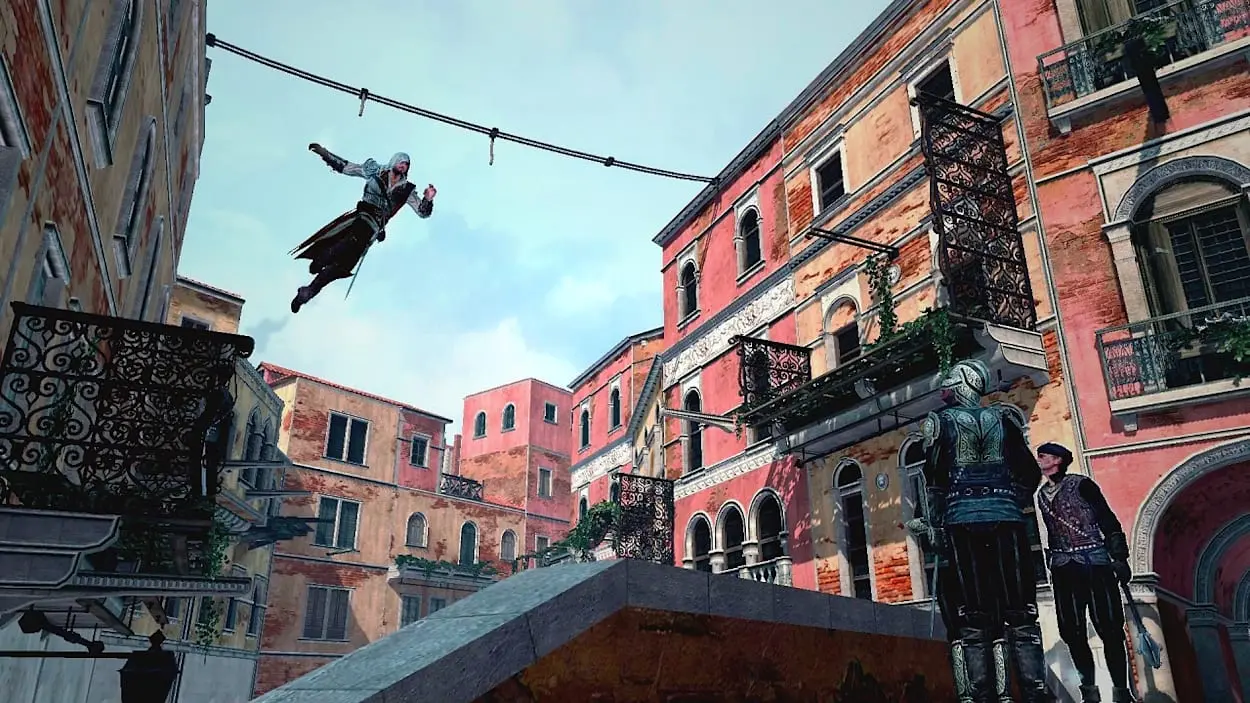
The collection’s historical cities encourage movement as much as observation. Renaissance Italy is represented through locations such as Florence, Venice, and Rome, while Constantinople becomes the final major setting for Ezio’s story. Their streets and rooftops support free-running routes that can turn a straightforward destination into an opportunity to climb, leap, and sprint above the crowds.
Open-world exploration gives these places room beyond the main narrative. Optional objectives, side quests, collectible items, cryptic puzzles, and assassination contracts add reasons to revisit districts and look beyond the next story marker. The design makes vertical space important: a tower, roofline, or landmark can become part of a route through the city.
There is also a strong atmosphere in moving between public spaces and elevated paths. Crowds fill the streets below, while rooftops offer a different view of the historical cities. That contrast is central to the games’ sense of place, balancing busy urban life with the solitary perspective of an assassin crossing high above it.
Stealth, Crowds, and Silent Assassinations
Stealth gameplay is a major part of how objectives can be approached. Ezio can use crowds for cover, blend into public spaces, take advantage of environmental elements, and remain undetected before making a move. These options suit the series’ focus on calculated assassinations rather than direct confrontation alone.
Silent takedowns reward careful positioning and patience. A route across rooftops may help avoid attention, while a crowd can provide an escape or a way to approach a target without immediately revealing Ezio’s presence. Disguises and environmental tools also contribute to the effort to stay unseen.
Combat remains available when stealth breaks down or when a mission demands a more open fight. Weapon choices, counter-attacks, disarming maneuvers, and stealth attacks provide different ways to deal with opponents. That mix gives the collection flexibility: players can favor a quiet plan, react with combat, or combine free-running and stealth to create a more controlled approach.
Brotherhood, the Borgias, and Ezio’s Leadership in Rome
Assassin’s Creed Brotherhood gives the middle chapter of the collection a different weight. Rome is not merely another city for Ezio to pass through. It is where he rebuilds the Assassin Order while opposing the Borgia family, turning his personal experience into a larger effort for freedom and control over the city.
This leadership role distinguishes the game from Ezio’s earlier path. He still acts directly through stealth, parkour, combat, and assassinations, but the narrative places more emphasis on the brotherhood he leads. The conflict against the Borgias frames Rome as a city under pressure and gives Ezio a purpose that extends beyond his own vendetta.
For players drawn to historical action-adventure games, ASSASSIN’S CREED THE EZIO COLLECTION Switch NSP offers a long-form story with connected characters, recognizable historical cities, and multiple ways to engage with missions. Its replay value comes from optional objectives, collectibles, puzzles, contracts, and the freedom to revisit the cities with a different stealth or combat approach.
Recommended Similar Games
 Western 1849 Reloaded Switch NSPView Game
 DRAGON QUEST MONSTERS: The Dark Prince Switch NSP XCIView Game
 Cult of the Lamb Switch NSPView Game
 The Fine Art of Murder Switch NSPView Game
 Scott Pilgrim vs. The World: The Game – Complete Edition Switch NSPView Game
 Valiant Hearts: Coming Home Switch NSPView Game
