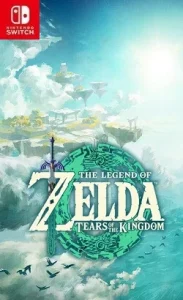
The Legend of Zelda: Tears of the Kingdom Switch NSP XCI
Report Link Error
Select the broken download file, then submit the report.
Screenshots
About Game
The Legend of Zelda: Tears of the Kingdom Switch NSP XCI begins with a disturbance that changes Hyrule from the ground up. Link and Princess Zelda enter the depths beneath Hyrule Castle to investigate a mystery, only to awaken an ancient threat whose return fractures the familiar kingdom into a far less stable place.
A New Hyrule Crisis Begins Beneath Hyrule Castle
The opening premise gives the adventure an immediate sense of unease. Beneath Hyrule Castle, Link and Zelda encounter an ancient mummified entity. Its awakening unleashes a violent upheaval across the land: the castle rises into the sky, areas of Hyrule are torn apart, and Zelda disappears into a temporal rift.
Link is left to confront the consequences alone. His Master Sword is broken, his arm is severely injured, and he later gains a mysterious new arm with powerful abilities. After awakening among the Sky Islands and receiving guidance connected to an ancient civilization, he is drawn into a search for Zelda and an attempt to understand the disaster now affecting Hyrule.
The threat is identified as Ganondorf, a malevolent force capable of pushing the kingdom toward lasting darkness. That premise supplies a dramatic frame for the journey, but the game’s momentum comes from the contrast between that urgent crisis and the freedom to investigate the transformed world in many directions.
Three Layers of Exploration: Surface, Sky Islands, and Depths
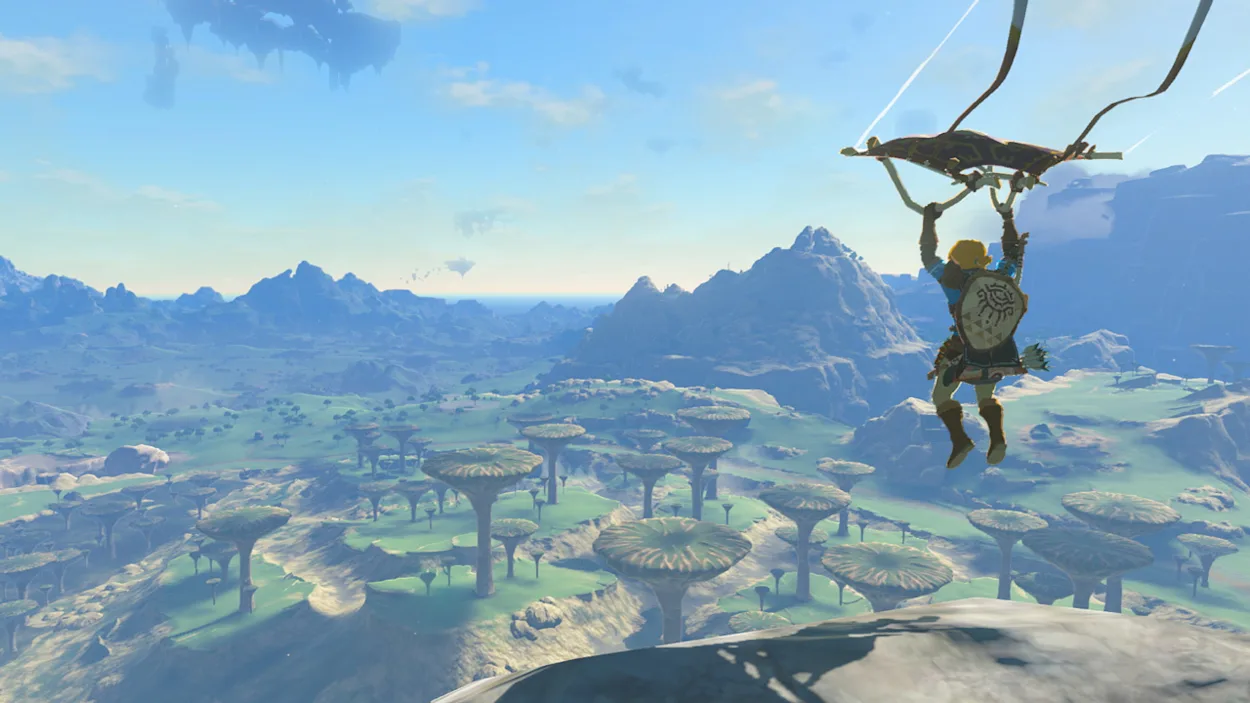
Hyrule exploration is no longer restricted to one broad landscape. The disrupted surface remains a major part of the adventure, but it is joined by floating Sky Islands overhead and the hazardous Depths below. These three spaces create different routes, challenges, and reasons to experiment with Link’s tools.
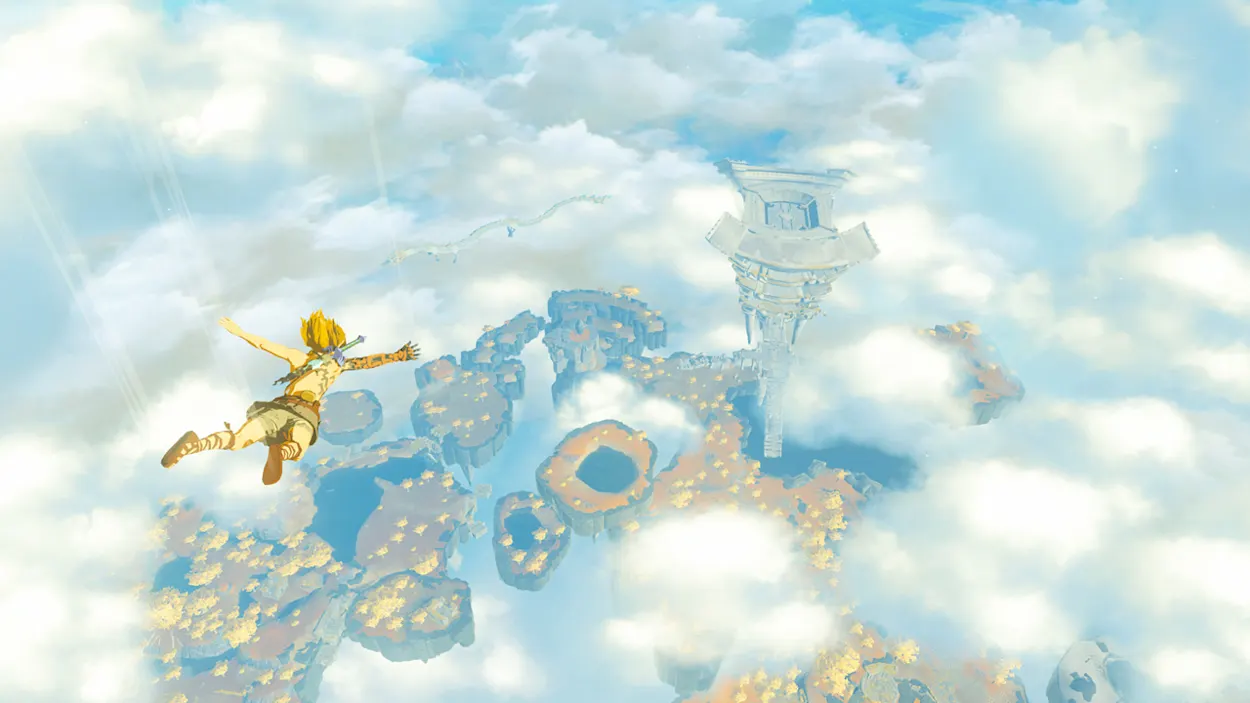
The Sky Islands introduce an elevated perspective on Hyrule. They contain their own puzzles, resources, and obstacles, while their position above the kingdom makes reaching them part of the challenge. A destination may be visible from afar, but the practical question is how to get there: by constructing a machine, using a moving object, finding a higher approach, or working with the surrounding terrain.
Below the surface, the Depths add another dangerous layer to the world. Together, the surface, sky, and underground areas make progression feel less like following one fixed road and more like studying a connected landscape. Discoveries in one layer can suggest possibilities in another, encouraging players to revisit places with a new plan or a newly built tool.
Ascend and Recall Redefine Vertical Travel
Two abilities in particular reshape how movement works. Ascend lets Link travel upward through solid ceilings, allowing a quick route to higher ground when there is a usable overhead surface. It can turn a cave, interior space, or sheltered position into an unexpected path toward a mountaintop or elevated area.
Recall works differently, reversing an object’s movement through time. A falling rock can be sent back along its previous route, potentially becoming a route toward the sky. The same ability can also reverse the course of enemy projectiles, giving encounters a more reactive quality.
These powers make vertical exploration less dependent on a single intended solution. Ascend rewards noticing what lies above Link, while Recall asks players to pay attention to motion and timing. In puzzles and encounters alike, the abilities support a design that often favors observation over simple force.
5 Core Gameplay Systems That Encourage Experimentation
The new ability set supplies a practical toolbox rather than a narrow sequence of scripted actions. The following systems define much of the game’s flexible approach to travel, puzzle solving, and combat.
- Ultrahand: Link can pick up, rotate, and join many environmental objects. Its central use is building functional structures, from a simple bridge to a more elaborate contraption.
- Fuse: Items can be merged with weapons, shields, and arrows to create altered tools. A rock attached to a sword increases its striking role, while a mushroom combined with an arrow can produce a smoke screen.
- Ascend: This upward movement ability provides direct access through ceilings, changing how players read enclosed spaces and high terrain.
- Recall: Reversing an object’s movement creates opportunities for traversal and can redirect danger during an encounter.
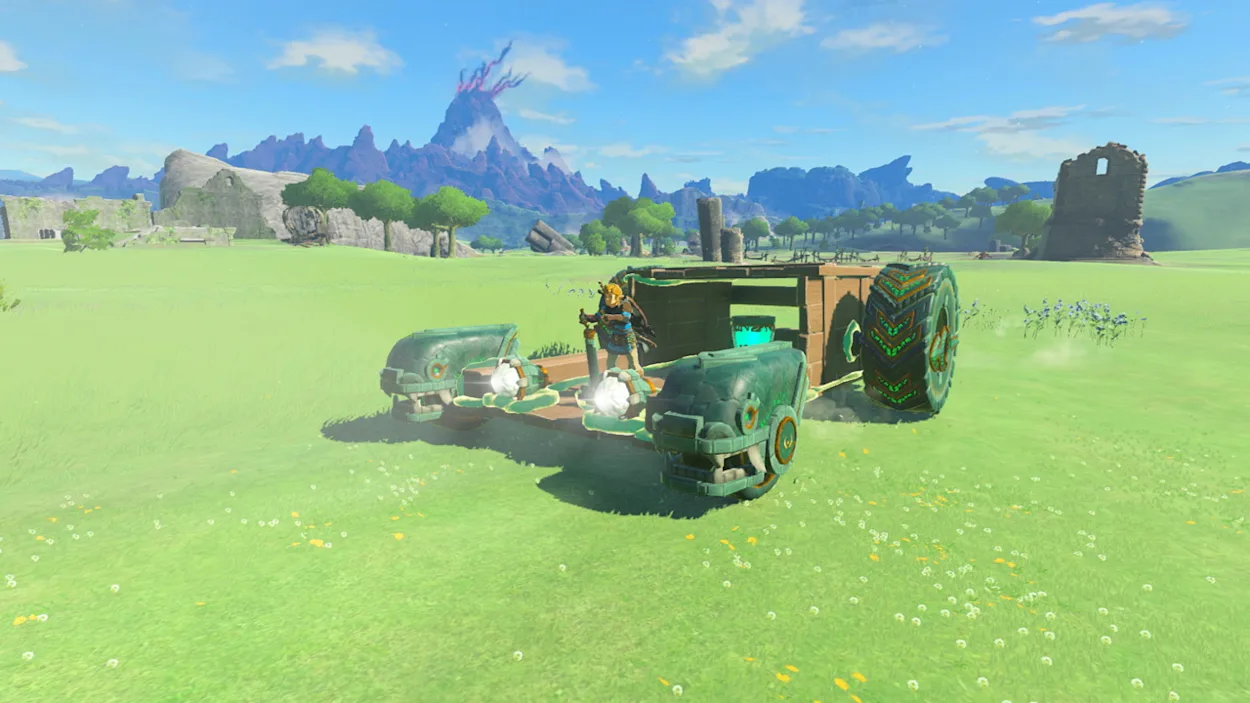
- Vehicle building: Using Ultrahand alongside Zonai Devices, players can construct cars, boats, and flying machines for exploration or combat purposes.
None of these systems exists in isolation. Fuse can change the usefulness of collected materials, Ultrahand can turn scattered objects into transport, and Recall can make a moving object part of a route. That overlap gives experimentation lasting value. A solution that works once may not be the only solution, and a player who returns to a challenge with different resources may approach it in a completely different way.
Combat, Resources, and Player-Made Tools
Tears of the Kingdom combat is shaped by the same willingness to improvise. Familiar and new foes are met with a wider range of possible responses, including fused weapons, modified arrows, recalled projectiles, and player-made contraptions. Direct attacks remain important, but the environment and available materials can influence the shape of a fight.
That gives resource management a clear practical role. Materials are not merely collected for their own sake; they can become parts of weapons, shields, arrows, or constructed devices. Crafting choices can therefore affect both immediate survival and longer journeys across Hyrule’s varied regions.
The result is a progression rhythm built around discovery. Finding a useful object, device, or environmental feature can change how a player handles the next puzzle or encounter. It also supports replay value through experimentation: different combinations of tools and different vehicle designs can produce distinct routes through the same broad world.
This approach is especially suited to players who enjoy action and adventure with room for self-directed problem solving. The role-playing element is present in the way Link’s capabilities and available tools shape the journey, while the large world rewards curiosity, planning, and a readiness to test unusual ideas.
The Verified Nintendo Switch Release Details
Title: The Legend of Zelda: Tears of the Kingdom
Publisher: Nintendo
Developer: Nintendo
Release date: May 12, 2023
Genres: Action, Adventure, Role-Playing
Regions: Europe, USA, Asia, Japan
Languages: English, Dutch, French, German, Italian, Japanese, Korean, Russian, Chinese, Spanish
For players looking at The Legend of Zelda: Tears of the Kingdom Switch NSP XCI as a reference point, the defining feature is the scale of its problem-solving freedom. Its crisis-driven story supplies the stakes, while its interconnected surface, Sky Islands, and Depths keep asking a simple but effective question: what can Link make, alter, or reach next?
Recommended Similar Games
 Metal Gear Solid – Master Collection Vol.1 Switch NSP XCIView Game
 THE KING OF FIGHTERS XIII GLOBAL MATCH Deluxe Edition Switch NSP XCIView Game
 Matsurika no kEi Tenmei Kashokuden Switch NSPView Game
 Guilty Gear -Strive- Nintendo Switch Edition Switch NSPView Game
 Gray Dawn Switch NSPView Game
 Virche Evermore -ErroR: Salvation- Switch NSPView Game
