Redout: Lightspeed edition Switch NSP XCI
Report Link Error
Select the broken download file, then submit the report.
Screenshots
About Game
Redout: Lightspeed edition Switch NSP XCI brings a severe, velocity-first strain of futuristic racing to Nintendo Switch. Released on May 14, 2019, this arcade racing game was developed by 34BigThings and published by Nicalis, with availability listed for Europe and the USA. Its appeal is direct: anti-gravity machines, demanding courses, and races that ask players to react cleanly when the track begins to twist, drop, and accelerate beyond comfortable limits.
Redout: Lightspeed Edition on Nintendo Switch: A Snapshot
Redout: Lightspeed Edition Switch is built around the traditions of high-speed arcade racers, but its machines do not stay tied to the ground. Pilots guide futuristic ships through courses designed for rapid directional changes and gravity-defying movement. The result is a racing experience where speed is not just a visual flourish; it is the central source of pressure.
34BigThings frames the action through a science-fiction lens, while Nicalis published the Switch release. The game’s structure and presentation keep attention on competition rather than long stretches of exposition. Each event is an opportunity to learn a circuit, improve control of a chosen ship, and find a cleaner route through its most difficult sections.
The European and USA release gives the game a broad regional presence, and its language support reflects that range. More importantly, the Switch version presents a complete package centered on racing skill, championships, ship handling, and repeat attempts at faster results.
A Bleak Future Built Around High-Speed Competition
The Redout Lightspeed Edition story begins with a distant future in which environmental decay has left much of Earth abandoned. In that damaged setting, anti-gravity racing has become an extreme public spectacle. Corporations sponsor pilots, and those pilots compete across global championships for prestige and supremacy.
There is no indication that the game is built around an elaborate narrative campaign with extensive character drama. Its premise instead provides atmosphere and motivation. The player is a racer looking to rise through competition, defeat rivals, and establish a name on the circuit. That stripped-back approach suits the game’s pace: the world is bleak, technologically advanced, and defined by the demand for ever more spectacular racing.
The corporate-sponsored pilots and global championships give the futuristic racing world a sense of scale without slowing the action down. Victories matter because they mark progress in a hostile competitive scene, but the real story is told through performance on the track.
How Anti-Gravity Racing Shapes Every Lap
Redout gameplay is designed around speed, reflexes, and the ability to keep a ship composed when a course becomes difficult to read. Anti-gravity racing changes the feeling of a lap: vehicles can drift, strafe, boost, and negotiate routes that demand quick adjustments rather than simple cornering discipline.
Precision is especially important. A fast line means little if the ship cannot be held steady through a demanding turn or positioned correctly for the next straight. Tracks reward attention to their layout, while the sheer pace puts pressure on every decision. The game also includes energy management, requiring players to consider when to boost and when to repair damage.
- Build control first. Learning a ship’s handling is essential before chasing maximum speed.
- Read the circuit. Tight bends, shifting routes, and rapid transitions require anticipation.
- Use boosts carefully. Energy can support acceleration, but it also has value for repairing damage.
- Make room to strafe. Lateral movement can help correct a line when a corner arrives quickly.
- Keep racing under pressure. The fastest moments demand calm reflexes as much as raw aggression.
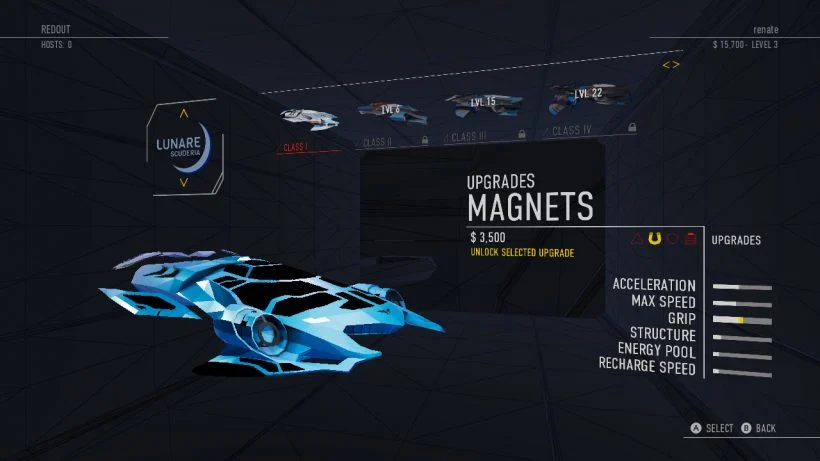
Different ship classes bring their own handling and stat profiles, giving players room to find a machine that suits their approach. Passive and active power-ups add another tactical layer, while upgrades and unlockable ships provide reasons to keep experimenting. The learning curve can be steep, but improvement is tangible when a formerly difficult section becomes manageable.
Career Championships and Multiplayer Competition
The career mode offers multiple championships, providing a structured route through Redout’s competitive world. It is the clearest place to develop familiarity with the courses, unlock new ships, and improve preferred vehicles. Progress is tied to racing performance, which makes the career format a natural fit for players who enjoy gradual mastery rather than a single isolated event.
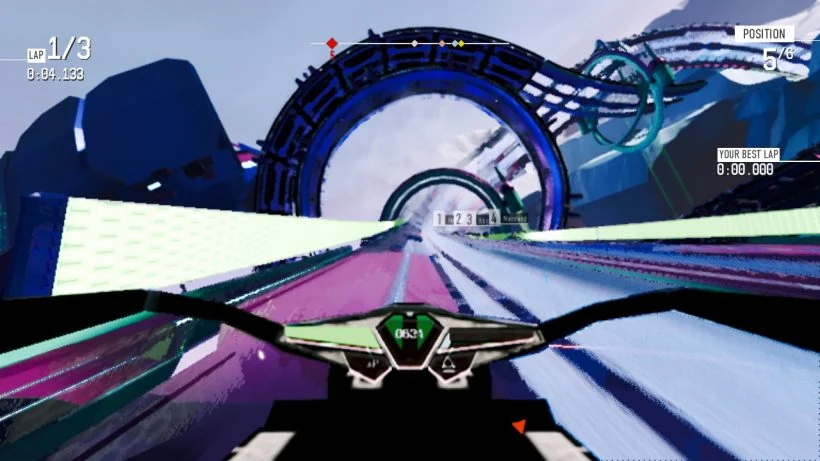
AI races provide regular competition for solo play, but the game also supports direct rivalry. Local split-screen racing lets players share the same system, while online racing expands competition beyond the room. These options give Redout multiplayer a practical role in the package: a well-learned track can become a new test when another human racer is pushing for the same racing line.
Replay value comes from more than simply finishing championships. Different ship classes, upgrades, power-ups, track knowledge, and the challenge of reducing mistakes all encourage repeated races. For players who enjoy shaving time from a lap or adapting to the handling of a new machine, the game’s competitive design leaves room for continued refinement.
Track Environments and the Game’s Futuristic Visual Style
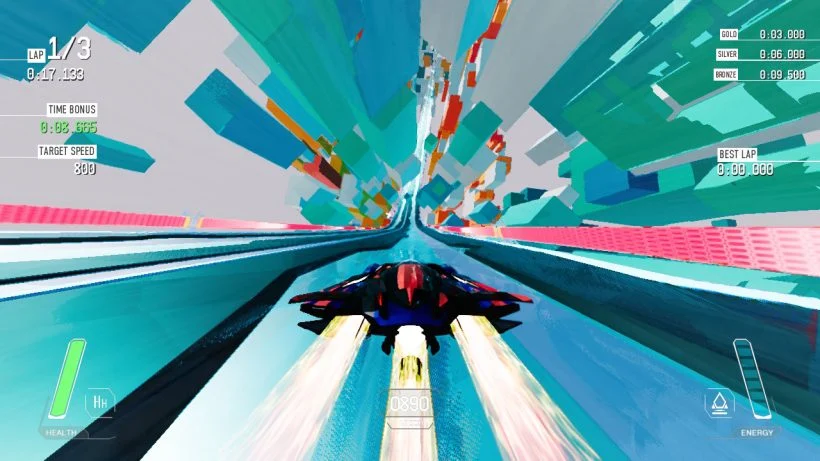
Redout tracks are spread across diverse and intricately designed environments, giving each competition a distinct science-fiction backdrop. The circuits are not merely scenery. Their shape, turns, and high-speed routes are fundamental to the game’s challenge, making visual readability part of the racing experience.
The futuristic visuals support an atmosphere of technological spectacle set against a harsher world. Ships cut through elaborate environments at extreme speed, reinforcing the contrast between the abandoned-Earth premise and the polished entertainment built around racing. It is an arcade racing spectacle that favors bold movement, sharp track design, and a persistent sense of momentum.
This presentation is likely to suit players looking for a concentrated sci-fi racing experience rather than a narrative-heavy game. The focus remains on the machine, the course ahead, and the narrow margin between a controlled run and a costly mistake.
Switch Release Details: Regions, Languages, and Technical Metadata
The Nintendo Switch release is identified by Title ID 0100DA20021D0000. Its listed release date is May 14, 2019, with Europe and the USA named as supported regions. The genre classification is Racing and Arcade, which accurately reflects its emphasis on fast competition and futuristic vehicle control.
Redout Switch languages include English, German, Spanish, French, Italian, Japanese, Dutch, Portuguese, and Russian. The listed firmware version is v9.2.0, and the file size is 3.6GB.
For players drawn to anti-gravity racing, sharp reflex tests, and a futuristic world built around global championships, Redout: Lightspeed edition Switch NSP XCI is defined by its relentless pace. Its career events, AI competition, local split-screen, and online racing modes all return to the same demanding idea: speed only matters when a pilot can keep control of it.