METAL SLUG ATTACK RELOADED Switch NSP

Report Link Error
Select the broken download file, then submit the report.
Screenshots
About Game
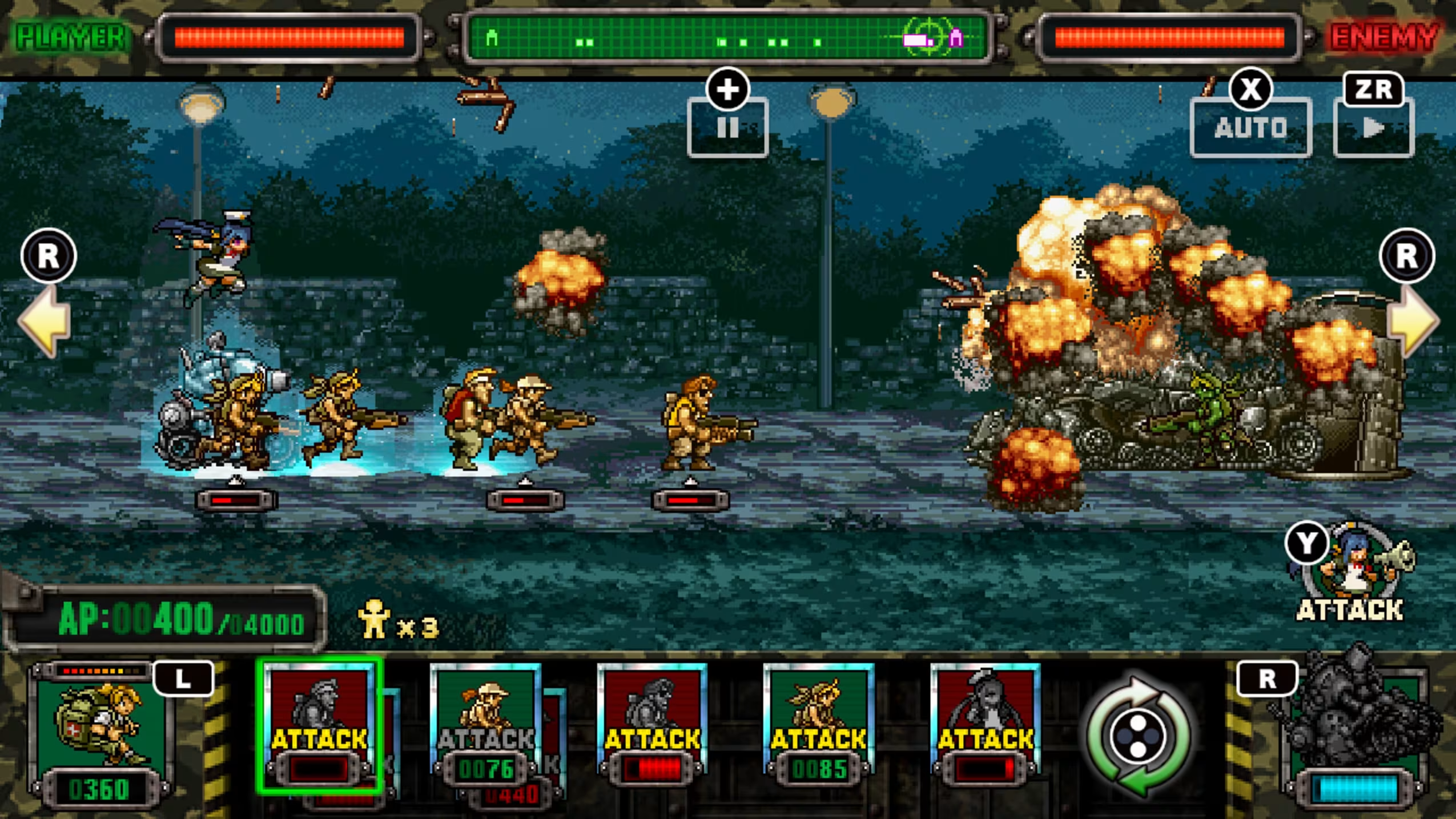
METAL SLUG ATTACK RELOADED Switch NSP brings SNK’s long-running military-cartoon universe to Nintendo Switch in a format built around quick decisions, accumulating resources, and base-versus-base pressure. Released in the USA region on June 18, 2024, this Strategy title shifts the series away from its familiar run-and-gun identity without leaving behind its soldiers, tanks, strange enemies, and animated pixel-art personality.
METAL SLUG ATTACK RELOADED at a Glance on Nintendo Switch
Published by SNK, METAL SLUG ATTACK RELOADED is a Nintendo Switch Strategy release with Title ID 010073401B8DE000. Its supported language list is broad: English, French, German, Italian, Japanese, Korean, Portuguese, Russian, Simplified Chinese, Spanish, and Traditional Chinese are included.
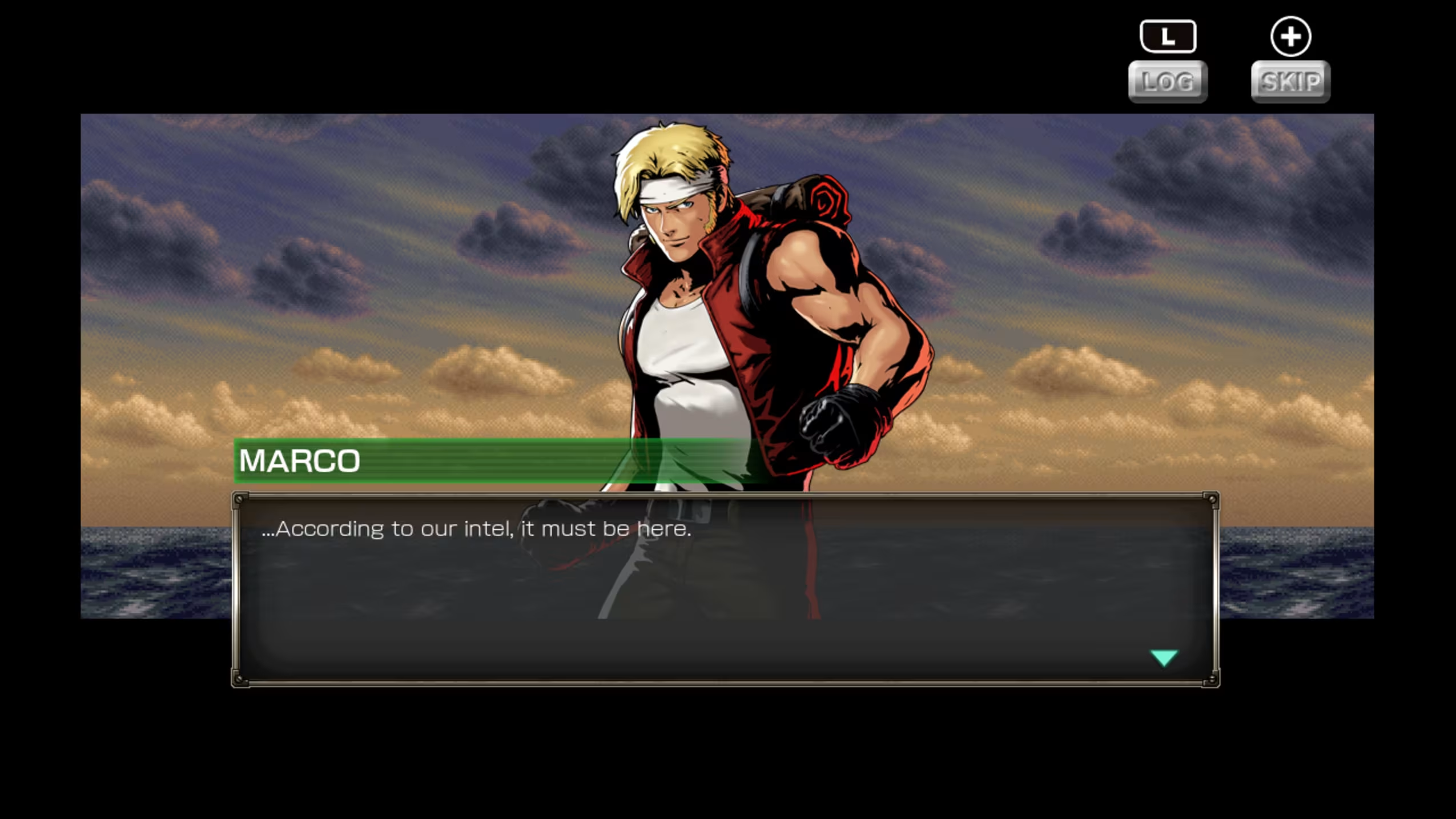
The game’s premise draws from the continuing conflict associated with the Metal Slug universe. The Regular Army and Rebel Army remain central forces, with General Morden among the familiar opposition. Alien invaders and ancient mummies also enter the conflict, creating a battlefield roster that is more eccentric than a conventional military strategy game. The emphasis is not on a heavily narrative-driven campaign, but on repeated tactical engagements in which each side attempts to overwhelm and destroy the other’s base.
That setup gives the game a clear, direct atmosphere. Its battles retain the series’ playful visual character and recognizable machinery while asking players to think less about individual platforming reflexes and more about pressure, pacing, and counterplay.
A Metal Slug Battlefield Built Around Real-Time Strategy
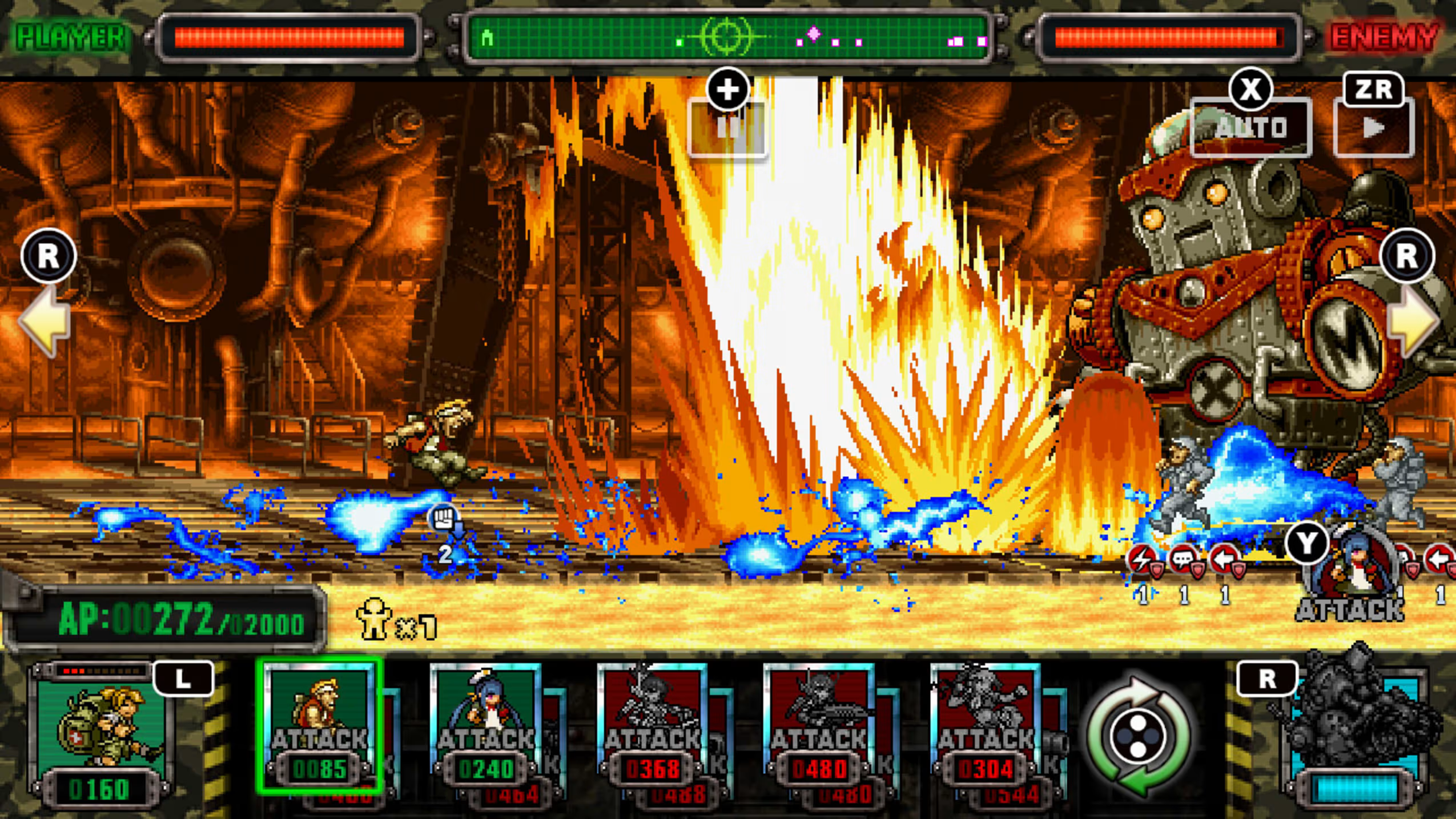
Rather than following the traditional run-and-gun structure, the game treats each encounter as a real-time strategy contest on a two-dimensional battlefield. Players deploy forces from their side, advance toward the opposing headquarters, and try to break through while preventing the enemy from doing the same.
The familiar Metal Slug setting is important here because it gives the tactical action a distinct identity. Soldiers may form the basic line of an advance, while tanks provide heavier support and unusual alien creatures add further variety to the available force. The result is a battlefield that can quickly change shape as new units arrive, collide, and open opportunities for a stronger push.
Success is not simply about reaching the other base first. A player also has to protect their own headquarters, respond to enemy pressure, and decide when a temporary advantage is worth turning into a full commitment. Missions and stages present different challenges and enemy compositions, encouraging adjustments rather than a single fixed approach.
AP Management: The Resource Behind Every Deployment
The central resource is AP, or Attack Points. AP accumulates over time and is spent to deploy units, making resource management a constant concern instead of a background task. Every choice has a cost: sending a unit immediately may help defend against an approaching threat, but doing so can delay access to a more powerful option.
This creates much of the game’s tension. A player who spends all available AP on a rapid early advance may gain ground, yet have little left to answer an enemy counterattack. Holding AP for too long carries its own danger, particularly if the opposing side uses that pause to establish momentum.
Good AP management therefore connects attack and defense. It is about reading the current battlefield, estimating what the enemy may deploy next, and deciding whether the best use of resources is to reinforce a line, stop an advancing force, or create a concentrated push toward the opposing base.
Units, Vehicles, and Special Attacks
The roster includes deployable soldiers, tanks, and alien creatures, each bringing different strengths, weaknesses, skills, and special attacks. Infantry can support a broad front or build numbers quickly, while heavier vehicles can provide a more forceful presence when the timing is right. Less conventional units help preserve the series’ oddball tone while expanding the tactical possibilities of a match.
Because units do not all perform the same role, combinations matter. A unit that is useful for a quick rush may not be the best defensive answer. Another may be more valuable when held until an enemy formation has committed to the field. Special attacks add another layer, offering a way to influence a pivotal exchange rather than relying solely on the steady arrival of standard deployments.
Progression also supports experimentation. Units can be collected and upgraded to improve their statistics, allowing players to develop a stronger force over time. That does not remove the need for battlefield judgment, but it gives missions and repeated play a practical reason to revisit different units and discover how they fit into a preferred approach.
Why Timing Matters More Than Simply Sending Units
METAL SLUG ATTACK RELOADED Switch NSP rewards a reactive mindset. Constantly sending every available unit may fill the field, but it can also leave a player short of AP when a more serious threat appears. Watching enemy deployment patterns is often more useful than trying to win through volume alone.
A well-timed tank can change the balance of a contested lane. A reserve of infantry may be more effective after the opposing side has already committed its answer. A special attack can be saved for the moment when an enemy push is at its most dangerous or when a defended base is finally vulnerable.
This is where the game’s accessible structure gains strategic depth. The goal remains easy to understand—destroy the enemy base while defending your own—but the route to that goal changes with every unit choice, enemy composition, and AP decision. Players are encouraged to test responses, learn unit behavior, and avoid treating every battle as a simple race.
Five Practical Battle Priorities for New Commanders
- Protect your AP reserve. Spend Attack Points with a purpose instead of committing everything as soon as it becomes available. Keeping some AP available gives you room to answer an enemy deployment or begin a stronger counterpush.
- Read the opposing force. Watch which units the enemy sends out and how they are being used. A response that works against infantry pressure may not be the right answer to a heavier vehicle-led advance.
- Test unit combinations. Mix soldiers, tanks, and other available forces to learn how their strengths and weaknesses interact. Missions with different enemy compositions can reveal which pairings feel dependable.
- Balance defense with forward pressure. Advancing toward the enemy headquarters is necessary, but leaving your own base exposed can end a promising attack quickly. Build pressure without ignoring the line behind it.
- Save decisive tools for decisive moments. Strong deployments and special attacks are most valuable when they can halt a dangerous enemy push or help turn an opening into direct base damage.
For players interested in strategy that favors short, readable battles over elaborate empire management, the game offers a compact tactical loop with recognizable Metal Slug flavor. Its replay value comes from changing mission conditions, unit experimentation, upgrades, and the continuing challenge of making sharper decisions with the AP available.
Recommended Similar Games
 ROMANCE OF THE THREE KINGDOMS XIV: Diplomacy and Strategy Expansion Pack Bundle Switch NSP XCIView Game
 Anime Tank Blitz: Warbound Legends Switch NSPView Game
 Arcana of Paradise – The Tower Switch NSP XCIView Game
 SteamWorld Build Switch NSPView Game
 Blossom Voyage Switch NSPView Game
 Pixel Cafe Switch NSPView Game
