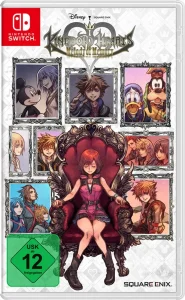
Kingdom Hearts Melody of Memory SWITCH NSP
Report Link Error
Select the broken download file, then submit the report.
Screenshots
About Game
Kingdom Hearts Melody of Memory SWITCH NSP brings the series’ characters, settings, and songs into a rhythm-action format built around recollection. Released after the events of Kingdom Hearts III, it revisits major moments from the wider saga while giving its musical battles a narrative purpose. The result is a game concerned with timing and score-chasing, but also with Kairi’s attempt to understand what happened to Sora.
A Rhythm-Action Chapter After Kingdom Hearts III
The Kingdom Hearts Melody of Memory story begins in the aftermath of Kingdom Hearts III. Kairi takes a central role as she revisits her memories, looking back across earlier adventures in search of clues connected to Sora’s disappearance. This gives the game a reflective structure: familiar events are not simply presented as a greatest-hits collection, but filtered through Kairi’s recollections and her hope of finding an answer.
That focus on Kairi memories makes the game an important continuation rather than a detached music spin-off. Players return to moments from across the Kingdom Hearts series, consolidating a far-reaching storyline through rhythm stages and cinematic imagery. The narrative also introduces new lore and points toward later developments, making it relevant for players following the series’ larger plot after Kingdom Hearts III.
The atmosphere shifts between energetic musical play and a more contemplative framing story. Kairi’s search gives the revisited material an emotional throughline, while the songs and recurring characters preserve the series’ familiar sense of adventure.
How Field Battle Stages Turn Music Into Combat
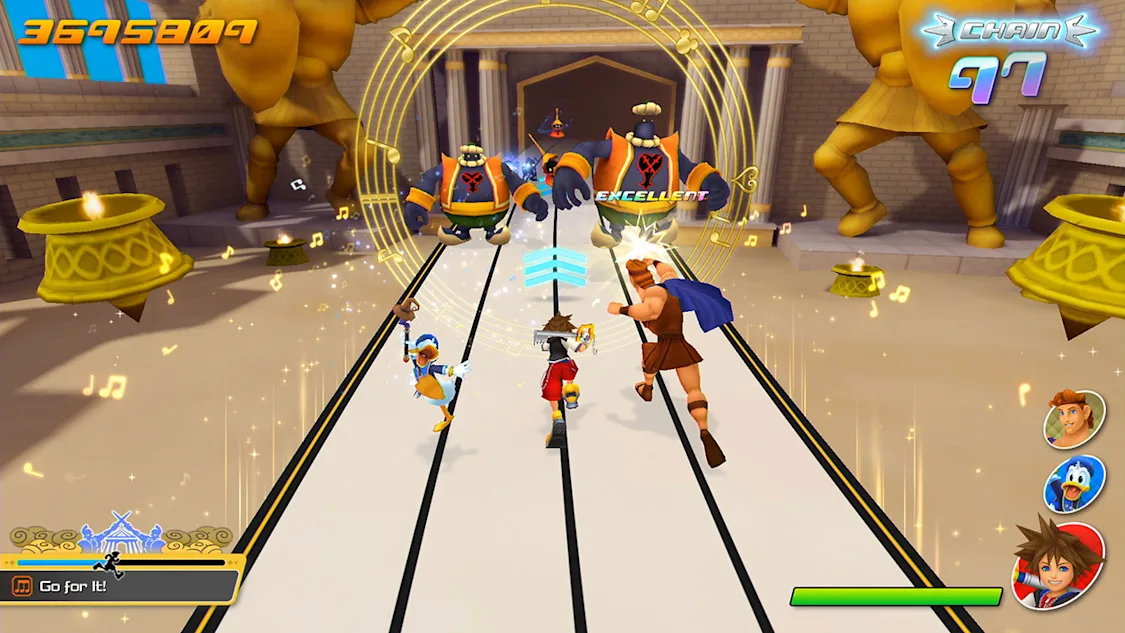
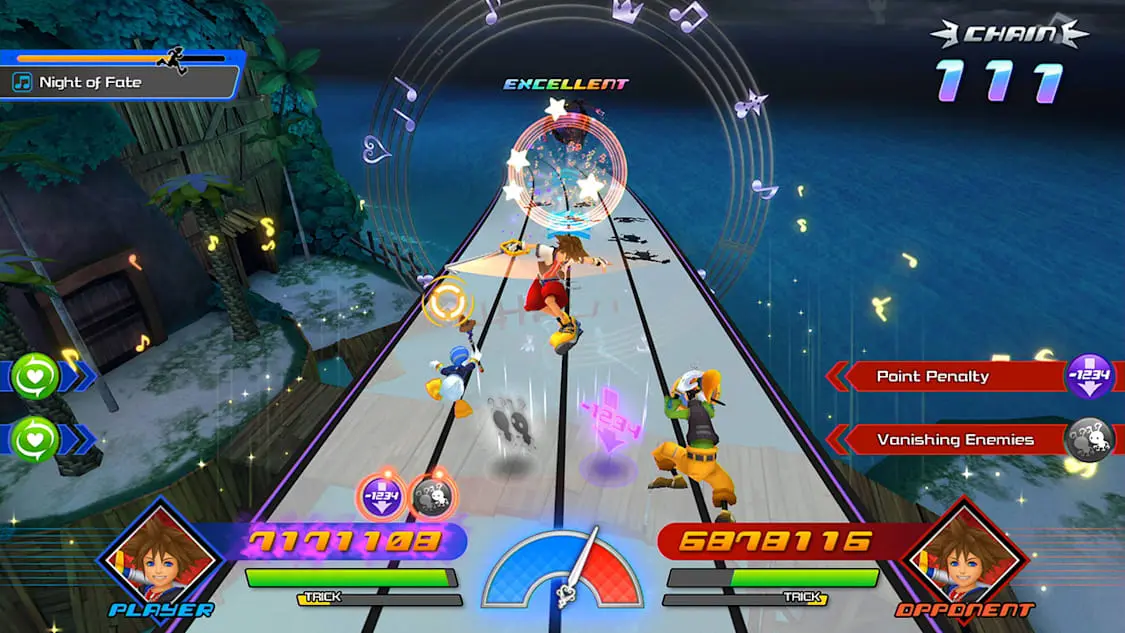
Kingdom Hearts Melody of Memory Field Battle stages provide the game’s clearest blend of action and music. A three-character team moves forward along a course as enemies approach, and players attack in rhythm with the selected track. Familiar faces, locations, and foes are recast through a beat-driven combat system where timing governs each response.
The standard party often includes Sora, Donald, and Goofy, though other teams can be unlocked. Characters such as King Mickey and Riku are available among the game’s team options, with distinct playstyles. The forward motion of Field Battle stages keeps the action readable: enemies arrive along the path, prompts signal the required input, and a successful sequence turns a line of attacks into part of the music.
It is rhythm combat, but it retains the visual language of Kingdom Hearts. Heartless and other enemies become targets in a musical encounter rather than opponents in a traditional action RPG battle. Some targets call for different inputs depending on whether they are marked as single, double, or triple targets, while jumps and abilities add further responses to learn.
- Keep the beat: Attacks are performed in time with the song as enemies come into range.
- Read the targets: Single, double, and triple enemy indicators require different button presses.
- Watch ahead: Visual cues can help prepare for attacks before the musical moment arrives.
- Use movement: Jumps and abilities are part of the rhythmic response during a stage.
- Refine the team: Different character teams, cards, and items offer room to adjust an approach.
The structure encourages replay without relying only on the story. Returning to a song can help players improve timing, learn enemy patterns, and raise performance on harder difficulties. Beginners can start on Beginner or Standard difficulty, while repeat attempts offer a practical way to become more comfortable with a stage’s rhythm and visual signals.
Memory Dive and Boss Battle Stage Types
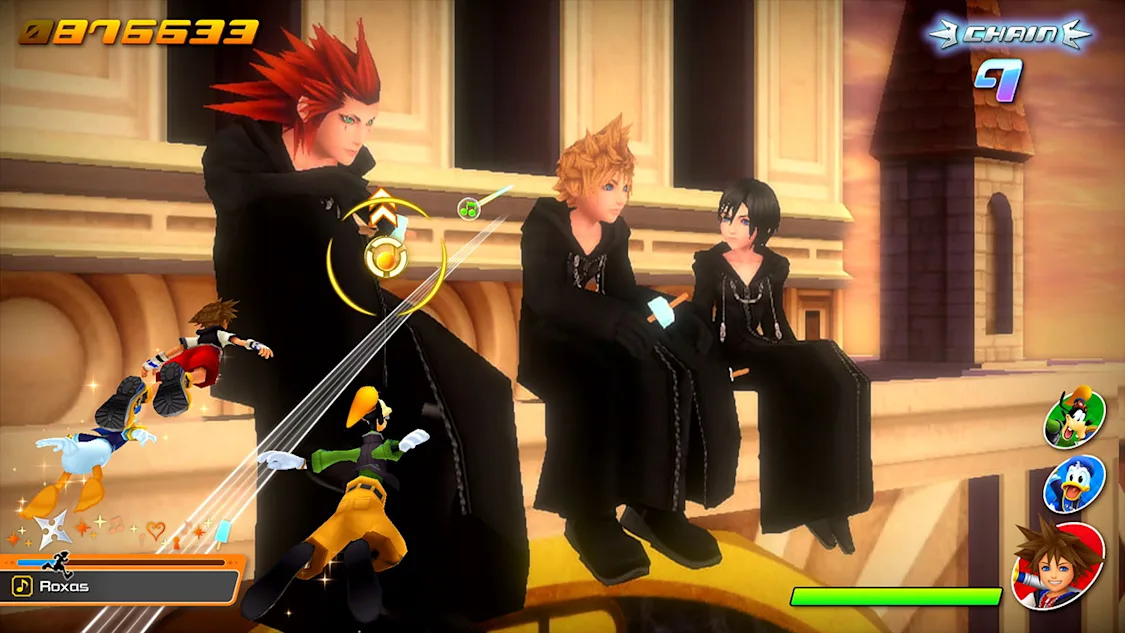
Field Battles are only one part of the game’s rhythm stage types. Kingdom Hearts Melody of Memory Memory Dive stages take a different visual approach, moving through cinematic imagery while players hit rhythmic prompts. These sequences emphasize the series’ remembered scenes and give the music a more overtly archival presentation.
The contrast is useful. Field Battles place a team on a moving route with approaching enemies, while Memory Dive stages use a journey through cinematic material as the backdrop for their note patterns. Both still depend on rhythm, but the presentation changes the feel of the performance: one is combat-forward, the other is tied more directly to revisiting the series’ past.
Kingdom Hearts Melody of Memory Boss Battle stages add another variation. They feature stronger opponents and distinctive rhythmic patterns, asking players to adapt rather than simply carry their habits from a standard Field Battle into a new track. Boss encounters fit the game’s broader replay appeal because learning patterns and improving timing matters as much as recognizing a song.
Items and cards can be collected and used to customize a team and enhance its abilities. On difficult stages, choosing appropriate items such as potions or defense boosters can be useful. This progression layer does not replace the need for timing, but it gives players another way to prepare for particular challenges.
The Tracklist: More Than 140 Songs Across Kingdom Hearts
The identity of Kingdom Hearts Melody of Memory songs is central to the experience. The tracklist contains more than 140 songs drawn from throughout the Kingdom Hearts series, allowing stages to connect music with locations, characters, battles, and memories from across the franchise.
That breadth gives Kingdom Hearts music a role beyond background accompaniment. Each track defines the pace of its stage, informs the timing of attacks or prompts, and helps establish the mood of the sequence. A song can support a forward-moving battle, frame a Memory Dive through cinematic imagery, or provide the foundation for a more demanding boss pattern.
With 140 songs spread across the series, the game has room for varied practice and repeat play. Players looking to improve their rhythmic consistency can return to tracks, while those interested in the Kingdom Hearts archive can encounter music associated with different chapters of the saga.
Local Co-op and Online Versus Rhythm Challenges
Kingdom Hearts Melody of Memory local multiplayer allows two players to tackle stages together in cooperative play. It offers a straightforward shared format for working through rhythm challenges alongside another player, with the focus remaining on coordinated performance rather than exploration or traditional party combat.
For competition, Kingdom Hearts Melody of Memory online versus mode lets players test their rhythm skills against others. The multiplayer options support two different moods: local co-op for shared stage attempts and online versus for direct rhythm-focused matches. Both build naturally on the game’s emphasis on accuracy, patterns, and replaying music-driven stages.
Nintendo Switch Release Details for Melody of Memory
Kingdom Hearts Melody of Memory Nintendo Switch released on November 13, 2020. Square Enix served as both publisher and developer, and the game is listed in the Action and Music genres. It is available across Europe, the USA, Asia, and Japan.
The available languages are English, German, French, Spanish, Italian, Japanese, Korea, and Taiwan. Its combination of story material after Kingdom Hearts III, a large series-spanning song selection, and accessible rhythm fundamentals makes it suited to Kingdom Hearts players following Kairi and Sora’s story, as well as players interested in music games built around recognizable characters and cinematic memories.
For players returning to the exact release known as Kingdom Hearts Melody of Memory SWITCH NSP, the defining feature remains its conversion of a sprawling action-RPG history into a structured rhythm journey: remember the past, follow the beat, and meet each stage on its own musical terms.