Invector: Rhythm Galaxy Switch NSP
Report Link Error
Select the broken download file, then submit the report.
Screenshots
About Game
Invector: Rhythm Galaxy Switch NSP presents rhythm action as a trip across a musical cosmos rather than a character-driven adventure. Players pilot a craft through celestial routes where every track becomes a test of timing, reflexes, and familiarity with the music. Its Arcade and Party classification fits an experience built around immediate play, repeated attempts, and the satisfaction of improving a run.
A Rhythm-Action Journey Through the Rhythm Galaxy
The Rhythm Galaxy is framed through movement and performance. Instead of following a conventional plot with named characters and narrative turns, players progress as a pilot moving through a sequence of rhythmic challenges. Each route offers another chance to read the music, respond to its pulse, and push further into the game’s galaxy of tracks and worlds.
That approach gives the journey a clear sense of forward momentum without relying on story scenes. Advancement comes from conquering beats, completing courses, and meeting the demands of increasingly involved musical patterns. The player’s own growing command of the controls becomes the story: a difficult section that once caused missed notes can later become a clean, confident passage.
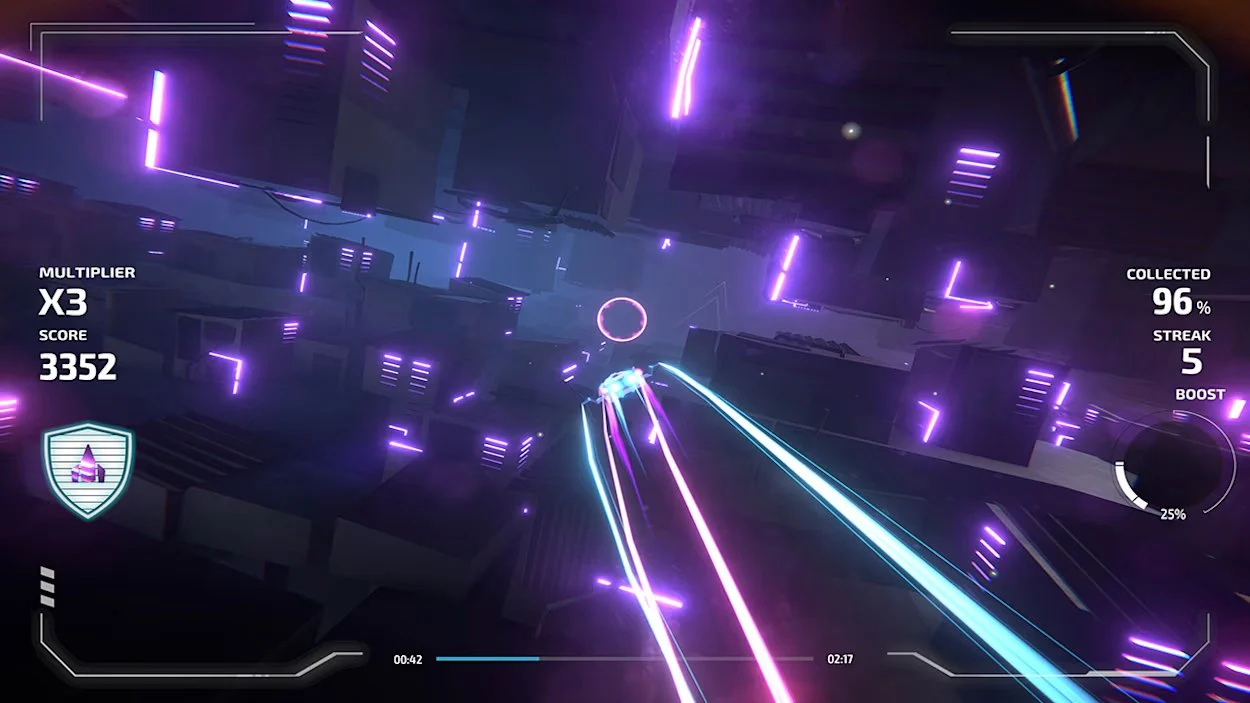
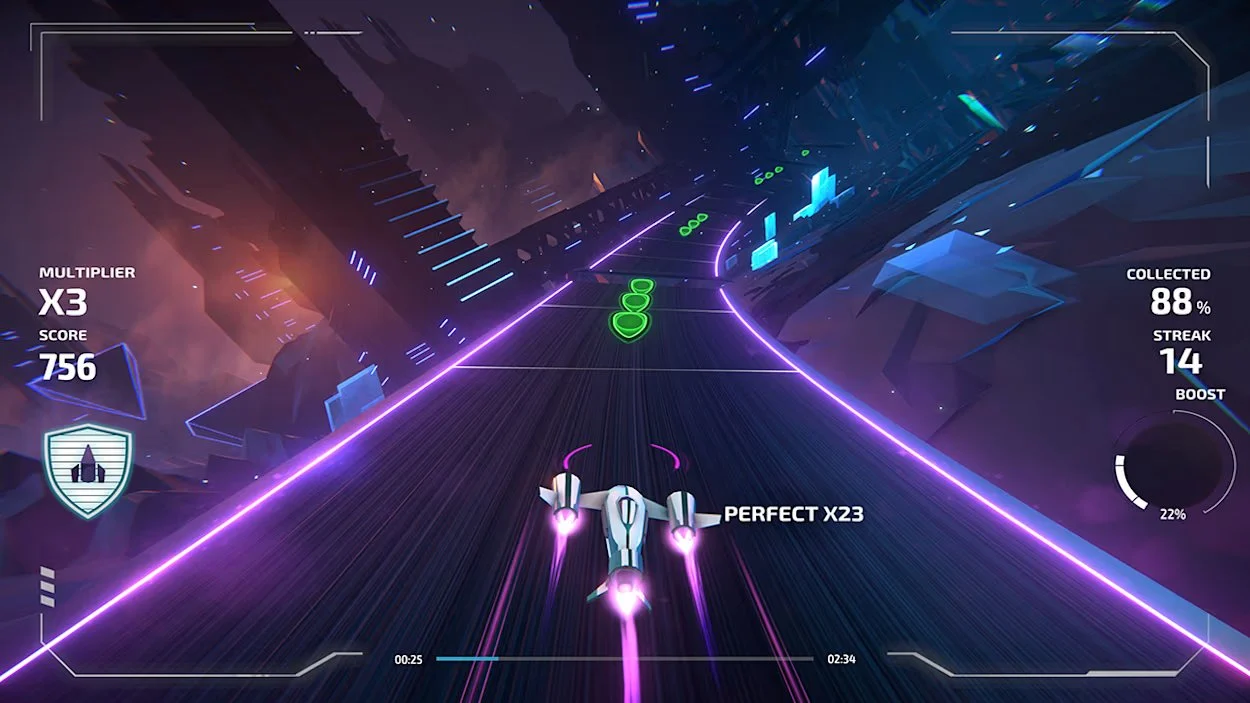
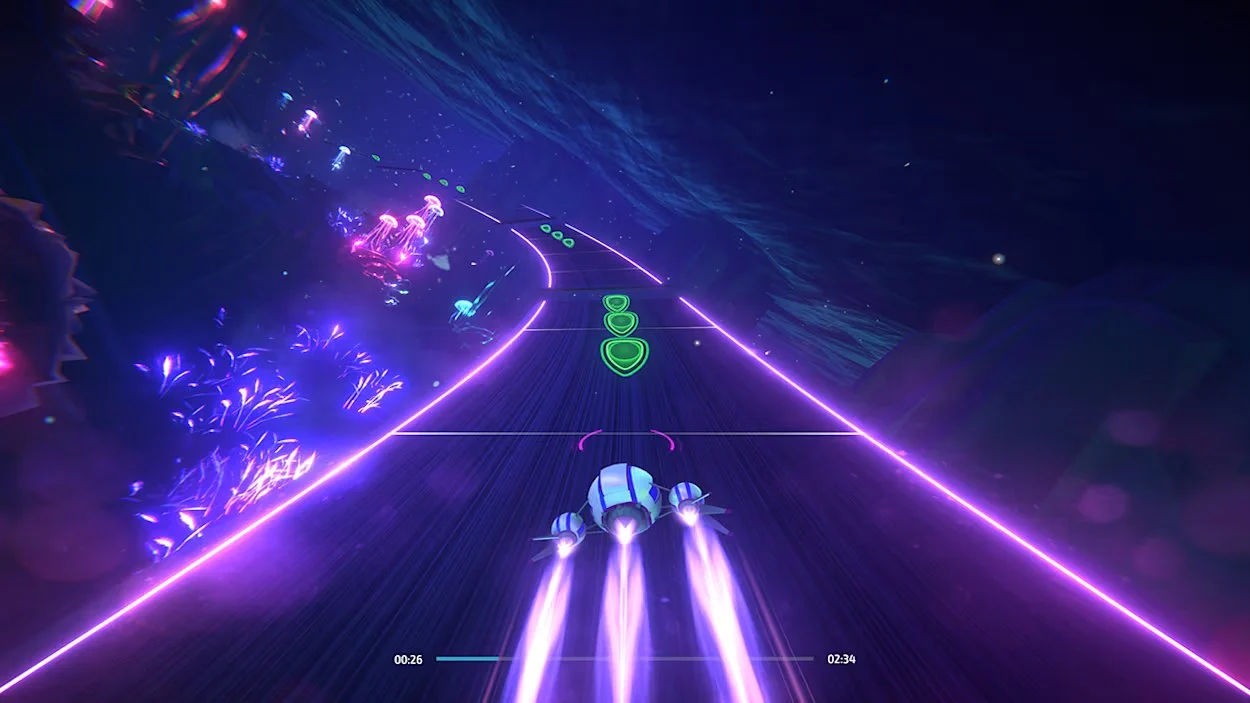
The presentation supports that musical focus with vivid visuals that pulse and react to the soundtrack. Lights, motion, and the changing course combine to make each stage feel like a performance in progress. The result is an arcade-style rhythm experience in which the screen is not just a backdrop; it is part of the timing challenge, asking players to follow the track while staying connected to the beat.
How Note Hitting and Track Navigation Work
Invector: Rhythm Galaxy gameplay combines note matching with ship navigation. Players guide a craft through dynamic tracks, hit notes in sync with the music, and avoid obstacles along the way. The structure calls for more than simply reacting to prompts: movement through the course and musical accuracy work together, so an effective run depends on keeping both the route and rhythm in view.
Timing is central to scoring. Accurate inputs build a stronger performance and support higher scores, while imprecise responses interrupt the flow a player is trying to maintain. Because the tracks are designed around music, listening closely can be as useful as watching the upcoming notes. Rhythms, melodies, and recurring phrases can help signal what is coming next.
The controls are presented as approachable, but the challenge deepens as players aim for greater precision. Early attempts may be about reaching the end of a course and learning its flow. Later runs can become focused on reducing mistakes, recognizing difficult sequences sooner, and turning a completed track into a polished score attempt. Leaderboards add another reason to revisit familiar music and chase a better result.
- Listen ahead: Following the rhythm and melody can make upcoming notes easier to anticipate than relying on visual reactions alone.
- Read the route: Keep track navigation in mind as well as note prompts, since obstacles are part of the course challenge.
- Learn repetitions: Replaying difficult sections helps reveal the patterns that shape each track.
- Protect timing: Calm, deliberate inputs are more useful than rushing through an intense sequence.
- Refine each run: A completed stage can still offer room for a higher score and cleaner performance.
Taps, Holds, and Sweeps: The Note Types to Master
The game’s note vocabulary includes taps, holds, and sweeps. These rhythm game note types ask players to pay attention not only to when an input begins, but also to how long it lasts or how it travels through a sequence. Learning the differences is important because a track can shift rapidly between short, immediate responses and patterns that demand sustained attention.
Taps reward direct timing. Holds ask the player to maintain control across a longer musical moment. Sweeps introduce another kind of motion to the performance, requiring players to follow the course of the note rather than treating every prompt as an isolated beat. Together, these note types keep the music from feeling uniform and give individual tracks their own flow.
For practical Invector: Rhythm Galaxy tips, repeated play is the reliable route to consistency. A difficult pattern becomes easier once its shape is familiar, especially when players connect it to a recognizable part of the soundtrack. Memorizing note sequences is not separate from enjoying the music here; it is part of understanding how a stage is built.
Difficulty Settings for Casual and Expert Players
Multiple difficulty settings give the game room for different levels of experience. A casual setting provides a more approachable way to enter the rhythm-action format, allowing newcomers to focus on the relationship between the music, the track, and the basic note patterns. It is a useful fit for players who want to learn the controls before concentrating on precision.
Higher settings shift the emphasis toward accuracy, faster responses, and stronger command of patterns. The expert rhythm challenge comes from handling demanding arrangements while continuing to navigate the course and avoid obstacles. This is where repeat play has particular value: better familiarity with a track can improve anticipation, and better anticipation can support more accurate performances.
The range also makes the game suitable for a shared setting. Since it carries a Party genre label alongside Arcade, its accessible starting point can help bring in players who are less experienced with rhythm games, while advanced settings offer a tougher target for those seeking a more exacting score chase.
Progression Through Tracks, Worlds, Ships, and Customization
Invector: Rhythm Galaxy progression is tied to continued performance across the galaxy. Completing tracks opens the path toward new worlds and additional musical challenges. This provides a practical reason to keep moving forward: each conquered route is both a completed performance and a step toward more of the game’s content.
Further play also unlocks ships and customization options. New ships give the player more to work toward beyond a single score, while customization adds a personal element to the craft used to cross the musical courses. These rewards remain connected to the game’s central loop rather than distracting from it: progress comes from playing tracks, mastering their patterns, and returning for improved results.
Replay value is supported by that combination of track unlocks, score goals, difficulty choices, and leaderboards. A player may return to a course to improve note timing, tackle it on a more demanding setting, or simply pursue a cleaner run. The emphasis remains on mastery, with each revisit offering another opportunity to make the performance feel more controlled.
Nintendo Switch Release Details and Language Support
Invector: Rhythm Galaxy Switch NSP released for Nintendo Switch on February 8, 2024. Hello There Games is listed as both the developer and publisher. The title is available in the Europe, USA, and Japan regions, with Arcade and Party identified as its genres.
Its language support includes English, French, German, Italian, Japanese, Korean, Portuguese, Russian, Simplified Chinese, and Spanish. That broad selection helps make the game’s menu and interface language available to players across its listed regions, while the musical challenge itself remains centered on universal fundamentals: following a beat, recognizing patterns, and improving through practice.
For players drawn to bright reactive visuals, score-driven replay, and music-led movement, the game offers a focused rhythm-action journey. Its tracks ask for attention, but its structure also leaves room to learn one run at a time.
Recommended Similar Games
 Let’s Sing 2024 with International Hits Platinum Edition Switch NSP XCIView Game
 Umamusume: Pretty Derby – Party Dash Switch NSP XCIView Game
 Horizon Chase Turbo Switch NSPView Game
 Horizon Chase 2 Switch NSPView Game
 Racing Car Chaos: Extreme Stunt Showdown Switch NSPView Game
 Jitsu Squad Switch NSPView Game
