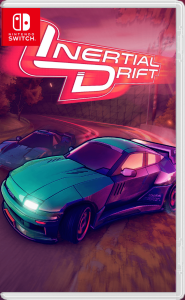
Inertial Drift Switch NSP
Report Link Error
Select the broken download file, then submit the report.
Screenshots
About Game
Inertial Drift Switch NSP takes arcade racing in an unusual direction: instead of treating a drift as a single button-assisted maneuver, it makes each slide a deliberate act of control. Developed by Level 91 Entertainment, the game builds its identity around precision driving, expressive cornering, and the satisfaction of improving through repeated runs.
What Makes Inertial Drift’s Twin-Stick Drifting Stand Out
The defining idea behind Inertial Drift is its twin-stick drifting system. One stick handles steering, while the other independently directs the car’s drift. That separation changes the familiar rhythm of arcade racing. Rather than simply turning into a corner and triggering a slide, players can adjust their driving line and the angle of the car independently.
In practice, this gives cornering a more technical, expressive quality. A player can set up a slide, hold a controlled angle through the bend, and make small corrections without abandoning the intended racing line. The system asks for attention, particularly when linking several corners together, but it also makes a clean drift feel earned. Precision matters as much as speed.
That learning curve is a major part of the experience. Conventional arcade racers often make drifting immediately accessible through a single command, while Inertial Drift asks players to develop new muscle memory. The controls are designed around experimentation and practice, and the payoff comes from becoming more confident with the separation between steering and drift direction. For players who enjoy arcade racing with a stronger emphasis on mechanical mastery, the format offers a distinctive challenge.
- Separate control: Steering and drifting use independent sticks, allowing more deliberate positioning through corners.
- Controlled slides: Each bend becomes an opportunity to adjust angle, direction, and speed with greater precision.
- Practice-driven improvement: The control scheme rewards time spent building familiarity rather than relying on automatic assists.
- Car experimentation: Different handling characteristics encourage players to reconsider their approach from one vehicle to another.
- Replayable runs: Races, time-focused challenges, and ghost competition give players reasons to refine individual laps.
A 90s Anime-Inspired Racing World
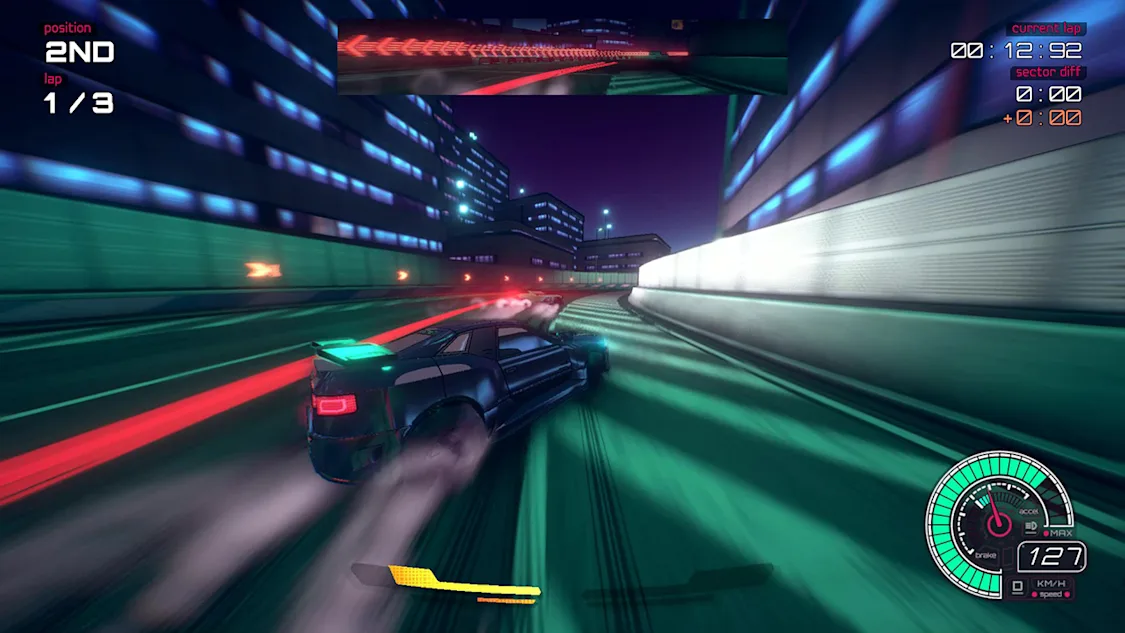
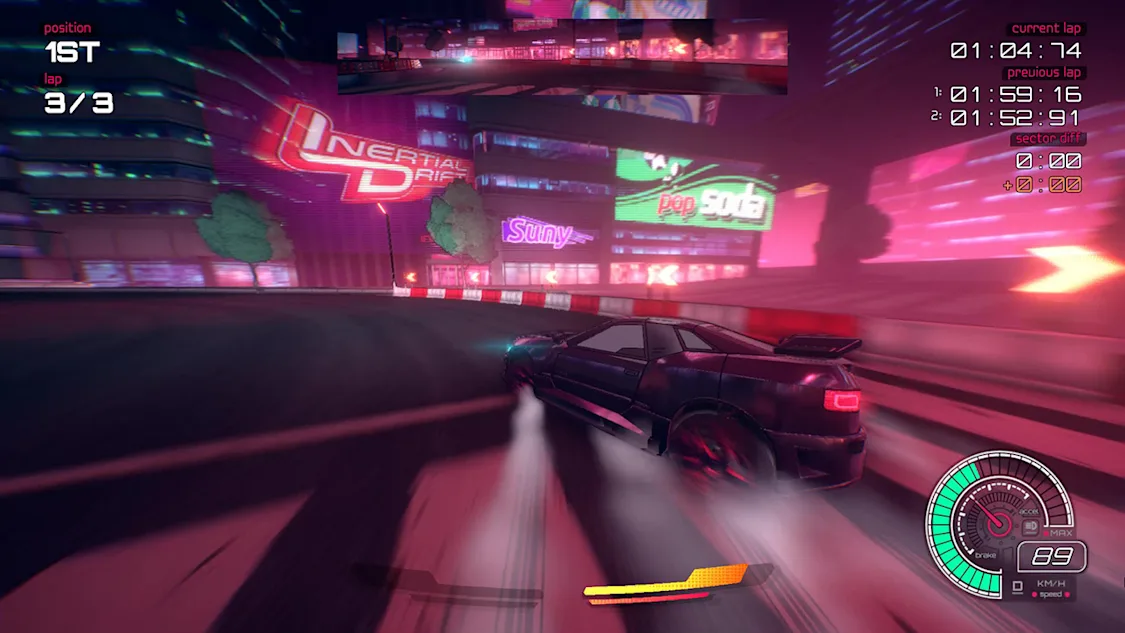
Inertial Drift visuals lean into a 90s anime aesthetic, using a stylized presentation to support the energy of its racing. The game’s environments are vibrant rather than grounded in realism, creating a setting that matches the exaggerated movement and confidence of its drifting mechanics. Cars slide through circuits that are built to be read quickly at speed, while the visual direction keeps the focus on motion and atmosphere.
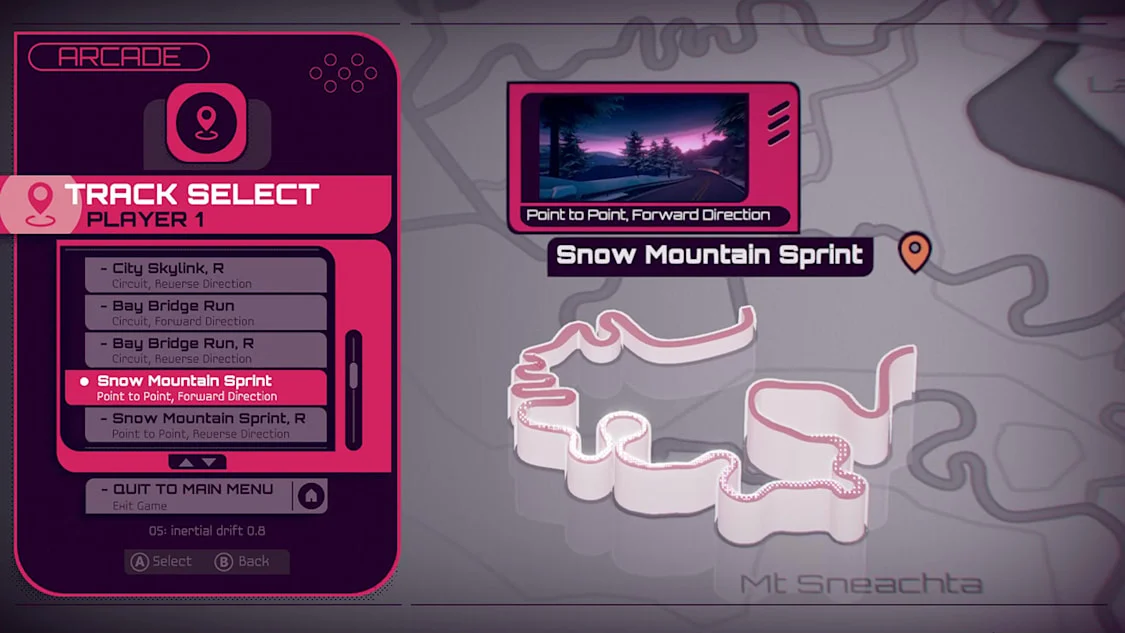
This approach suits a stylized racing game particularly well. The appeal is not in simulating ordinary roads or motorsport broadcasts; it is in presenting races as fast, colorful contests of timing and control. The anime-inspired look gives the game a recognizable identity, while the varied environments prevent its 20 tracks from feeling like a single repeated backdrop.
Presentation and gameplay work closely together here. The bright visual style reinforces the sense that drifting is not merely a way to get around a corner, but the central performance of every event. A well-held slide has a visual presence, and a sequence of successful drifts can make a lap feel fluid even before the finishing position is decided.
16 Cars, 16 Distinct Handling Personalities
The roster includes 16 cars, each with its own handling characteristics and personality. That distinction matters because the twin-stick system puts so much emphasis on feel. A car that suits one player’s instincts may not suit another’s, and changing vehicles can alter the way a corner needs to be approached or recovered.
Experimentation is therefore central to drift racing in Inertial Drift. Some players may prefer a vehicle that feels comfortable during long, controlled slides, while others may gravitate toward handling that better suits their preferred rhythm through technical circuits. The game encourages drivers to find a car-and-track combination that feels natural, rather than assuming one style will work equally well everywhere.
This variety also gives progression a practical dimension. Unlocking and trying new vehicles is not simply about expanding a collection. It is an invitation to revisit familiar tracks with a different handling profile and a new set of demands. For a game built around precision, those changes can meaningfully reshape the driving experience.
Racing, Time Trials, and Ghost Battles: Modes That Test Skill
Inertial Drift game modes include Story, Race, Ghost Battle, and local multiplayer. Together, they provide several ways to engage with the same core discipline: getting around a circuit quickly and cleanly. Racing events bring the pressure of competing against opponents, while time trials place the attention directly on lap quality, consistency, and small improvements.
Ghost Battle is especially suited to the game’s precision-focused design. Competing against a ghost turns a lap into a direct comparison, making errors and gains easier to recognize. A missed line through one turn or a less controlled drift can become visible in the gap between runs. That makes the mode a useful test of personal improvement as well as a competitive challenge.
Local multiplayer adds a more immediate social dimension, while the game also features AI opponents that adapt to player skill. Across these activities, replay value comes less from a sprawling narrative framework than from the drive to improve a route, master a vehicle, and put together a smoother sequence of corners.
Progression Without a Traditional Storyline
There is no deep, overarching narrative driving Inertial Drift forward. Instead, its progression is organized around racing challenges, new vehicles, circuits, and the player’s growing understanding of the controls. Story mode is part of the available activity set, but the larger emphasis remains on performance rather than lore.
That structure fits the game’s priorities. The important story is the one created on the track: learning how a particular car responds, recovering from an awkward slide, or finally finding the correct line through a difficult section. Skill-based progression gives each success a personal quality because it reflects improved timing and confidence rather than simply moving through plot points.
Inertial Drift Switch NSP is consequently best suited to players who enjoy arcade racing challenges that reward repetition, experimentation, and better execution. Its appeal lies in building competence, not in racing through a lengthy narrative campaign.
Release and Platform Details for Inertial Drift on Switch
Inertial Drift released on September 11, 2020. PQube published the game, with Level 91 Entertainment serving as developer. It is available for the USA and EUR regions and supports English, Japanese, French, Spanish, and Russian language options.
For Switch players looking for a racing game with a distinct control concept, Inertial Drift presents a focused alternative to more conventional arcade racers. Its stylized racing world, 16-car roster, 20 tracks, and varied challenge modes all return to the same idea: a great lap is built one carefully controlled drift at a time.