Goat Simulator 3 Switch NSP
Report Link Error
Select the broken download file, then submit the report.
Screenshots

About Game
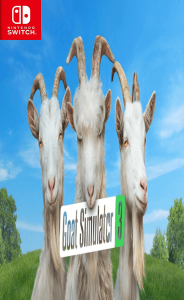
Goat Simulator 3 Switch NSP arrived on Nintendo Switch on August 27, 2024, bringing Pilgor’s deliberately unruly sandbox to the system. Published and developed by Coffee Stain, it is classified as an Action, Adventure, and Simulation game, a combination that suits its open-ended approach: players are given an island, a goat, and plenty of opportunities to see what happens when normal rules are treated as suggestions.
Goat Simulator 3 on Nintendo Switch: Release Details and Game Profile
The Nintendo Switch release places Goat Simulator 3 Switch in the Europe and USA regions, with Coffee Stain handling both publishing and development. Its August 27, 2024 release date marks the arrival of a game built less around a traditional campaign structure than a freeform series of disruptions, discoveries, and strange detours.
The Action, Adventure, and Simulation labels describe different sides of the experience. Action comes through Pilgor’s direct interactions with the world, from charging into targets to sending objects flying. Adventure is found in the search for odd locations, collectibles, and unusual events across the island. The simulation element is intentionally comic rather than realistic, with physics-driven reactions helping turn small actions into outsized scenes.
That combination gives the game a playful atmosphere. San Angora is not presented as a place that needs to be saved by a hero. Instead, it is a satirical open world made to absorb a player’s curiosity, impulse, and appetite for nonsense. Pilgor is the central source of trouble, but the player decides where that trouble goes next.
A Sandbox Story Built Through Player Experiments
The Goat Simulator 3 story does not follow a conventional sequence of heroic objectives or dramatic rivalries. Pilgor’s role is more immediate: enter San Angora, interact with whatever seems interesting, and allow the results to shape the session. A strange encounter can become a diversion, a hidden area can send exploration in another direction, and an ordinary object can become part of a much bigger accident.
This non-linear gameplay makes progression feel personal. Some players may focus on challenges and collectibles, while others may spend their time chasing bizarre events, investigating secluded corners of the island, or testing how NPCs and loose objects react to a headbutt. The game’s sense of narrative comes from these player-made episodes rather than a fixed plot.
Its emergent gameplay is central to that appeal. A single action can trigger a physical reaction that changes the scene around Pilgor, encouraging another experiment immediately afterward. The result is a game that rewards curiosity more than efficiency. San Angora works as a setting for repeated detours, where the unexpected consequence is often more entertaining than the intended task.
- Follow curiosity: Hidden areas, unusual characters, and strange events can pull exploration away from any planned route.
- Use the environment: Objects and NPCs are not merely background details; they can become part of a larger chain reaction.
- Try unlikely moves: The game encourages experimentation, including ideas that would make little sense in a more serious adventure.
- Change Pilgor’s tools: Mutations and gear expand the range of possible interactions and invite fresh approaches.
- Return to old places: A location can feel different when approached with another ability, another object, or a different plan for chaos.
Headbutting, Licking, and Parkour: Pilgor’s Core Actions
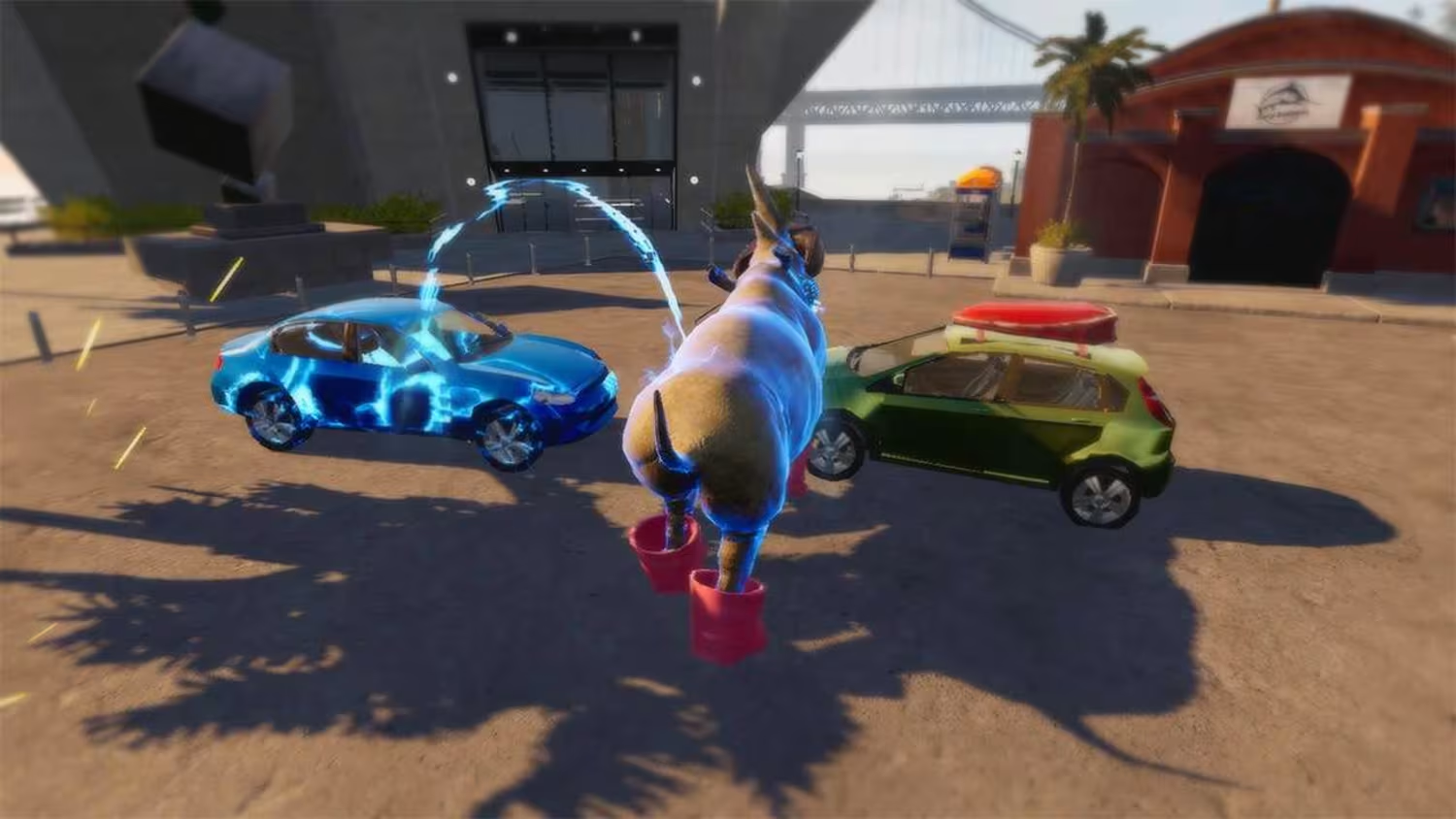
Goat Simulator 3 gameplay is built around a simple but flexible set of actions. Pilgor can headbutt people and objects, creating immediate disruption and often setting physics-based consequences in motion. The act is blunt, fast, and suited to a game that treats everyday surroundings as potential props.
Then there is the goat tongue. Pilgor’s long tongue can attach to objects or people, turning them into extensions of the player’s movement and mischief. It is a deliberately absurd mechanic, useful not only for causing disorder but also for seeing how far an object can be dragged, pulled, or carried into an already unstable situation.
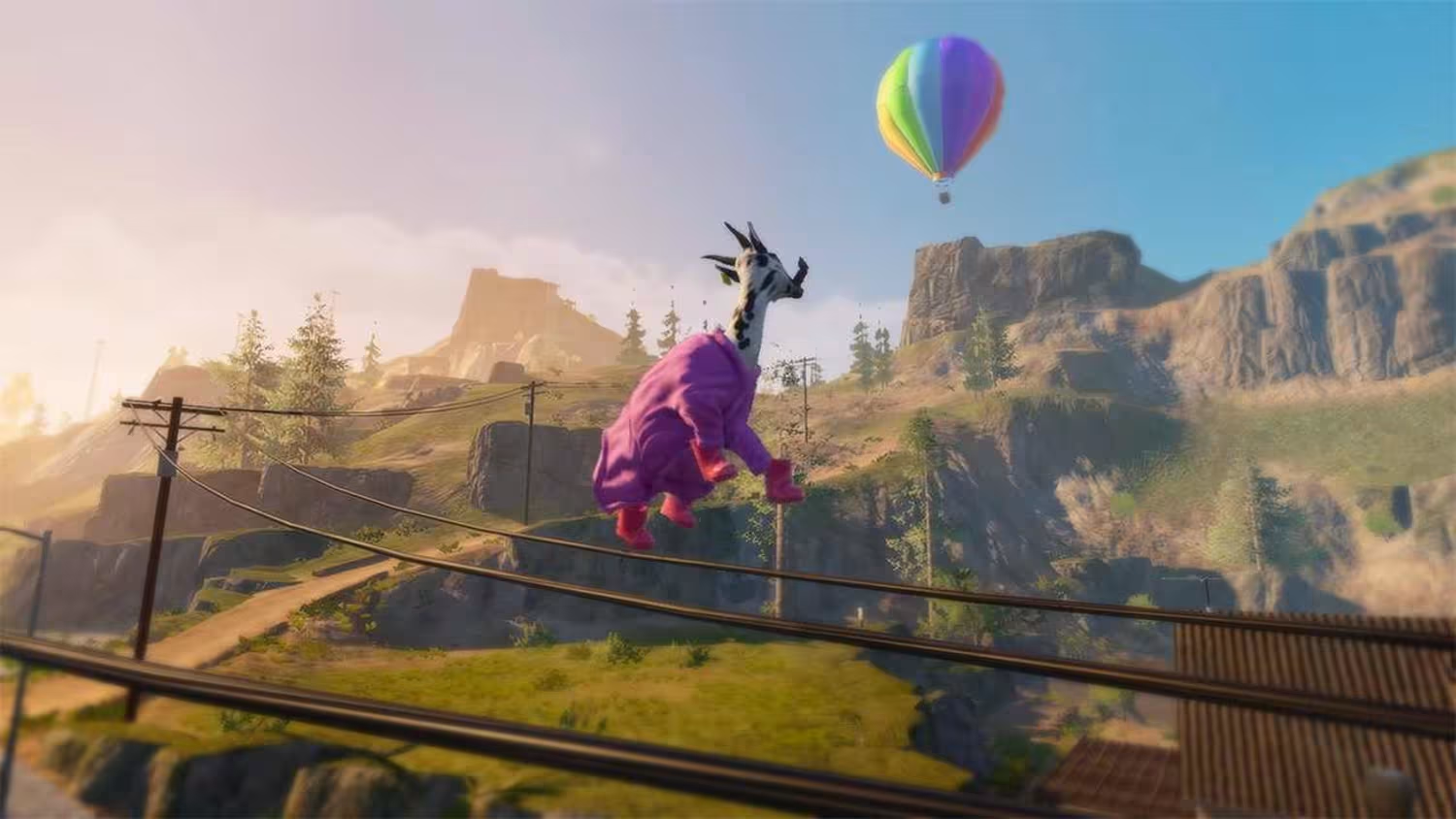
Jumping, climbing, and parkour add another layer to exploration. Buildings and structures are not simply scenery when Pilgor can use them as routes upward or across the island. Movement becomes part of the joke as well as part of the adventure: an ambitious leap can lead to a new discovery, an odd viewpoint, or a tumble into an unexpected chain reaction.
The physics-driven design ties these actions together. Headbutting may send an object into something else; a tongue attachment may turn a nearby person into an unwilling participant; a jump into a crowded space may create a scene that could not have been planned exactly. The game is designed to let that instability be entertaining rather than inconvenient.
Exploring San Angora’s Absurd Open World
San Angora is the game’s broad satirical playground, an island meant to be explored at the player’s own pace. Its appeal lies in the freedom to roam without needing to follow a strict route. One moment can be spent looking for collectibles, the next interacting with an NPC, and the next climbing toward a location that simply looks worth investigating.
San Angora exploration benefits from the game’s interest in unusual details. Quirky characters, bizarre activities, hidden spaces, and nonsensical quests give players reasons to keep moving through the world. The island supports a loose rhythm of discovery: notice something odd, approach it, interfere with it, then see where the consequences lead.
Collectibles also give the sandbox a sense of direction without making it rigid. Players who want a clearer purpose can seek them out, while those more interested in spontaneous destruction can treat them as occasional rewards found during wandering. This balance helps the sandbox adventure remain open without feeling empty.
The replay value comes from possibility rather than a single prescribed outcome. Different routes through San Angora, different interactions, and different uses of Pilgor’s abilities can produce new moments across repeated sessions. It is especially suited to players who enjoy playful exploration, offbeat humor, and games that make room for self-directed experimentation.
Mutations, Gear, and Ridiculous Goat Abilities
Mutations and gear broaden Pilgor’s already unusual toolkit. By discovering and equipping them, players gain new humorous ways to engage with San Angora and alter how the goat approaches its challenges, locations, and objects. These additions fit the game’s larger interest in escalation: the world is strange from the start, and Pilgor can become stranger still.
Goat Simulator 3 mutations and gear are not presented as solemn upgrades for a conventional power fantasy. Their purpose is to create more possibilities for comic interaction. A new ability can encourage a player to revisit a familiar area, test another approach to a challenge, or simply invent a different kind of disturbance.
That makes customization part of the game’s progression. Instead of narrowing the player toward one efficient style, new goat abilities support more experimentation. The best use of an item may be practical, ridiculous, or both, which is in keeping with a game where disruption is often its own reward.
Language and Region Information for the Switch Release
The Nintendo Switch release is listed for the Europe and USA regions. Its language selection includes English, French, German, Italian, Japanese, Korean, Portuguese, Russian, Simplified Chinese, Spanish, and Traditional Chinese.
For players looking at Goat Simulator 3 Switch NSP as a portable version of Pilgor’s San Angora adventure, the key detail is its broad language support alongside the familiar focus on open-world exploration, collectibles, unusual gear, and freely created chaos. The game’s humor is rooted in actions and reactions as much as dialogue, making its physical comedy central to the experience.