Gal*Gun Double Peace Switch NSP

Report Link Error
Select the broken download file, then submit the report.
Screenshots
About Game
Gal*Gun Double Peace Switch NSP is a Nintendo Switch release of the school-set arcade shooter published by PQube in the USA region on March 17, 2022. Its unusual setup combines rapid aiming action, branching romance choices, and a deliberately chaotic one-day story built around Hodai Shirona’s sudden popularity.
Gal*Gun Double Peace on Nintendo Switch: Release and Game Details
Released on March 17, 2022, Gal*Gun Double Peace is listed for Nintendo Switch as an Arcade and Shooter title from PQube. The USA-region release supports English, Japanese, Korean, and Chinese. Its Title ID is 01006FE016FB2000, and the listed firmware requirement is 13.0.0.
The game frames its action as an on-rails shooter, so movement through each area is handled by the stage while the player’s attention stays on aiming, timing, and incoming threats. That structure gives the game a brisk arcade rhythm: situations develop quickly, groups approach from different directions, and a run can reward sharper reactions and better target choices.
The school setting supplies the game’s atmosphere, moving the action through familiar locations while preserving the heightened, comic premise. Rather than presenting a conventional military or science-fiction shooting scenario, this Nintendo Switch shooter makes its central challenge a frantic attempt to manage unwanted affection while pursuing a personal romantic outcome.
Hodai Shirona’s One-Day Search for True Love
Hodai Shirona begins as an ordinary high school student, but his day is upended by Ekoro, a cupid angel who shoots him with a pheromone arrow. The result is immediate: the girls at school become infatuated with him. The effect is temporary, however, lasting only a single day.
That deadline gives the Gal*Gun Double Peace story its urgency. Hodai has to find his true love before the day ends or face being alone forever. Along the way, he must deal with repeated advances from the girls affected by the arrow while working toward a confession. The story centers on two main heroines, Shinobu and Maya, and Hodai’s dialogue decisions help shape his relationships and eventual route.
Ekoro’s mistake is not simply a premise for the action; it also explains why every stage is so busy. Hodai is trying to move forward through a school full of love-struck pursuers, creating a comic contrast between the romantic stakes and the pressure of an arcade-style challenge. The setup supports multiple paths and endings rather than one fixed resolution.
How the On-Rails Pheromone Shot Gameplay Works
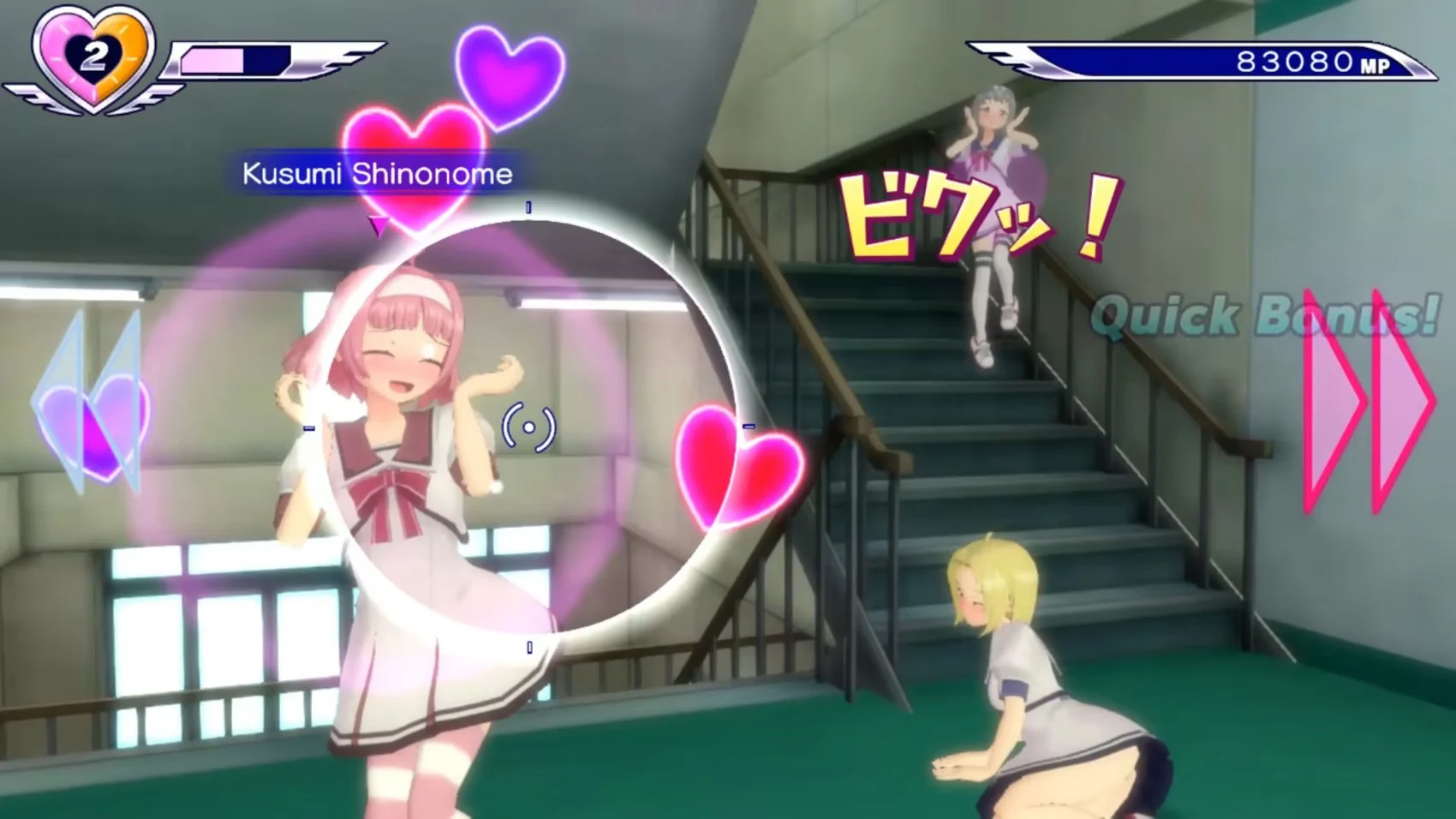
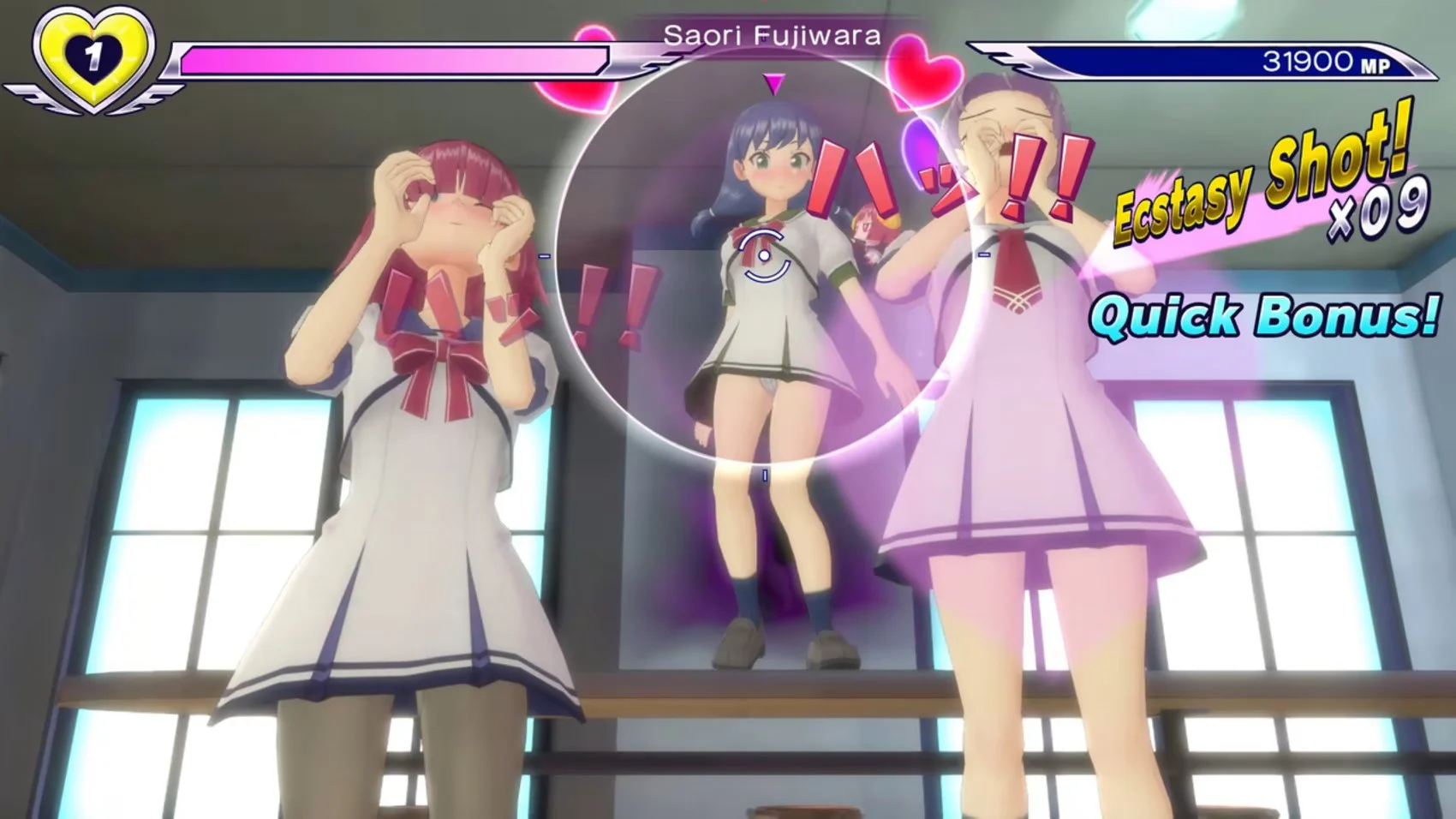
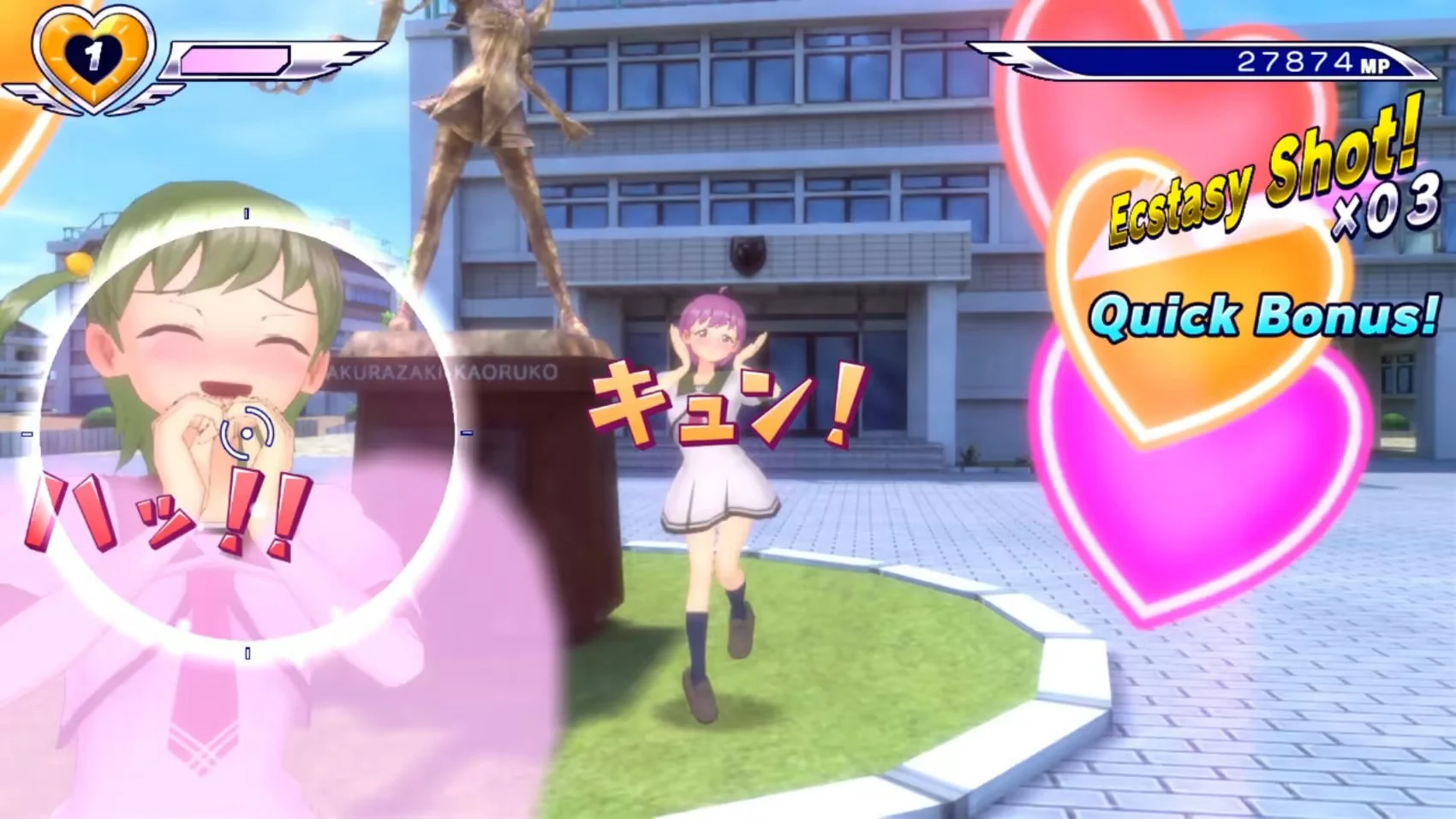
The shooting system puts players in control of Hodai’s aiming reticle as the game carries him through each route. Groups of girls advance toward him, and the basic response is to use Pheromone Shots to stop their approach. The goal is not merely to fire quickly. Stronger results come from locating an opponent’s weak point, called an Ecstasy Spot.
Hitting an Ecstasy Spot produces an Ecstasy Shot, rendering that girl harmless and helping maintain momentum. This creates a small but important layer of decision-making within the fast pace. A player can react broadly to a crowd, but better runs depend on reading who is closest, who is harder to handle, and where to aim for maximum effect.
Special options add further pressure and payoff. Doki-Doki Mode focuses attention on a single girl and fills her Doki-Doki Gauge. Doki-Doki Attacks can then clear screens of girls and earn points. Different girls bring their own patterns and defenses, so the action asks for observation as well as reflexes. Gal*Gun Double Peace Switch NSP uses those systems to make the score chase and the narrative routes feel connected: the same school day can play out differently depending on choices and performance.
A Stage Tour of the School-Based Action
The game’s stages move through school environments including classrooms and the school gym. These spaces provide changing backdrops for the on-rails format while keeping the focus on the action in front of the reticle. A classroom can turn into a tight sequence of approaching targets; the gym offers another setting for the same quick-response structure.
Because stage movement is guided, the player does not need to navigate the school manually. Instead, the route determines the flow through each location, and the challenge lies in keeping up with attacks, identifying targets, and making shots count. That design is suited to short, repeatable sessions as well as longer attempts to improve a route.
The school is also more than scenery. It gives the story a consistent place for Hodai’s encounters, dialogue choices, and relationship developments. As routes change, the game can present different scenarios and conversations without abandoning its central setting.
5 Practical Tips for Better Runs
- Handle immediate threats first. When several girls approach, prioritize the ones most likely to interrupt your momentum. Fast reactions matter, but sensible target order can prevent a crowd from becoming unmanageable.
- Study recurring patterns. Different girls have distinct behaviors and defenses. Replaying a section makes those patterns easier to recognize, helping you prepare your aim instead of responding at the last second.
- Find Ecstasy Spots quickly. An Ecstasy Shot is more effective than unfocused firing. Practice identifying weak points promptly so encounters are resolved efficiently and scoring opportunities are not lost.
- Save special options for pressure. Doki-Doki Mode and Doki-Doki Attacks are valuable when a single target needs focused attention or a crowded screen needs to be cleared. Using them with purpose is more useful than triggering them without a plan.
- Replay routes with a goal. A repeat run can be used to improve a score, learn a difficult sequence, pursue another dialogue path, or work toward additional unlocks. Small improvements add up across a route.
Replay Value Through Routes, Galleries, Costumes, and Achievements
Replay value comes from both the story structure and the arcade systems. Hodai’s choices can lead toward alternate relationship paths, and the game includes multiple endings. Each route can offer unique dialogue and scenarios, giving a reason to revisit the school day from a different direction.
There is also progression beyond the ending itself. Players can unlock gallery items, costumes, and achievements as they advance. Those rewards sit naturally beside score improvement, since learning enemy patterns and refining the use of Pheromone Shots can make later attempts more effective.
For players looking for a light, unusual shooter with a school-romance premise, the appeal lies in that combination of quick aiming, route-based storytelling, and repeatable challenges. It is best approached as a stylized arcade experience: one where sharp shots, better decisions, and curiosity about alternate outcomes all encourage another run.