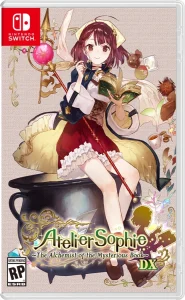
Atelier Sophie: The Alchemist of the Mysterious Book DX SWITCH NSP
Report Link Error
Select the broken download file, then submit the report.
Screenshots

About Game
Atelier Sophie: The Alchemist of the Mysterious Book DX SWITCH NSP is a role-playing adventure built around curiosity rather than conquest. Its appeal comes from the meeting of a young alchemist still learning her craft and a mysterious book with no memory of its former life. Gathering materials, testing recipes, helping townspeople, and exploring new places all feed into a story with a gentle sense of forward motion.
Sophie and Plachta: The Mystery at the Heart of the Adventure
Sophie Neuenmuller begins her journey in Kirchen Bell, where she practices alchemy with enthusiasm but without a mentor to guide her. Mistakes are part of her early work, giving her room to develop as she learns through trial, observation, and repeated experimentation. That starting point matters: Sophie's progress is not presented as effortless mastery, but as an ongoing effort to become more capable.
Her life changes when she discovers Plachta, a sentient book carrying forgotten alchemical knowledge. Plachta has lost her memories, and the mystery of who she was becomes inseparable from Sophie's own future. The two work together as Sophie fills the book's blank pages with recipes and experiences, gradually moving toward the restoration of Plachta's memories and human form.
The premise gives the adventure a personal center. The larger search for knowledge is important, but it is grounded in the relationship between Sophie and Plachta. Their growing trust turns each new recipe, location, and discovery into another small step toward understanding the past.
Alchemy as a Puzzle: Understanding Grid-Based Synthesis
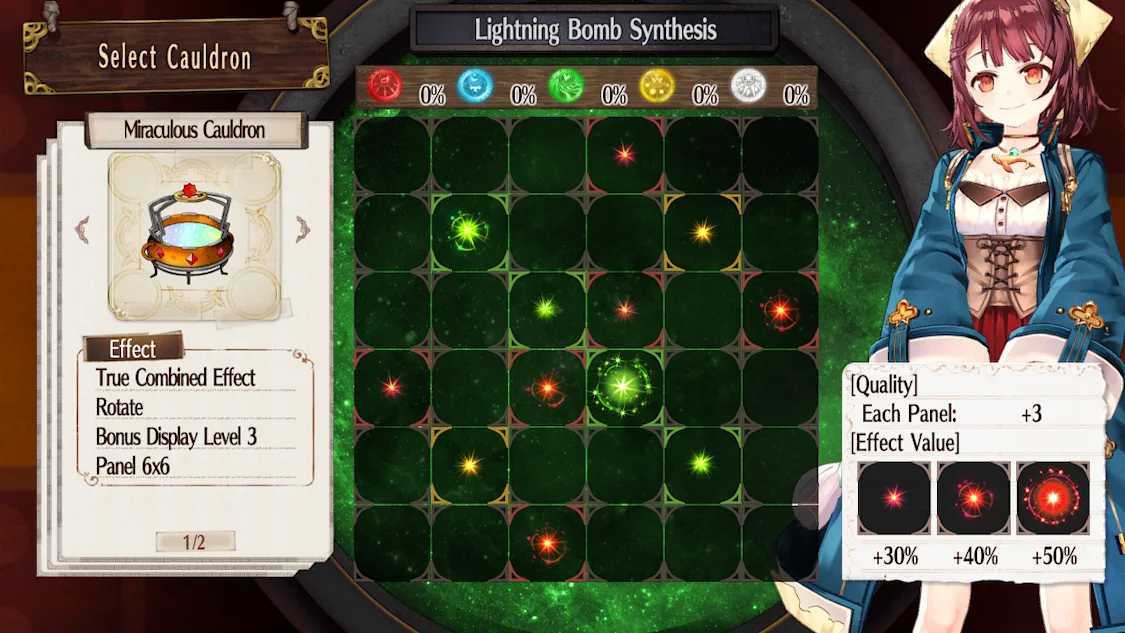
The alchemy system is the main engine of progression. Ingredients are not simply selected and combined; they are arranged through grid-based synthesis, where placement can affect an item's properties and quality. That structure makes crafting feel closer to solving a puzzle than checking off a recipe list.
Ingredient placement encourages players to pay attention to the materials they collect and to revisit familiar formulas with different approaches. A layout that suits one goal may not suit another, especially when the aim is to improve an item's result. Experimentation is therefore more than a side activity. It is how Sophie develops access to stronger creations and gains a clearer understanding of what each ingredient can contribute.
This design also connects exploration to crafting in a practical way. Diverse environments contain resources needed for more advanced recipes, so roaming beyond town is not merely scenic. New materials can open fresh synthesis possibilities, while landmarks and discoveries help broaden the scope of Sophie's alchemical work. The process supports a relaxed rhythm: gather, test, refine, and then return with a better idea of what to try next.
Turn-Based Battles and the Value of Crafted Items
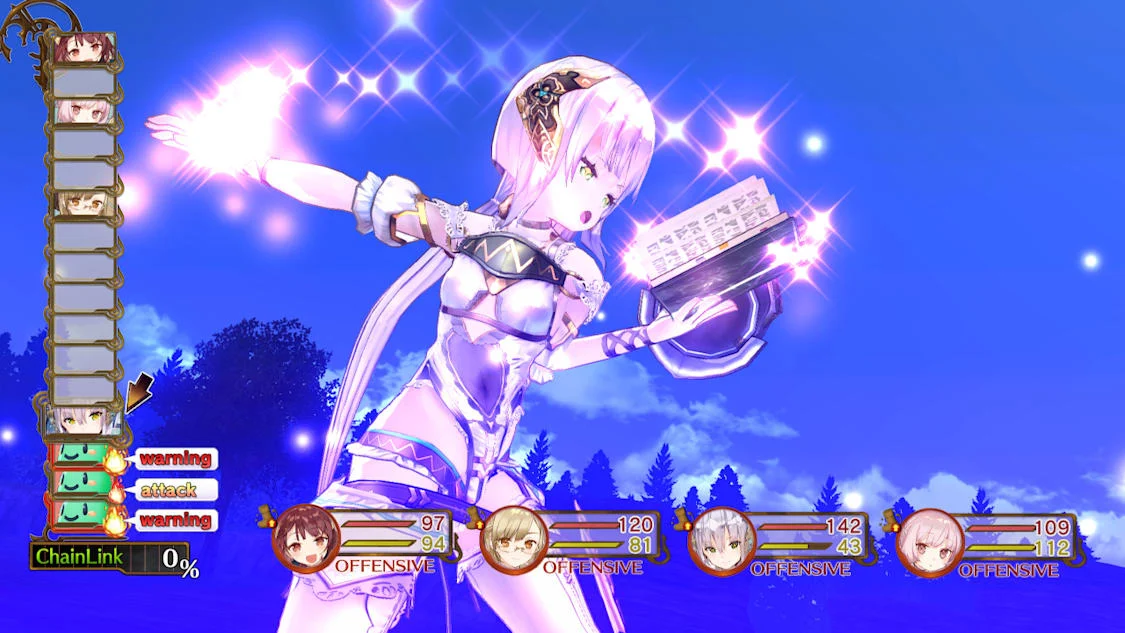
Combat uses a turn-based combat structure with a party of characters. Party skills and item use give battles a strategic link to the work done at the workshop. Crafted items are not isolated from the rest of the game; successful synthesis can improve preparation for encounters with creatures found during exploration.
That connection gives alchemy a useful purpose beyond recipe completion. Players can prepare items before heading into new areas, then put those results to work when facing stronger enemies. Equipment can also be developed through alchemy, allowing the party's abilities and readiness to grow alongside Sophie's knowledge.
The result is a progression loop with clear relationships between its parts. Resources support synthesis, synthesis supports equipment and battle items, and exploration provides both materials and challenges. Rather than treating combat and crafting as separate systems, the game asks players to consider how their workshop decisions affect the journey outside it.
Friendship, Growth, and the Search for Forgotten Knowledge
The story's focus on friendship and character growth keeps its alchemical mystery from becoming purely mechanical. Sophie meets friends and rivals with their own stories, while side quests and character events offer opportunities to deepen relationships with party members and other people she encounters.
Plachta's lost past gives the search for forgotten knowledge an emotional dimension. Recipes are valuable because of what they allow Sophie to make, but they also help fill the pages connected to Plachta's identity. As Sophie becomes a more confident alchemist, her partnership with Plachta becomes stronger, linking personal development to the wider mystery.
The atmosphere is supported by vibrant towns, wilderness areas, and a cast whose interactions provide context for Sophie's work. It is a suitable fit for players who enjoy role-playing games where discovery, crafting, and character relationships receive as much attention as combat preparation.
The DX Edition on Nintendo Switch: Key Release Details
Atelier Sophie: The Alchemist of the Mysterious Book DX SWITCH NSP refers to the DX edition released for Nintendo Switch on April 22, 2021. It is a role-playing game published and developed by Koei Tecmo, with English language support in the listed USA region metadata.
The DX presentation is described as offering additional content and refined visuals for Sophie's adventure. For players looking at the Nintendo Switch release specifically, the essential reference points are its 2021 date, Koei Tecmo credit, English support, and role-playing genre.
7 Practical Priorities for a Stronger Alchemy Journey
- Gather broadly. Collect materials whenever new environments become available, since resources are essential for expanding synthesis options.
- Test the grid. Try different ingredient layouts rather than relying on a single arrangement; placement can influence item properties and quality.
- Take requests. Requests from townsfolk can provide money, reputation, and access to new recipes.
- Explore with purpose. Search towns and wilderness areas for ingredients, landmarks, secrets, and enemies that support further progress.
- Bring crafted items. Use synthesized items as part of battle preparation, alongside party skills in turn-based encounters.
- Build better equipment. Develop equipment through alchemy to enhance the party's abilities as challenges increase.
- Watch for recipes. New recipes can come from discovering ingredients, observing daily life, and completing requests, so advancement is tied to attention as well as combat.