Agatha Knife Switch NSP
Report Link Error
Select the broken download file, then submit the report.
Screenshots
About Game
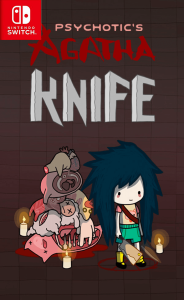
Agatha Knife Switch NSP is a darkly comic Adventure/Puzzle game from Mango Protocol, released for Nintendo Switch on April 26, 2018. Available in Europe and the USA, it follows a child protagonist whose innocent logic collides with weighty questions about animals, faith, family, and survival.
Agatha Knife at a Glance: Switch Release Details
Mango Protocol developed and published Agatha Knife Switch, placing the game firmly in the tradition of narrative-led point-and-click adventures. Its Adventure and Puzzle classification fits a structure built around exploring locations, handling objects, speaking with local residents, and working through unusual problems.
The game’s setting and subject matter give it a distinctive tone. Rather than treating its central premise with realism, it uses exaggerated personalities, strange rituals, and dark humor to frame Agatha’s view of the world. The result is an adventure shaped by a child’s direct, sometimes unsettling interpretation of adult problems.
Released on April 26, 2018, the Switch version brought Mango Protocol’s peculiar town and hand-drawn presentation to players in the Europe and USA regions. Its compact adventure format is centered on story progression, conversations, object-based puzzles, and the gradual discovery of the town’s people and secrets.
A Darkly Comic Story About Agatha and Carnivorism
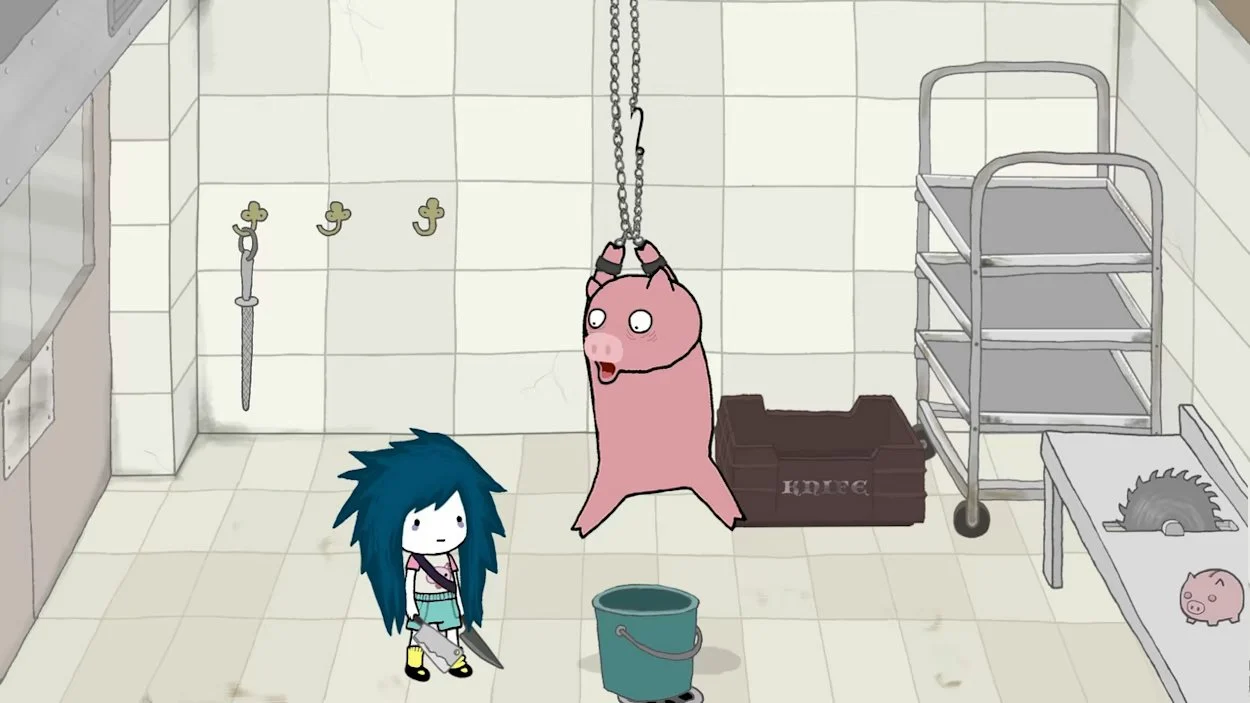
The Agatha Knife story begins with seven-year-old Agatha, a girl who loves meat and lives alongside the difficulties of her mother’s struggling butcher shop. Agatha’s answer to the problem is not a conventional business plan. She decides to create a religion called Carnivorism, hoping it can give meaning to the shop’s work and encourage people to support it.
That idea creates the game’s central tension. Agatha must deal with sacrifices connected to the religion while confronting the fact that she has formed attachments to animals. The contradiction gives the story its uneasy comic edge: her beliefs, friendships, and practical goals do not sit comfortably together.
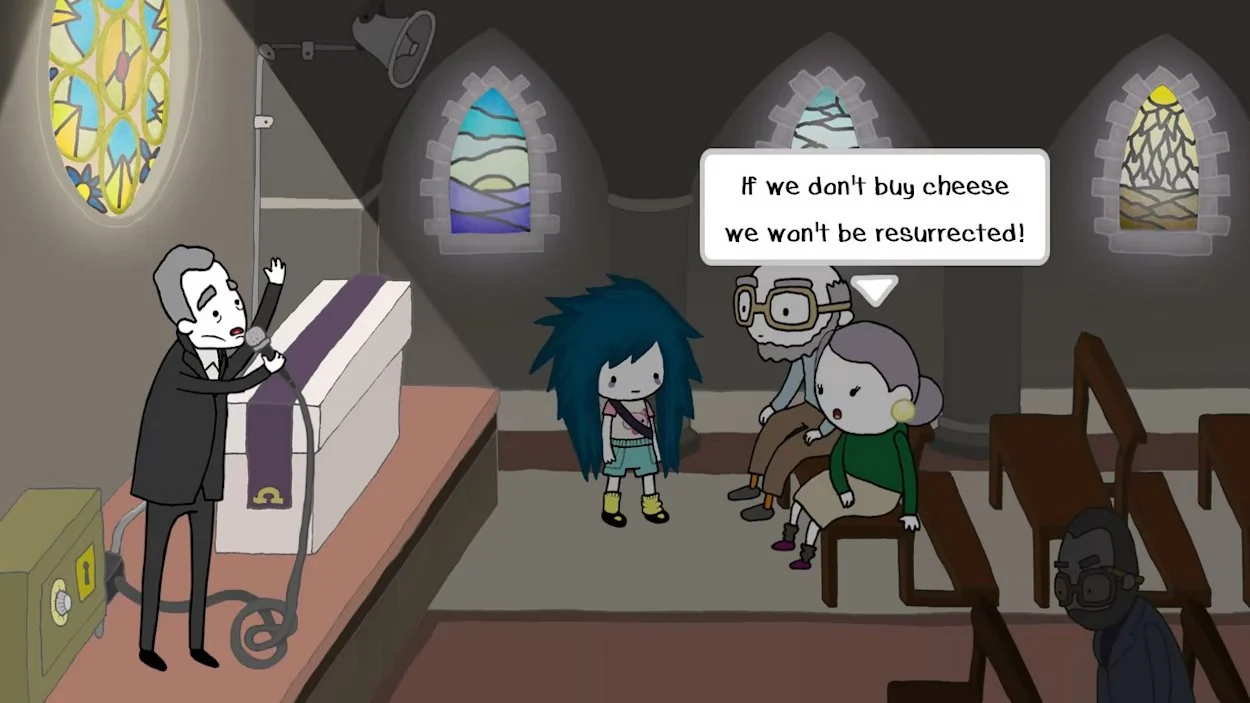
This is a dark humor adventure, but its humor serves the story rather than softening every uncomfortable moment. Agatha’s perspective lets the game explore life, death, friendship, belief, and belonging through dialogue that can be playful, philosophical, and deliberately awkward. Her journey through town also introduces a wider cast of odd figures, each contributing to the satire around her growing religion.
Point-and-Click Exploration in a Whimsical Town
Agatha Knife gameplay uses classic point-and-click adventure principles. Players investigate environments, inspect notable details, interact with objects, gather useful items, and return to characters when new information or tools change what can be done. Progress depends less on reflexes than on patience, observation, and a willingness to test unusual ideas.
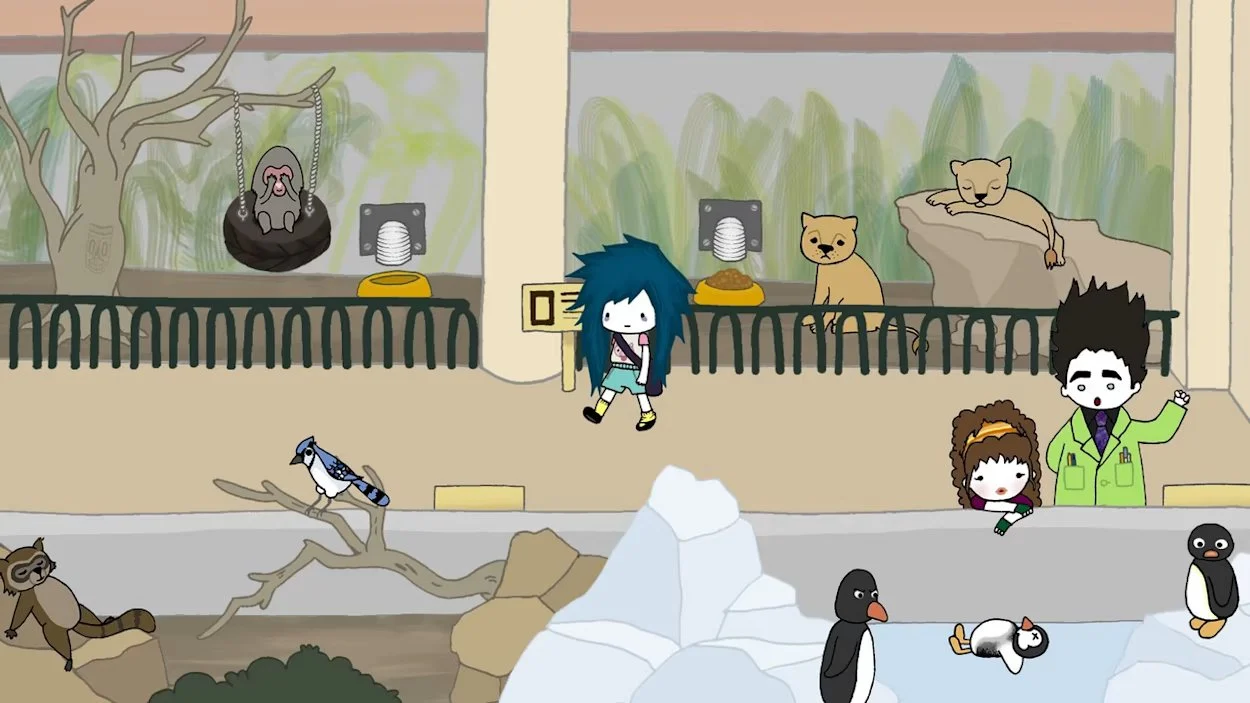
The town is presented as a darkly whimsical place, with hand-drawn environments that support the game’s eccentric tone. Exploration is not simply a route between story scenes. Locations contain clues, objects, and conversations that help explain what Agatha needs next, while the people she meets can open new paths or provide context for a puzzle.
Some activities extend beyond straightforward exploration. The game includes elements tied to operating the butcher shop and taking part in Carnivorism rituals. These moments add variety to the main adventure and keep Agatha’s personal mission connected to the day-to-day pressures facing her family.
As in many point and click adventure games, an item may appear unimportant until a later conversation reframes its purpose. A careful look at the environment can be as useful as a newly collected object. That design encourages players to revisit areas and reconsider earlier details rather than expecting every solution to be immediately obvious.
Puzzles, Dialogue, and Eccentric Characters
Agatha Knife puzzles are closely tied to the story’s strange logic. They ask players to notice environmental details, collect and apply items, and consider how the town’s unusual residents might respond to Agatha’s requests. Creative thinking matters because the game’s situations are rarely ordinary, and its solutions are informed by its comic, offbeat world.
Dialogue is equally important to progression. Extended conversations reveal practical clues, but they also build the game’s lore and establish the personalities of its eccentric characters. The writing uses those exchanges to show how Agatha interprets the people around her, often highlighting the gap between her youthful certainty and the complicated implications of her choices.
The story’s satire emerges through these encounters. Characters are not merely puzzle dispensers; their reactions help define the town’s odd social rules and the reception of Carnivorism. Listening closely can uncover information that moves the plot forward, while also making room for the game’s darker jokes and philosophical undertones.
Moral questions are part of Agatha’s journey, particularly where her affection for animals intersects with her religious project. The game frames these questions through her developing understanding of friendship and responsibility, giving the adventure more weight than its colorful, whimsical presentation might initially suggest.
5 Practical Tips for Exploring Agatha Knife
- Search each location carefully. Examine the environment before moving on, since objects and visual details can support later puzzle solutions.
- Revisit conversations. Dialogue can contain direct hints, character context, or new information that changes what Agatha can do next.
- Inspect collected items. An object may have a purpose that is not clear when it is first found, especially in a world built around unusual situations.
- Think beyond the obvious. Puzzle exploration rewards creative connections between items, locations, rituals, and the people Agatha meets.
- Remember character details. The town’s residents often reveal their interests, concerns, and personalities through conversation, and that information can guide the next step.
Language and Regional Availability on Nintendo Switch
This Nintendo Switch adventure game is listed for the Europe and USA regions. Its language options are English, French, German, Italian, Korean, Russian, and Spanish, giving players several ways to follow Agatha’s dialogue-heavy story.
The available language selection matters in a game where conversations carry both puzzle guidance and much of the humor. From the troubled butcher shop to the rituals of Carnivorism, the experience depends on the details in Agatha’s exchanges with the town’s unusual inhabitants. Players looking for a narrative puzzle game with hand-drawn style, pointed satire, and an intentionally uncomfortable comic premise will find a focused adventure built around those elements.
Recommended Similar Games
 Teppo and The Secret Ancient City Switch NSPView Game
 Grounded Switch NSPView Game
 Snipperclips Plus – Cut it out, together! Switch NSPView Game
 Coffee Talk Episode 2: Hibiscus & Butterfly Switch NSP XCIView Game
 UFO Robot Grendizer – The Feast of the Wolves Switch NSPView Game
 Pokémon Scarlet Switch NSP XCIView Game
