The Caligula Effect: Overdose Switch NSP

Report Link Error
Select the broken download file, then submit the report.
Screenshots


About Game
The Caligula Effect: Overdose Switch NSP places a role-playing story inside a carefully constructed escape: a virtual high school life with no apparent sorrow, no pressure to move forward, and no reason to leave. Yet its appeal comes from the unease beneath that promise. Mobius is designed as a refuge, but the game steadily asks what is lost when a comforting illusion replaces an imperfect reality.
Mobius: The Virtual World at the Center of The Caligula Effect: Overdose
Mobius is a virtual world created by the sentient vocaloid μ, offering its residents the chance to relive an idealized version of their high school years. In this digital space, pain can be set aside and daily life can continue in a form of eternal happiness. The premise gives the psychological JRPG its distinctive atmosphere: bright school-life routines are present, but they exist alongside the growing suspicion that this perfection is not freely chosen.
The Caligula Effect: Overdose builds tension from that contrast. Mobius does not present itself as an obvious nightmare. Its comfort is precisely what makes it difficult to reject. For people carrying real-world problems, the opportunity to remain in a painless simulation has understandable appeal. The game’s central conflict is therefore not simply about defeating enemies or uncovering a secret. It is about deciding whether a pleasant falsehood is worth accepting when reality remains painful.
That framing gives the setting more weight than a standard virtual-world backdrop. Mobius is both a sanctuary and a form of confinement, shaped by the emotional needs of the people who inhabit it.
Why the Go-Home Club Wants to Escape
The protagonist and the students of the Go-Home Club come to recognize that Mobius is a prison, despite its inviting surface. Their response is not based on the belief that reality will be easy. Instead, they choose to pursue their true lives while knowing that doing so means facing the hardships and personal histories that led them toward Mobius in the first place.
This decision drives The Caligula Effect Overdose story. The Go-Home Club’s effort to escape from Mobius carries a sense of resistance against a world built to prevent doubt. Their goal is not merely to reach a new location; it is to reclaim the ability to confront life outside the simulation on their own terms.
The premise also gives the party’s journey emotional stakes. Each member has a reason to find the virtual world appealing, so leaving is never framed as a simple act of bravery without cost. The group’s shared objective creates forward momentum, while their individual burdens keep the story focused on personal consequences.
μ and the Ostinato Musicians’ Control Over Mobius
μ is responsible for creating Mobius, but the world’s continued stability is supported by the Ostinato Musicians, her loyal followers. They use powerful songs to brainwash and pacify residents, helping ensure that people do not question the reality around them. Music is therefore more than background texture in the narrative; it is tied directly to the control exerted over Mobius.
The Ostinato Musicians serve as the principal resistance to the Go-Home Club’s escape. Their role reinforces the game’s concern with persuasion, denial, and emotional vulnerability. If Mobius is sustained by the desire to avoid pain, the musicians help preserve that desire by making its residents less likely to challenge the system.
There is also a thematic connection between this control and the game’s dungeon material. Dungeons are themed around the emotional traumas of the Ostinato Musicians, linking conflict with the wounds and motivations behind the people defending Mobius. That approach keeps the narrative focused on interior struggles rather than treating opponents as obstacles without context.
A Psychological Story Built Around Hidden Trauma
The party members’ hidden trauma forms a major part of the psychological adventure. As the Go-Home Club progresses, the reasons each person was drawn into Mobius become increasingly important. Their pain shapes not only their character stories, but also their ties to the virtual world and their abilities within it.
This emphasis on emotional burdens gives the game’s relationships a practical and narrative purpose. Learning more about the club members deepens the context around their decisions, while the group’s connections support the broader effort to leave Mobius behind. The stakes remain personal even as the conflict expands into a struggle over the nature of the world itself.
The Causality Link system extends that social dimension beyond the central party. Players can build relationships with more than 500 NPCs, with those connections able to provide information, quests, and assistance in battle. It is a substantial progression layer for players interested in exploring the people around Mobius rather than moving only through the main conflict. The system also supports replay value through its large network of possible interactions.
Imaginary Chain: Planning Attacks Before They Happen
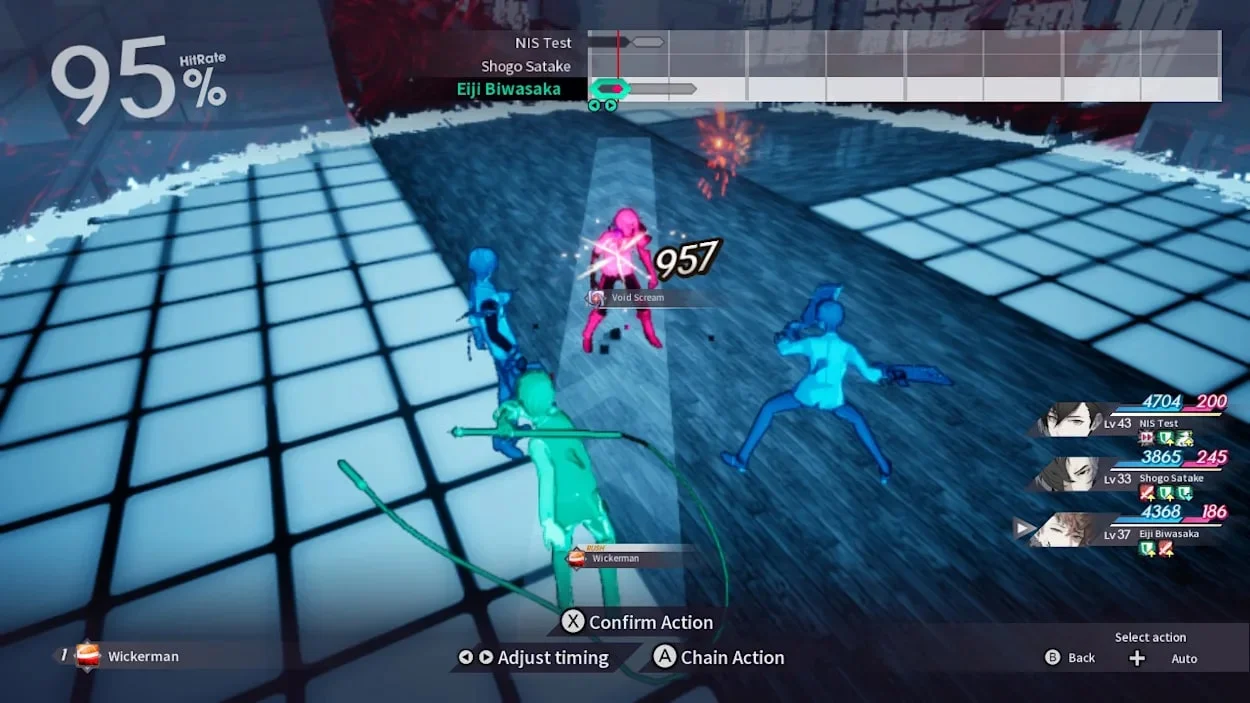
Combat in The Caligula Effect: Overdose Switch NSP uses a tactical turn-based structure centered on the Imaginary Chain system. This feature lets players visualize and predict likely enemy actions before committing to an attack sequence. Rather than acting without information, players can study anticipated outcomes and plan around timing, interruptions, counters, and combinations.
The result is a battle system that rewards foresight. An attack can be chosen for its damage, but also for its place in a larger chain: setting up a follow-up, countering an enemy threat, or creating an opening for another party member. Positioning and timing matter when attempting to exploit enemy weaknesses, making each encounter more concerned with coordination than isolated commands.
- Read the forecast: Use Imaginary Chain to examine likely enemy actions before arranging an attack sequence.
- Build a chain: Plan attacks that connect cleanly, rather than treating each character’s action as separate.
- Answer threats: Account for enemy moves and use counters when the projected exchange calls for them.
- Use the field: Consider positioning and timing when pursuing weaknesses or setting up combinations.
- Equip with purpose: Stigmas can enhance character statistics and provide special abilities in battle.
Building an Effective Party for Strategic Battles
Party composition is vital because each character brings unique skills to combat. A balanced group is better equipped to handle varied challenges, particularly when battles ask players to coordinate actions around weaknesses, movement, and the projected behavior shown through Imaginary Chain.
The most effective approach is not simply choosing individual strength. A useful party needs attacks that work together, members who can respond to threats at the right moment, and equipment choices that support the intended plan. Stigmas provide stat enhancements and special abilities, adding another layer to character preparation.
For players drawn to role-playing games with a strong psychological premise, tactical planning, and extensive social connections, the game offers a focused blend of narrative and systems. Published and developed by NIS America, this Nintendo Switch release arrived on March 12, 2019, with English, German, Spanish, French, Italian, and Russian language support across the USA, EUR, and Asia regions.
Recommended Similar Games
 My Time at Portia Switch NSPView Game
 Atelier Rorona ~The Alchemist of Arland~ DX Switch NSPView Game
 Shin Megami Tensei III NOCTURNE HD REMASTER Switch NSP XCIView Game
 DARK SOULS : REMASTERED Switch NSP XCIView Game
 Bakugan: Champions of Vestroia Switch NSP XCIView Game
 South Park: The Stick of Truth Switch NSPView Game
