Persona 4 Golden Switch NSP

Report Link Error
Select the broken download file, then submit the report.
Screenshots
About Game
Persona 4 Golden Switch NSP refers to the Nintendo Switch release of SEGA’s role-playing game, issued on January 19, 2023. Set against a rural backdrop and built around a supernatural investigation, it combines school-day routines, relationship-building, dungeon exploration, and strategic battles into a year-long mystery.
Persona 4 Golden on Nintendo Switch: Release and Game Details
The Switch edition arrived on January 19, 2023, with SEGA serving as both publisher and developer. It is available across Europe, the USA, Asia, and Japan, supporting English, French, German, Italian, Japanese, Korean, Chinese, and Spanish.
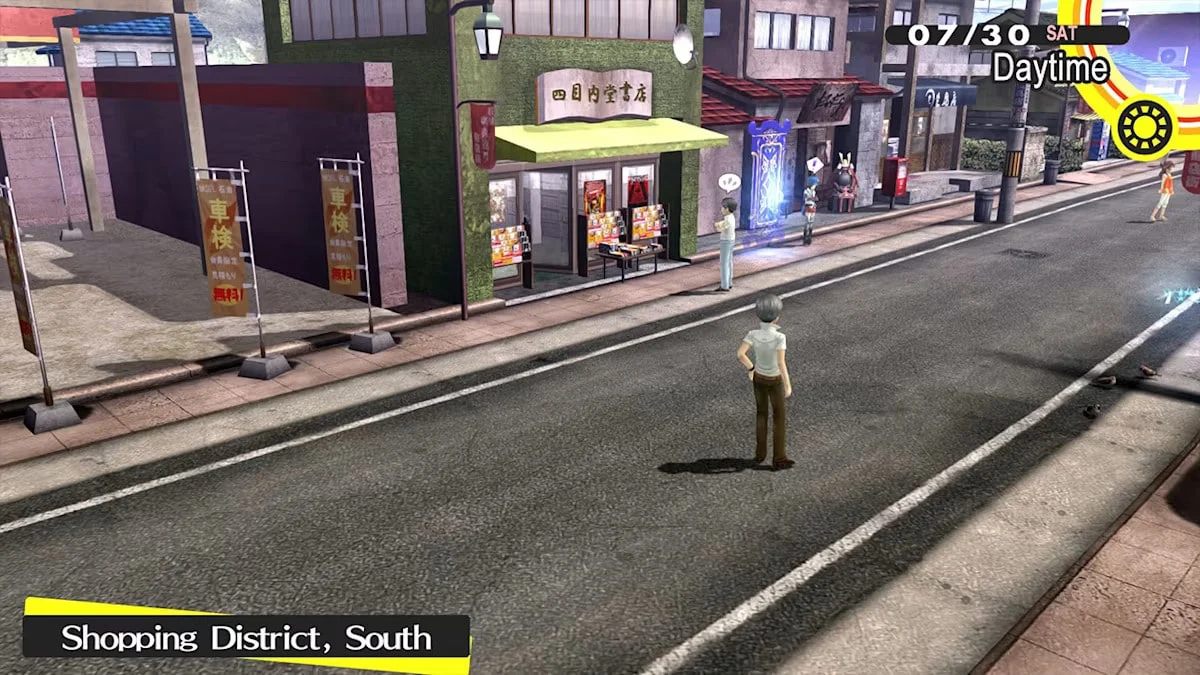
As a role-playing game, Persona 4 Golden moves between two distinct rhythms. One is rooted in ordinary life: attending classes, exploring Inaba, taking part in activities, developing social statistics, and spending time with classmates or townsfolk. The other is a dangerous supernatural investigation involving an alternate dimension connected to television screens.
That contrast gives the game much of its atmosphere. Inaba is presented as a quiet rural town, but its calm surface is unsettled by unexplained deaths, a recurring fog, and rumors that a strange TV world reflects reality. The player’s daily choices matter because time is divided across a calendar, making each day an opportunity for social activity, personal development, or preparation for the next trip into danger.
Inaba’s Murder Mystery and the TV World
The Persona 4 Golden story begins when its protagonist, Yu Narukami, comes to Inaba for a year-long stay. His arrival coincides with a series of baffling murders. As the town becomes increasingly uneasy, a connection emerges between the crimes, the spreading fog, and a persistent rumor about a world inside television screens.
Yu and his friends eventually enter this hidden dimension, where Shadow creatures roam and victims can become trapped. Their purpose is both urgent and investigative: rescue those in danger, understand the circumstances behind each case, and uncover the truth behind the murders before more people disappear.
The TV world is not merely a separate combat area. It is closely tied to the characters’ personal struggles. Confronting the darkness there involves confronting difficult inner truths, which take form through Personas. This makes the mystery feel personal as well as procedural. The group is not simply chasing clues; its members are also learning more about themselves and one another as the case develops.
Turn-Based Battles Built Around Enemy Weaknesses
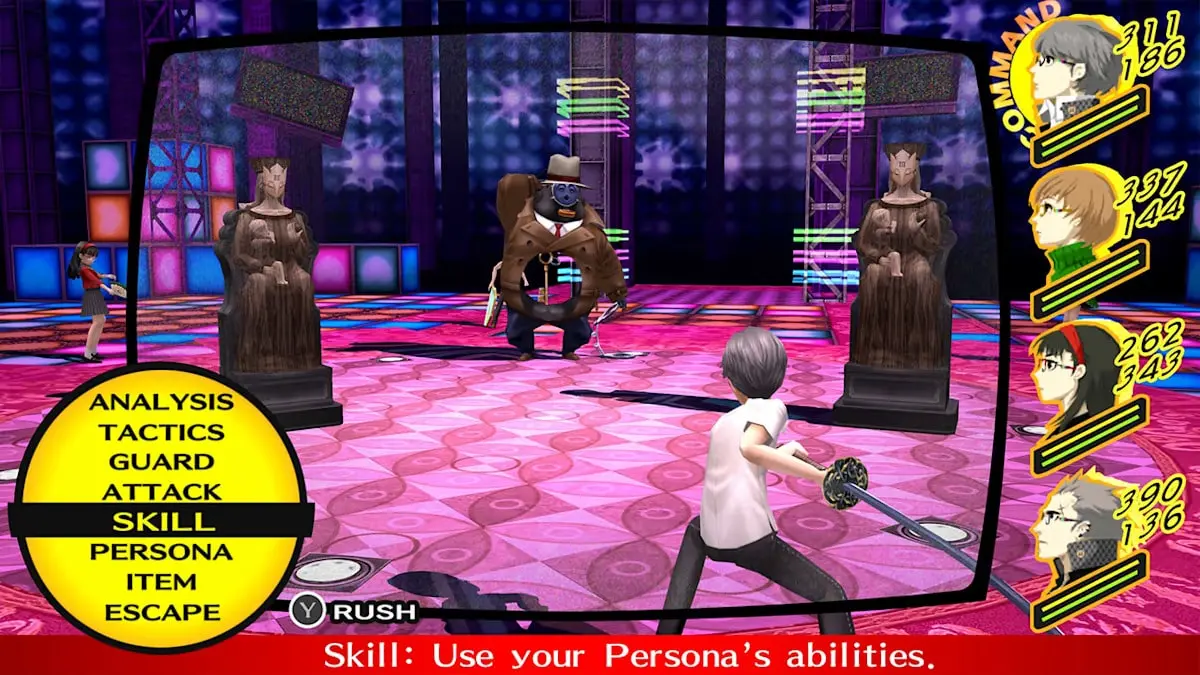
Persona 4 Golden combat uses turn-based battles against Shadows. Encounters ask players to consider elemental attacks, Persona skills, party abilities, and enemy behavior rather than relying on a single approach. A successful turn often starts with identifying an opponent’s weakness and selecting the right attack to exploit it.
That system gives party composition and Persona management real importance. Personas possess different abilities, and collecting, managing, and fusing them allows the player to shape a battle strategy around the challenges ahead. Party members contribute their own abilities as well, so an effective group can respond to a wider range of Shadow weaknesses.
- Read the enemy: Learning patterns and weaknesses helps create openings against Shadows.
- Use elemental options: Matching attacks to weaknesses can provide a major tactical advantage.
- Build a flexible Persona roster: Different Personas bring different skills to the party’s strategy.
- Consider the full team: Party abilities matter alongside the protagonist’s Persona choices.
- Prepare for bosses: Tougher encounters reward attention to skills, weaknesses, and party setup.
The appeal of these battles comes from the link between information and action. Discovering how a Shadow responds affects the next decision, while Persona skills and party tools create room to adjust. Boss fights build on that foundation, asking the player to use what has been learned through regular encounters.
How Social Links Strengthen the Journey
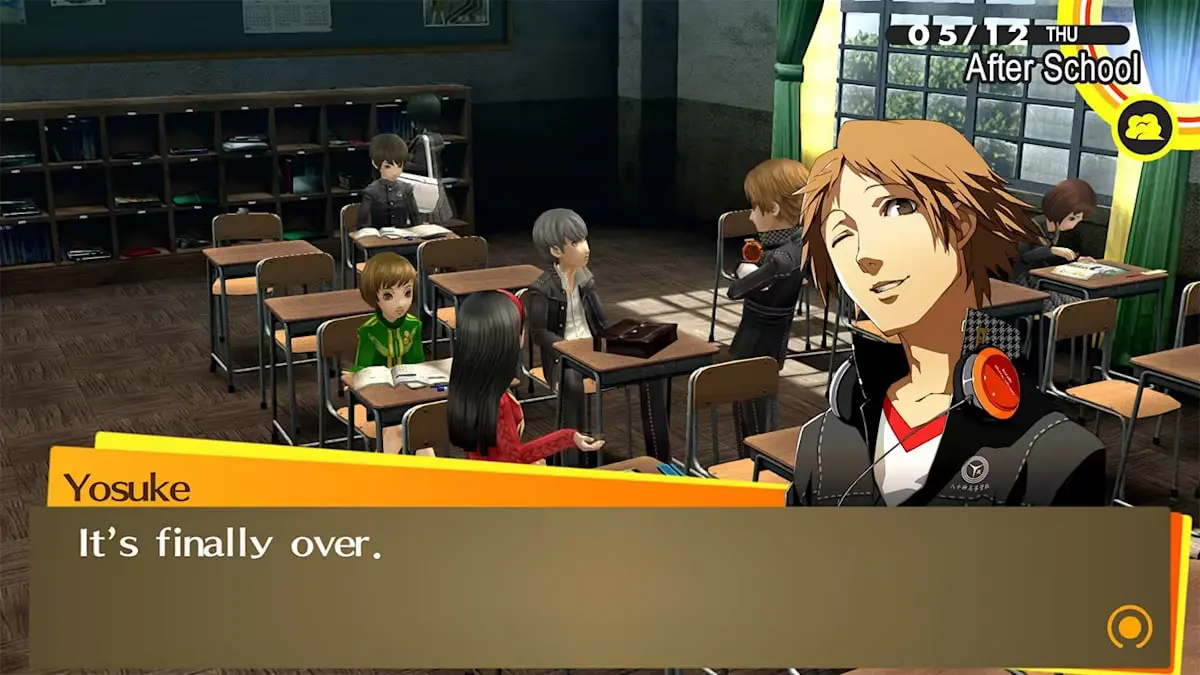
Social Links connect the game’s relationship systems to its larger progression. By spending time with classmates and townsfolk, the player opens story events and forms stronger bonds. These interactions give Inaba more weight than a simple hub between dungeons, since the town’s people are part of both the protagonist’s daily life and his growth.
Those bonds also enhance Personas and can unlock combat abilities. The result is a progression system in which social activity has practical value without being reduced to a checklist. Conversations and events can deepen character relationships while also contributing to future effectiveness in battle.
Time management is therefore central to the experience. School, clubs, part-time jobs, social activities, exploration, and dungeon crawling all compete for attention within the daily calendar. There is no need to treat Inaba’s ordinary routines as a pause from the main game; they are part of the structure that supports Persona growth and story development.
For players drawn to role-playing games that make relationships part of advancement, this combination is especially important. The mystery supplies momentum, but the social bonds give the investigation its human context.
Dungeon Exploration in the Hidden Dimension
The TV world dungeons provide the most direct route into the danger surrounding Inaba. These areas are procedurally generated and filled with Shadow encounters, puzzles, and bosses. Each trip carries narrative significance because dungeon exploration is tied to rescuing victims and moving the central investigation forward.
Procedural generation means exploration is not framed as a fixed sequence of identical rooms. Players must navigate changing layouts while managing combat resources and preparing for tougher challenges. Puzzles break up the battles, while boss encounters act as major barriers on the path toward resolving each stage of the mystery.
The dungeons also reinforce the game’s unusual atmosphere. Television imagery, rumors, fog, and the hidden dimension create a sense that Inaba’s everyday spaces are connected to something deeply unnatural. Moving between school life and these threatening interiors gives the journey a steady tension: the town remains familiar, but the case is never far away.
Nintendo Switch Edition Technical Profile
For the Nintendo Switch release, the Title ID is 010062B01525C000. The listed file size is 9GB, and the base firmware requirement is version 15.0.1. The release is associated with Europe, the USA, Asia, and Japan.
Persona 4 Golden Switch NSP is listed with support for English, French, German, Italian, Japanese, Korean, Chinese, and Spanish. Those language options accompany a Switch version of SEGA’s role-playing mystery, one that balances a rural town’s daily routines with strategic dungeon battles, Persona development, and a long-running search for the truth behind Inaba’s murders.
Recommended Similar Games
 Valkyria Chronicles Switch NSPView Game
 Legend of Mana Switch NSP XCIView Game
 Library Of Ruina Switch NSPView Game
 2weistein – The Curse of the Red Dragon 3 – Ronger Pirates – V2 Switch NSPView Game
 Pokémon Let’s Go Eevee Switch NSP XCIView Game
 void* tRrLM2(); // Void Terrarium 2 Switch NSP XCIView Game
