Tools Up! Ultimate Edition Switch NSP

Report Link Error
Select the broken download file, then submit the report.
Screenshots
About Game
Tools Up! Ultimate Edition Switch NSP frames home renovation as a fast-paced shared challenge rather than a careful solo project. Blending Action and Simulation elements, it sends a small crew into neglected apartments, homes, and building floors with a blueprint, a timer, and a long list of jobs still to be done. The result is a cooperative renovation game built around communication, quick reactions, and the comic disorder that can emerge when several workers try to solve the same problem at once.
Tools Up! Ultimate Edition: A Cooperative Renovation Challenge on Switch
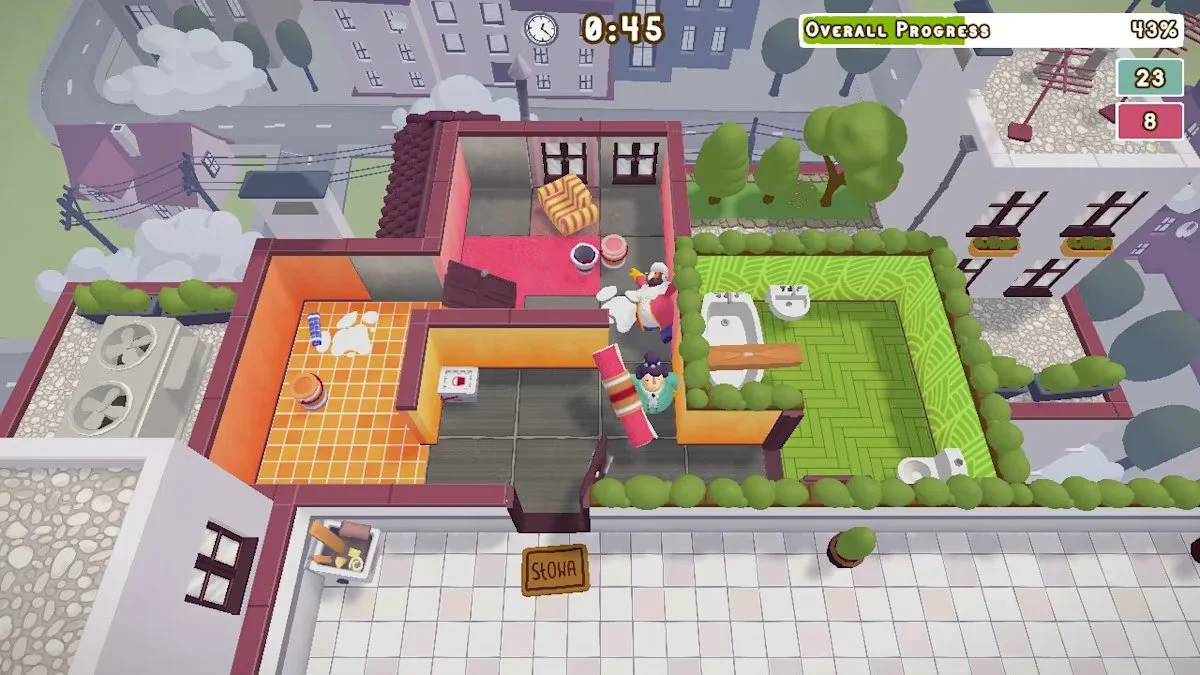
The central idea is simple: turn an unfinished or messy space into a completed client job before time runs out. In practice, that means carrying materials through compact rooms, finding the right tools, and dividing responsibilities while the team works around one another. A wall may need paint, a floor may need covering, and furniture may need moving before the final seconds disappear.
Its Action and Simulation labels make sense together. The simulation side comes from the renovation tasks and the use of blueprints that specify what each space requires. The action side comes from the pressure of performing those tasks quickly. There is little room for a leisurely approach when several objectives compete for attention and the work area itself becomes crowded.
That tension gives the game its lively atmosphere. Tools Up! Ultimate Edition treats renovation less as a quiet makeover and more as a team exercise in staying organized amid confusion. Accidental spills, misplaced objects, and poorly timed movements can complicate a job, but they also become part of the shared experience. The most memorable moments are likely to come from a plan that nearly works, then has to be rescued by rapid cooperation.
What the Ultimate Edition Includes
The Ultimate Edition combines the base game with all DLC. That broader package adds to the available content through more levels, characters, environments, and renovation challenges. For players returning to the worksite repeatedly, the appeal is not just completing a single series of rooms, but encountering more layouts and conditions that ask the crew to adjust its habits.
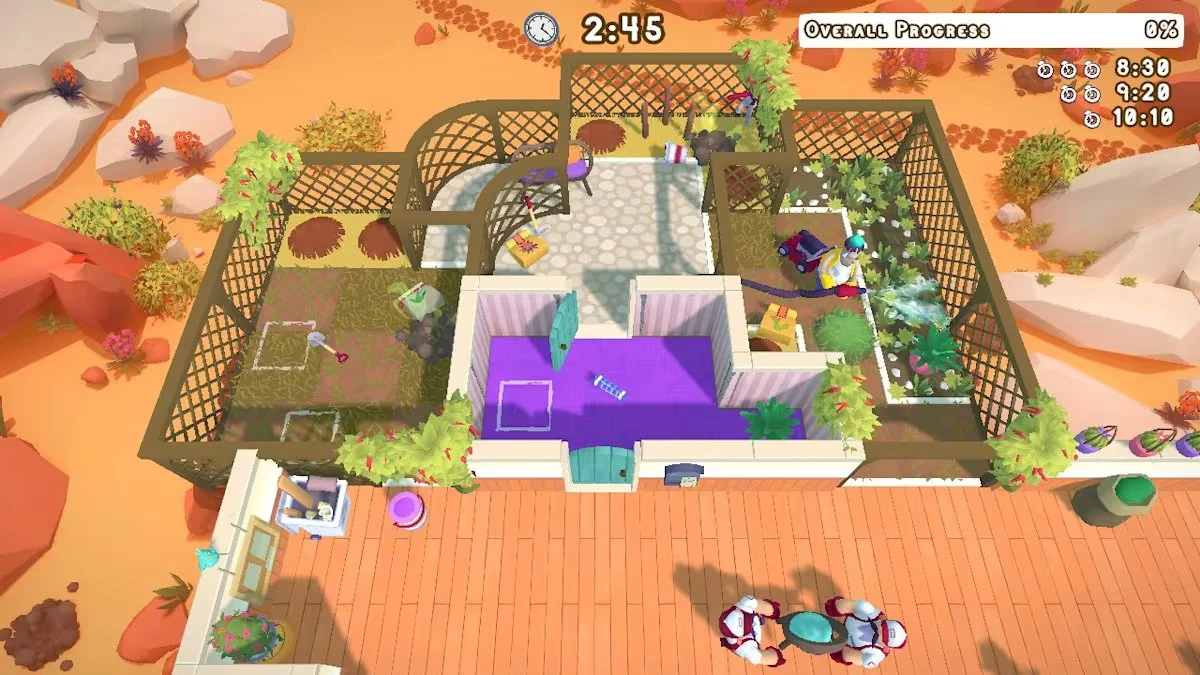
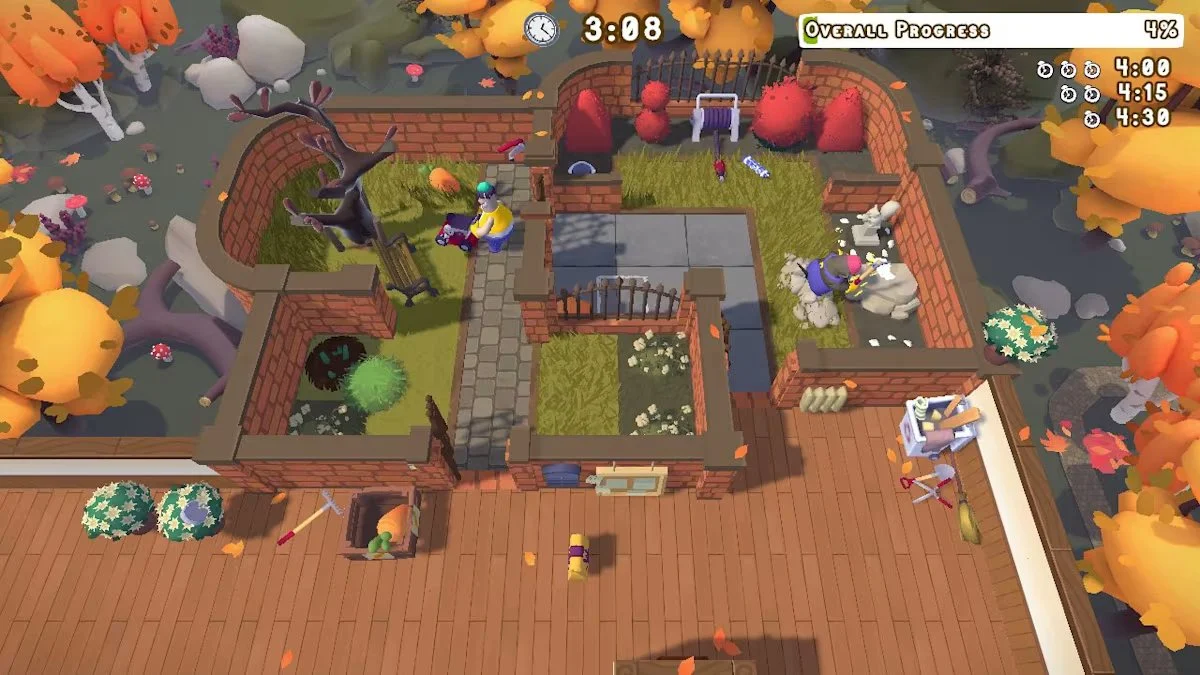
Additional environments matter because the game’s work is shaped by the space around the team. Different level settings and obstacles can change how a group moves, carries materials, and organizes a task list. Icy floors and lava pits, for example, introduce hazards beyond the ordinary demands of painting or cleaning. These interruptions keep a familiar job from feeling exactly the same in every room.
The included character roster also gives players options when choosing their contractors. The focus remains on shared work rather than individual roles with separate specialties, but a range of characters supports the game’s playful construction-crew presentation. Combined with the expanded set of Tools Up! Switch levels, the Ultimate Edition is designed to provide a substantial rotation of renovation scenarios.
The Renovation Premise and Level-by-Level Progression
Tools Up! Ultimate Edition story is intentionally light. Players join a renovation company tasked with restoring spaces that have fallen into disrepair. Instead of building toward a major narrative confrontation, progression comes through client blueprints and increasingly demanding jobs across apartments, homes, and different floors of buildings.
Each level establishes its own practical target. Early work can involve direct tasks such as painting, while later apartment renovation levels can combine several jobs and add more complicated floor plans. The campaign’s momentum comes from escalating demands: more work to complete, more reasons to coordinate, and more chances for a crowded room to become difficult to manage.
This approach lets the moment-to-moment stories come from the players. A crew may decide to split up, assign one person to materials, or focus everyone on a final urgent task. Another group may discover too late that furniture is blocking a route or that a necessary wall has not been finished. The blueprint provides the objective; the team’s response provides the drama.
- Read the plan: Check the renovation blueprint before scattering across the room.
- Divide the work: Let different players handle separate jobs when the layout allows it.
- Keep routes clear: Furniture, tools, and materials can make tight spaces harder to cross.
- Watch the clock: The timer turns unfinished details into urgent priorities.
- Adapt together: Environmental hazards and unexpected mistakes may require a quick change of plan.
How Cooperative Gameplay Works for 1–4 Players
Tools Up! Ultimate Edition multiplayer supports one to four players. Each participant controls a construction worker who can pick up tools, carry materials, and perform renovation actions. With one player, the challenge is managing every demand personally. With a full group, success depends more directly on co-op teamwork and clear communication.
There is a natural contrast between efficiency and interference. More players can complete separate tasks at the same time, but they also have to share the same compact workspaces. A team that communicates well can establish an effective rhythm: one worker carries supplies, another handles a wall, and someone else prepares the next part of the room. A team that does not may end up blocking paths, dropping items, or duplicating work.
The pressure is not only about speed. It is also about recognizing what the group needs next. When a renovation requires several types of work, timing matters as much as individual skill. That makes the game suitable for groups looking for an accessible cooperative challenge where conversation, last-second decisions, and occasional chaos are part of the appeal.
Core Jobs: Cleaning, Painting, Demolition, Flooring, and Furniture
The task list gives the game a clear working rhythm. Cleaning messes is one part of the job, while painting walls asks players to prepare and finish surfaces according to the blueprint. Flooring work includes laying tiles or carpets, creating another reason to transport materials efficiently through a busy room.
Demolition and cleaning sit alongside more constructive work. Teams may need to tear down structures or walls before they can complete a new layout. Moving furniture adds another logistical layer, especially when larger objects affect how players travel through an apartment. These jobs are straightforward individually, but their combination is what creates the game’s pressure.
Because the objectives are visually practical, a group can usually understand what it is working toward even as the room grows busier. The challenge lies in execution: choosing the right order, avoiding delays, and making sure every requested detail is complete before the timer ends. Tools Up! Ultimate Edition Switch NSP finds its replay value in those changing team dynamics, level conditions, and attempts to improve coordination on another run.
Nintendo Switch Release Details and Supported Languages
Tools Up! Ultimate Edition released in the USA on Nintendo Switch on January 6, 2024. It is published by Untold Tales and is listed in the Action and Simulation genres. The game supports English, Japanese, Spanish, French, German, Italian, Portuguese, Russian, Korean, Simplified Chinese, and Traditional Chinese.
For local groups, the four-player format and renovation theme make it a natural fit for short, energetic sessions in which everyone has something to do. Players who enjoy time-limited cooperative games, shared problem-solving, and humorous workplace chaos are the clearest audience. Its appeal is less about a plot-heavy campaign than the satisfaction of getting a difficult room finished together—sometimes neatly, sometimes only just in time.
Recommended Similar Games
 Vivitter for Nintendo Switch NSPView Game
 Ghostbusters: The Video Game Remastered Switch NSP XCIView Game
 It Takes Two Switch NSP XCIView Game
 River City Saga: Journey to the West Switch NSPView Game
 Shovel Knight Showdown Switch NSPView Game
 UFO Robot Grendizer – The Feast of the Wolves Switch NSPView Game
