Touhou Luna Nights Switch NSP
Report Link Error
Select the broken download file, then submit the report.
Screenshots
About Game
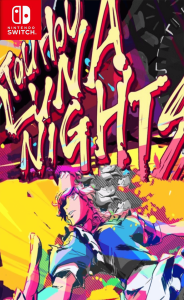
Touhou Luna Nights Switch NSP places Sakuya Izayoi in a compact but intricate 2D adventure built around speed, discovery, and her unusual command of time. Released for Nintendo Switch on December 17, 2020, the game combines action-platforming with a progression structure that rewards close attention to its connected environments.
Sakuya Izayoi’s Escape From a Sealed World
Sakuya Izayoi, the chief maid of the Scarlet Devil Mansion, begins her journey in a strange sealed world with no clear route home. The realm was created by Remilia Scarlet, Sakuya’s mistress, and its purpose is initially uncertain. What begins as confinement becomes an investigation: Sakuya must push through unfamiliar areas, meet Touhou characters, and work out what Remilia intends.
The premise gives the adventure a contained, mysterious atmosphere. Rather than sending Sakuya across a conventional fantasy kingdom, the game frames its setting as a fragmented reality shaped by Remilia’s amusement. New locations and encounters gradually add context to that situation, while Sakuya’s immediate goal remains simple: understand the world around her and escape it.
That focus suits the game’s action-exploration format. Story details unfold alongside movement through the map, so the act of reaching a new section also carries the possibility of another clue, conversation, or unexpected challenge. The Scarlet Devil Mansion connection anchors the scenario in Touhou’s world, while the sealed setting gives the game room to build its own atmosphere.
Time Manipulation at the Center of Combat
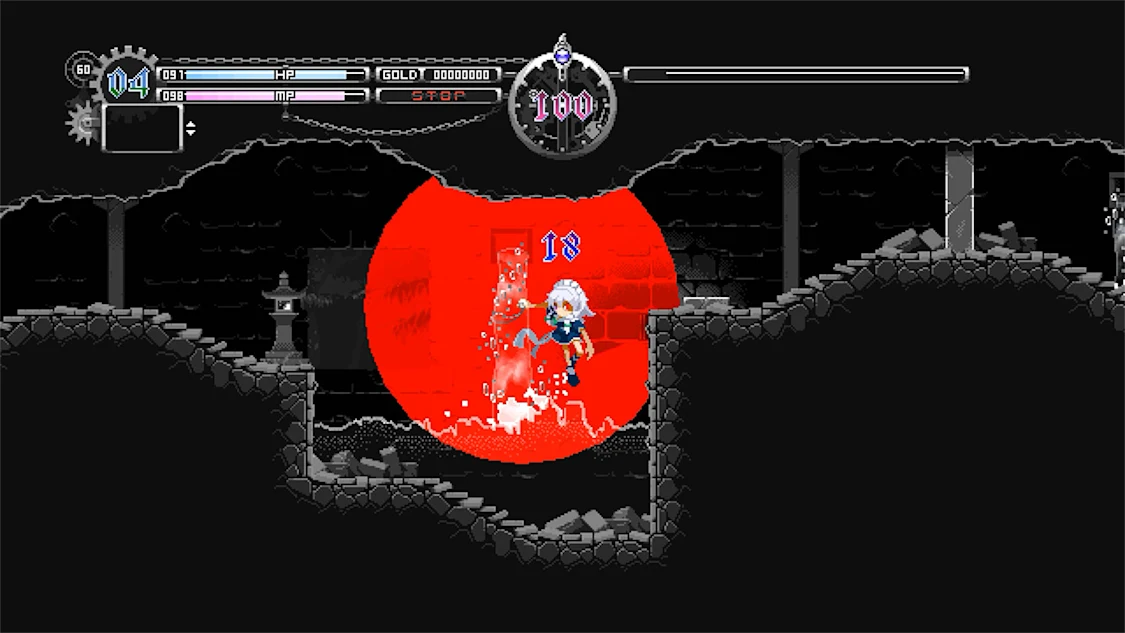
Sakuya’s time manipulation is more than a thematic trait. It is central to how encounters, obstacles, and puzzles are approached. Freezing enemies can create a moment of safety in a crowded fight, but it can also open an attacking window that would not otherwise exist. A difficult enemy pattern becomes easier to read when time can be interrupted at the right moment.
This makes combat strategy less dependent on simply pressing forward. Sakuya can use time stop defensively, offensively, or as a way to move through hazards and awkward spaces. Her attacks include projectile knives and close-range strikes, giving the action a mix of distance management and direct pressure. Time control links those options together by helping players set the pace of a confrontation.
- Pause the threat: Freezing enemies can reduce immediate pressure and create room to reposition.
- Create an opening: Time manipulation can be used to set up attacks rather than only to avoid damage.
- Read patterns: Tricky enemy behavior and boss encounters can be approached with more deliberate timing.
- Cross obstacles: The same ability has a role beyond combat, helping Sakuya navigate difficult situations.
- Experiment often: The system encourages players to test when time stop is most useful in a given room or fight.
The result is action that asks for awareness as well as quick reactions. Boss battles are part of that test, pairing visually impressive confrontations with the need to make good use of Sakuya’s abilities. Time manipulation gives the game a clear mechanical identity and keeps its fights connected to its lead character.
A 2D Action-Exploration Adventure
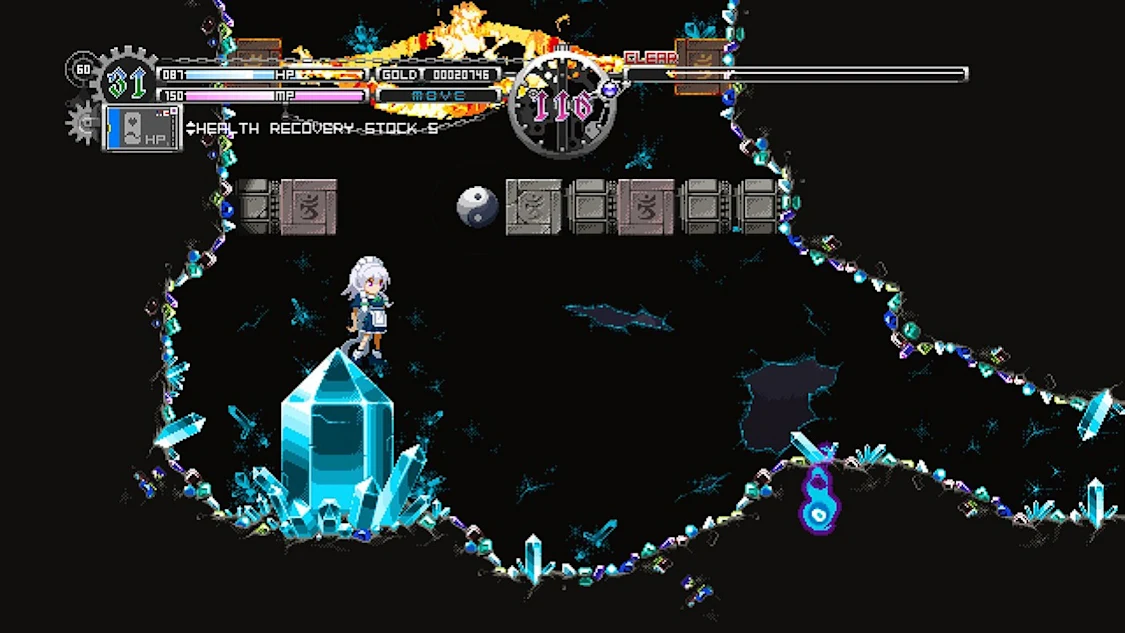
Touhou Luna Nights is structured as a 2D action platformer with exploration woven directly into its movement and combat. Sakuya travels through an interconnected map, using responsive controls to deal with enemies, negotiate jumps, and search for routes that may not be obvious at first glance. Its action is quick, but exploration gives the journey its longer rhythm.
The world is not presented as a sequence of isolated stages. Areas connect with one another, encouraging players to learn their layout and remember places that seem inaccessible. A suspicious wall, a high ledge, or a blocked corridor can become important later. This approach makes each new route feel like part of a larger space rather than a brief detour.
For Nintendo Switch players, the game’s focused 2D structure is well suited to a system known for both handheld and television play. The experience remains centered on precise movement, immediate combat, and map awareness, without losing the sense that every explored corner may have a practical reward.
Metroidvania Progression and Returning to Earlier Areas
Progression follows familiar metroidvania principles: Sakuya gains new abilities and powers, and those additions change what she can do in places already visited. Earlier obstacles are not simply dead ends. They become reminders to return once a new skill provides the means to move beyond them.
Backtracking therefore has a purpose. Revisiting old zones can reveal hidden passages, missed upgrades, and routes that were previously unreachable. The game’s map design supports that process by making exploration part of advancement rather than a separate optional activity. Players who pay attention to unusual gaps, sealed routes, and difficult jumps have reasons to come back later.
Upgrades can improve Sakuya’s HP, MP, or knife capacity, adding a practical incentive to thorough searching. This also gives the adventure a degree of replay value through completion-minded exploration: returning with expanded abilities can expose secrets that were easy to pass by during an earlier visit. The structure should appeal to players who enjoy tracing a connected map and gradually turning unfamiliar territory into a known space.
Pixel Art and Animation in Touhou Luna Nights
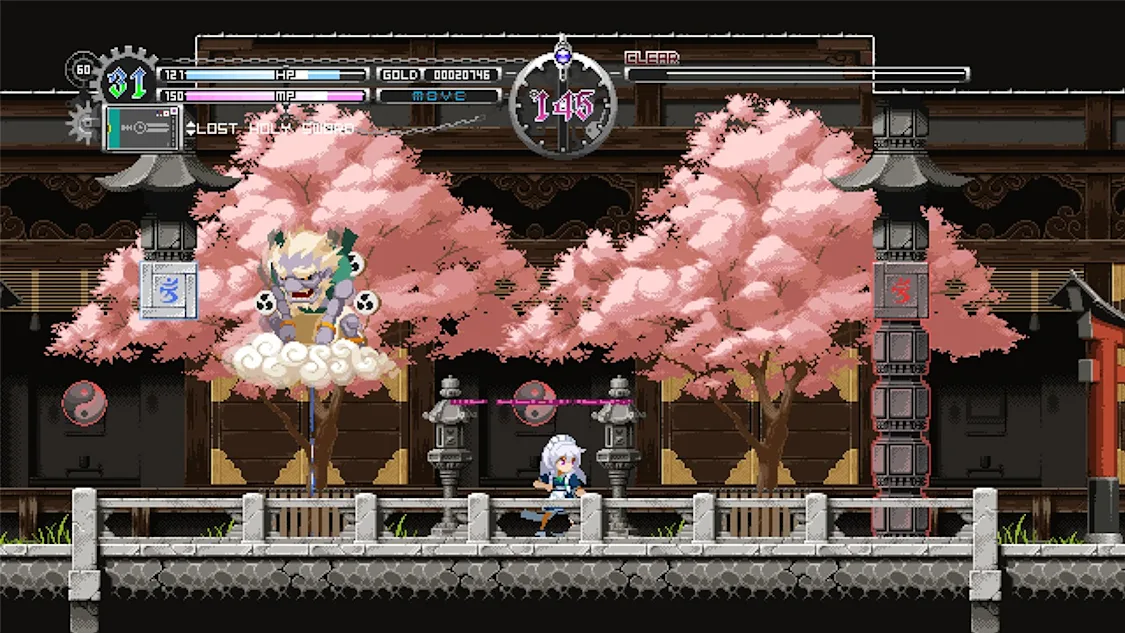
The game presents its sealed world through pixel art and smooth animation. That visual direction supports both sides of the experience: detailed 2D environments establish the strange Touhou-inspired setting, while fluid animation helps fast attacks, movement, and enemy encounters remain readable.
Pixel art is especially effective for a game built around quick decisions. Sakuya’s knives, movement, and time-based actions need to be clear amid active combat, and the animated presentation helps convey that motion. The visual style also complements the fragmented reality of the story, giving individual areas a distinct sense of place while maintaining a consistent 2D look.
Rather than treating presentation as separate from play, Touhou Luna Nights uses its graphics to support the pace of its action. Players are regularly asked to react, reposition, and inspect the environment, so clarity matters as much as decoration. The result is a visual style that fits the game’s Touhou setting and its rapid platforming demands.
Nintendo Switch Release Details and Language Support
Touhou Luna Nights Switch NSP refers to the Nintendo Switch release of the action game launched on December 17, 2020. Phoenixx is listed as both publisher and developer. The release is region free and supports English, German, Spanish, French, Italian, and Russian.
Its combination of time-based combat, 2D exploration, hidden routes, and ability-led progression makes it a fitting choice for players looking for a focused action-platforming adventure. Those drawn to interconnected maps, boss encounters, pixel-art visuals, and the Touhou visual style will find those elements closely tied together throughout Sakuya’s attempt to leave Remilia Scarlet’s sealed world.