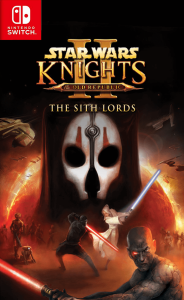
Star Wars Knights of the Old Republic II: The Sith Lords Switch NSP
Report Link Error
Select the broken download file, then submit the report.
Screenshots
About Game
Star Wars Knights of the Old Republic II: The Sith Lords Switch NSP brings a dark, character-driven role-playing journey to Nintendo Switch. Developed and published by Aspyr, this Action, Adventure, and Role-Playing release arrived on June 08, 2022, with English, French, German, Italian, and Spanish language options across Europe and the USA. Its focus is not simply on a new galactic threat, but on uncertainty: what remains of the Jedi, what the Force means to the Exile, and what personal choices can cost.
A Galaxy Five Years After the Original Knights of the Old Republic
The Knights of the Old Republic II story begins five years after the events of the original game. The player awakens as the Exile, a former Jedi who has been separated from the Force at a moment when the galaxy is close to collapse. This starting point gives The Sith Lords a notably uneasy mood. The Exile is not introduced as an uncomplicated hero with a clear purpose, but as someone carrying a fractured connection to their own past and power.
The broader situation is equally bleak. The Sith Lords have hunted down and destroyed nearly all remaining Jedi, making the Jedi Purge central to the adventure’s tension. The Exile’s journey involves seeking a renewed connection to the Force while pursuing the truth behind that destruction. The path leads through dangerous locations, difficult conversations, and encounters with companions whose histories and intentions are not always easy to read.
This is a Star Wars setting shaped by absence as much as spectacle. The Jedi Order is weakened, trust is fragile, and the threat of the Sith hangs over each new discovery. The Exile’s position between the past and the future gives the narrative room to examine what rebuilding might mean—and whether rebuilding is even the goal the player wants to pursue.
Moral Ambiguity at the Center of The Sith Lords
The Sith Lords approaches morality through more than a simple heroic-versus-villainous frame. Its Star Wars moral choices ask players to consider motives, consequences, loyalty, and betrayal. Discussions can become philosophical, especially when characters challenge assumptions about the Jedi, the Sith, good, evil, and the Force itself.
The game still tracks light side dark side alignment, but the decisions surrounding that alignment are presented within a story full of uncertainty. A seemingly helpful choice can have wider consequences, while a harsh or self-interested response may reshape how others see the Exile. The narrative’s interest in conflicting agendas makes each conversation feel connected to a larger question: what kind of person is the Exile becoming?
That uncertainty suits the premise. The player is navigating a galaxy marked by loss and distrust, not simply moving toward a clean moral answer. Rebuilding the Jedi Order or embracing the dark side depends on personal decisions, giving the role-playing framework real weight within the story.
How Player Decisions Shape the Exile’s Journey
KOTOR 2 dialogue choices are a major part of progression. Conversations do more than fill in background details; they influence Force alignment, relationships with companions, available abilities, and possible story outcomes. The result is a role-playing structure that encourages players to pause before responding, particularly when a character’s loyalty or perspective may be affected.
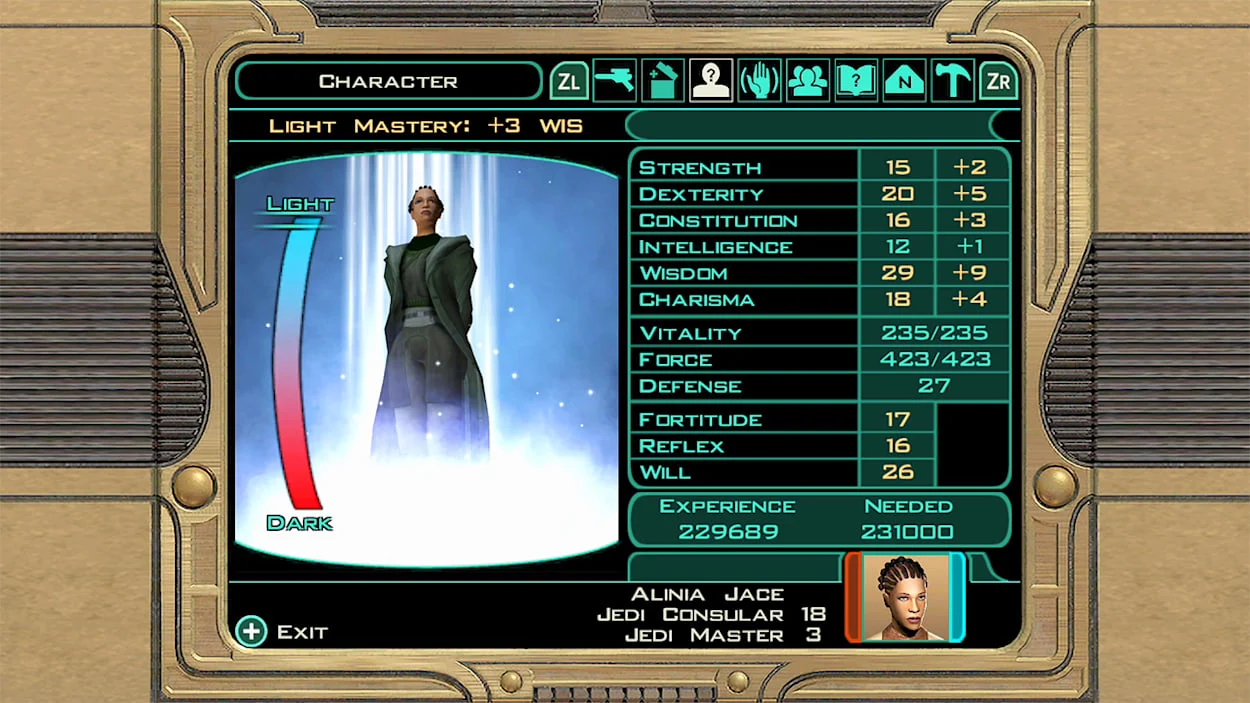
The Exile can be customized through class choices, skills, feats, and Force powers. These systems work alongside the game’s decisions rather than sitting apart from them. As the player’s Force alignment shifts toward the light or dark side, different abilities and narrative possibilities can come into view. This makes character development feel tied to the tone of the journey, not merely to combat effectiveness.
Companions are especially important here. The Exile gathers a varied crew, and each party member brings a distinct past and agenda. Building strong relationships can matter, while fractured loyalty can also have an effect on the story. For players who enjoy revisiting an RPG with a different approach, the combination of alignment, dialogue, builds, and companion interactions gives the adventure replay value without requiring every playthrough to follow the same path.
Party-Based Combat With Pause-and-Play Strategy
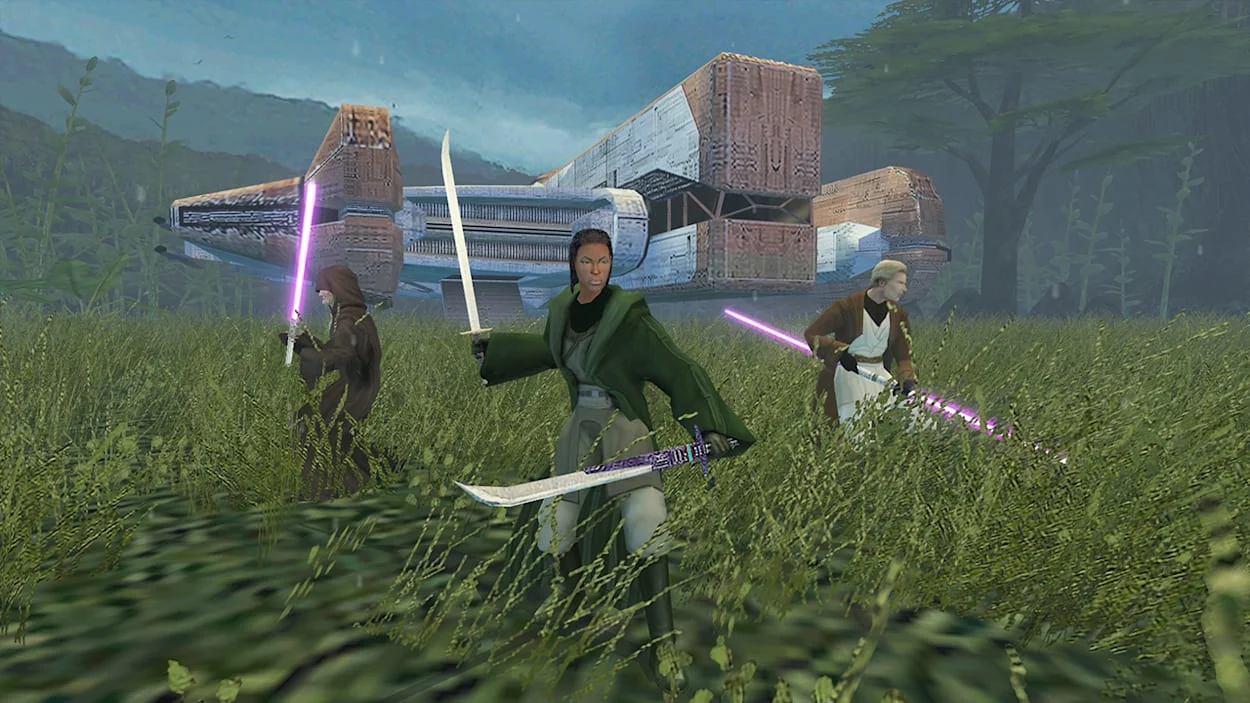
Combat uses a three character party, allowing the Exile to travel with two companions. Party selection is therefore more than a matter of preference. Different characters bring different strengths, and choosing who accompanies the Exile can affect how a fight is approached as well as which conversations occur along the way.
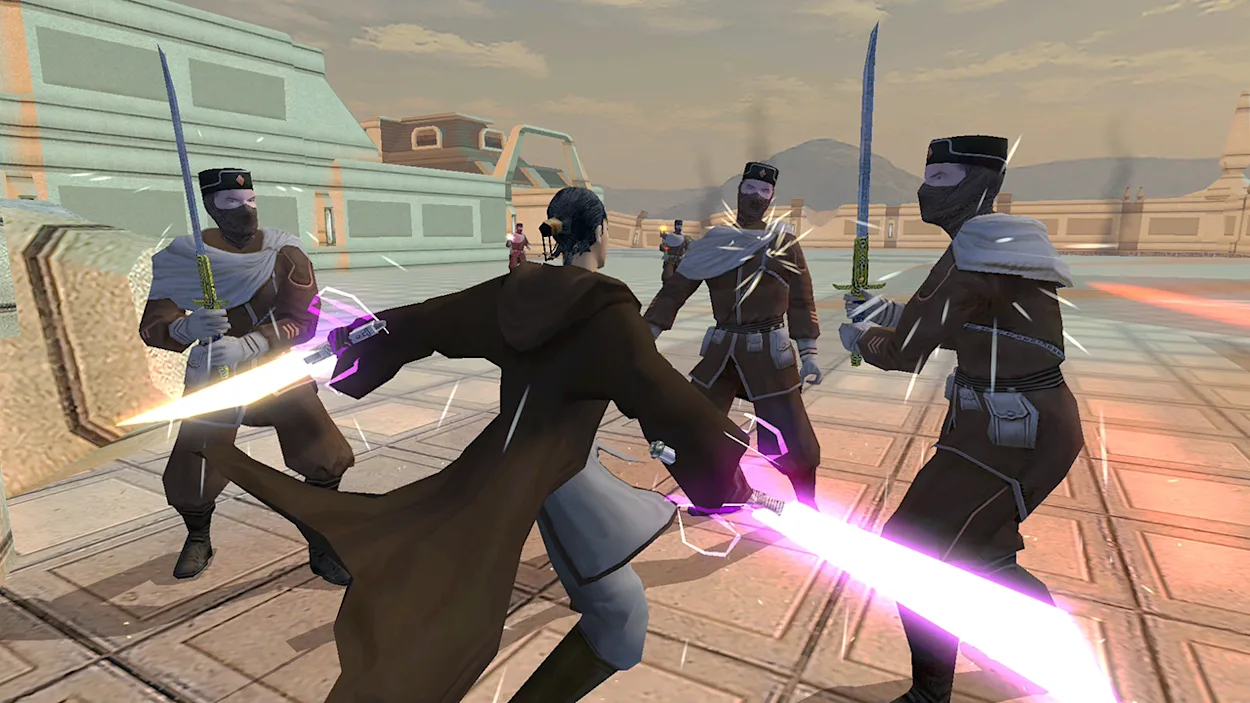
KOTOR 2 combat unfolds in real time, with pause-and-play strategic options available to help players make tactical decisions. That structure supports a measured pace: players can stop the action, consider abilities and targets, and then resume combat. It is a useful fit for an RPG built around skills, feats, Force powers, weapons, armor, and companion roles.
Character progression extends into equipment through crafting and item modification. Weapons, armor, and utility items can be customized and upgraded, giving players another way to shape a party around preferred tactics. A group focused on particular abilities may be built differently from one that relies on a separate mix of skills and equipment.
Exploring Telos IV, Dxun, and Ancient Sith Secrets
Exploration carries the Exile beyond dialogue and combat into major Star Wars locations including Telos IV and Dxun. These journeys support the wider search for answers about the Jedi Purge, the Force, and the Sith Lords’ influence. The destinations are part of the game’s sense of scale, but they also serve the personal investigation at the center of the narrative.
Puzzles add another layer to exploration, asking players to engage with the environment rather than relying only on battle or conversation. The pursuit of ancient Sith secrets reinforces the darker atmosphere surrounding the Exile’s mission. Each discovery can feel connected to a galaxy in which old powers, buried histories, and unresolved conflicts continue to shape the present.
For players approaching Star Wars Knights of the Old Republic II: The Sith Lords Switch NSP as a portable RPG, this mix of travel, party interaction, tactical encounters, and character building gives the experience a deliberate rhythm. It is suited to those interested in a story-heavy Star Wars adventure where choices and relationships are as important as combat preparation.
7 Strategic Priorities for a First Playthrough
- Choose words carefully. Dialogue decisions can influence alignment, companion relationships, and story outcomes, so it is worth considering more than the immediate response.
- Build a balanced party. Pay attention to party composition and bring companions whose strengths fit the challenges and tactics you prefer.
- Experiment early. Try different class, skill, feat, and Force power combinations before settling too quickly into one approach.
- Use individual strengths. Each companion has a role and background of their own; make use of their abilities rather than treating every party member the same way.
- Consider alignment. Light and dark side decisions influence Force alignment and can affect available abilities and narrative direction.
- Develop relationships. Speak with companions and consider how the Exile’s actions may strengthen or weaken their loyalty.
- Improve equipment. Crafting, modifications, and upgrades for weapons, armor, and utility items can support the party’s chosen strategy.
Recommended Similar Games
 Formula Retro Racing Switch NSPView Game
 RetroRealms Double Feature: Halloween and Ash vs Evil Dead Switch NSPView Game
 TSUKIHIME -A piece of blue glass moon- Switch NSPView Game
 Cupid Parasite Switch NSPView Game
 Tokyo Xanadu eX+ Switch NSPView Game
 Towa and the Guardians of the Sacred Tree Switch NSPView Game
