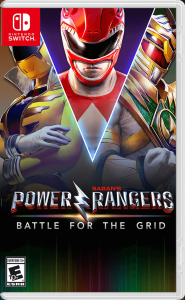
Power Rangers: Battle for the Grid Switch NSP
Report Link Error
Select the broken download file, then submit the report.
Screenshots
About Game
Power Rangers: Battle for the Grid Switch NSP brings nWay’s fast-moving Power Rangers fighting game to Nintendo Switch. Released on March 25, 2019, it centers on three-character teams, quick character swaps, assist attacks, and dramatic finishing moves. Its appeal comes from bringing Rangers and villains from across the wider Power Rangers universe into one compact competitive format, with matches built around pressure, timing, defense, and team coordination.
Power Rangers: Battle for the Grid on Nintendo Switch at a Glance
Published and developed by nWay, Power Rangers: Battle for the Grid is an Action and Fighting release designed around 3v3 combat. Players assemble a group of three fighters and bring them into battles where every member of the team can affect the flow of a match. The format gives the game more to consider than a one-on-one contest: a character can attack directly, support from off-screen, or be swapped out when the situation changes.
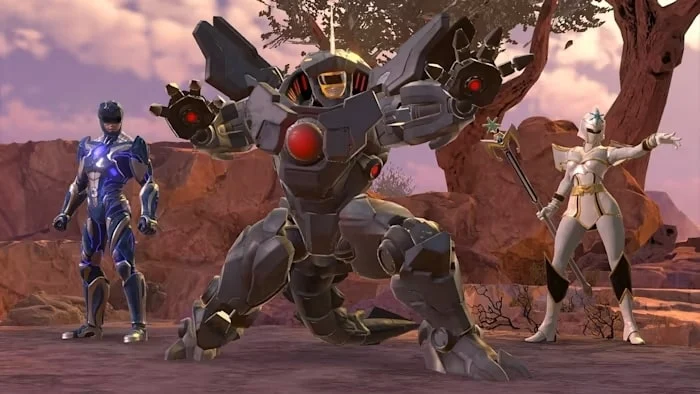
The Power Rangers setting supplies the crossover energy. Characters are drawn from different corners of the franchise, allowing Rangers from separate eras, timelines, and realities to meet in the same conflict. That premise suits a fighting game especially well, since the campaign and individual battles are both driven by confrontations between heroes and villains with different powers and styles.
On Nintendo Switch, the game’s accessible control approach provides a clear route into its combat, while the tag structure leaves room for players to refine their teams and tactics. Newcomers can focus first on movement, attacking, and blocking; more experienced players can spend time learning assists, exchanges, combos, counters, and special-move timing.
Lord Drakkon and the Threat to the Morphin Grid
The campaign begins with a threat that reaches beyond a single Ranger team. Lord Drakkon, an alternate version of Tommy Oliver, seeks to shatter the Morphin Grid and draw on its energy for ambitions that extend across dimensions. The stakes are therefore tied to the fabric of the Power Rangers universe rather than a local rivalry.
To oppose him, Rangers from different eras, timelines, and realities must unite. The story creates a reason for its broad collection of heroes and conflicts: characters who would not normally fight alongside one another are pushed into a common effort to stop Drakkon’s plan. Their battles carry the campaign forward as they attempt to protect the Morphin Grid and restore balance.
This gives the game a suitably heightened atmosphere. The conflict is built around alternate realities, powerful energy, and an enemy capable of threatening every dimension. The campaign supplies context for the matches without changing the game’s central focus: direct, competitive Power Rangers combat.
How the 3v3 Tag-Team Battles Work
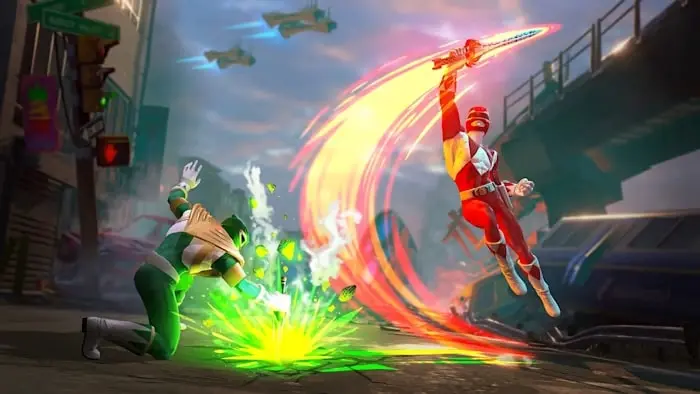
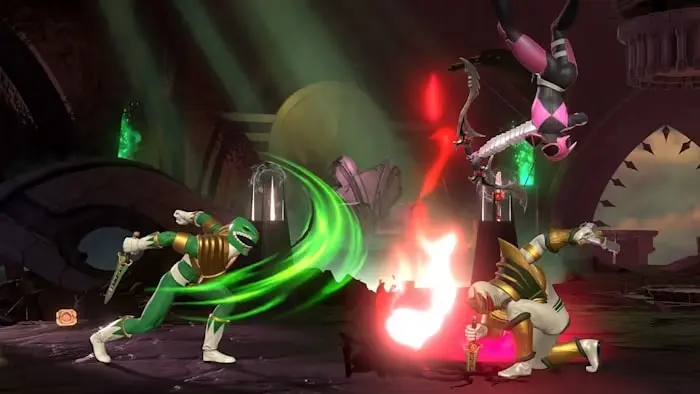
The heart of the game is its 3v3 tag-team fighting system. Before a battle, players build a team of three unique characters. During the match, they can switch between those fighters, changing the active character without leaving the contest. That simple structure creates important decisions: a player may bring in another character to continue offense, alter their approach, or retreat from pressure.
Teammates are not merely waiting for their turn. Assist calls allow a supporting character to enter briefly with an attack, helping extend a combo or interrupt an opponent’s pressure. This makes team composition meaningful, because the relationship between three fighters can matter as much as the abilities of any one character.
The result is a Switch fighting game with an emphasis on adaptation. One player may rely on direct pressure, while another may prefer to create space, call an assist, and look for a safer opening. Switching at the right moment can turn a defensive position into an offensive one, and assist timing can change the pace of a close round.
Power Rangers: Battle for the Grid Switch NSP uses that team-based structure to encourage repeated experimentation. A different trio can produce a different rhythm, and learning when to attack, defend, assist, or switch is part of the game’s longer-term challenge.
Megazord Ultras as Cinematic Finishers
Megazord Ultras provide the game’s most spectacular moments. These powerful cinematic finishers offer a visual payoff after the close-range exchanges, assist setups, and special-move attempts that define a match. Their scale fits the Power Rangers atmosphere, turning a successful finishing opportunity into something more dramatic than a routine attack.
They also help give battles a clear sense of escalation. Much of a match depends on practical fighting-game decisions—blocking, countering, selecting attacks, and managing team support—but Megazord Ultras add a larger-than-life release to that tension. The presentation stays connected to the game’s combat, rather than replacing it: the finishers are earned within the flow of battle.
7 Fundamentals to Practice Before Your Next Battle
- Learn the attack strengths. Spend time with light, medium, and heavy attacks to understand the basic tools available to each character.
- Block with purpose. Solid defense helps control the pace of a fight and prevents an opponent’s offense from becoming overwhelming.
- Work on counters. Countering effectively can shift momentum and create an opening when an opponent is pressing forward.
- Use assist calls. Bring teammates in to extend combos or help break an opponent’s pressure rather than treating the active fighter as your only resource.
- Switch strategically. Swap between the three Rangers to adapt to changing situations, continue offense, or step away from danger.
- Experiment with teams. Try different three-character combinations to find a group that suits your preferred fighting style.
- Practice special moves. The game uses simple inputs for special moves, but reliable timing and placement remain important in real matches.
Switch Release Details: Date, Regions, and Languages
Release date: March 25, 2019
Genre: Action, Fighting
Publisher: nWay
Developer: nWay
Regions: Europe and USA
Language support: English, French, German, Spanish, and Portuguese
The Nintendo Switch release supports a broad set of European language options alongside English, making its menus and game text available across five listed languages. With its campaign premise, three-character team construction, and competitive 3v3 matches, it is suited to players looking for a Power Rangers-focused fighting game that rewards both immediate action and continued practice.