INSIDE Switch NSP XCI

Report Link Error
Select the broken download file, then submit the report.
Screenshots
About Game
INSIDE Switch NSP XCI brings Playdead’s bleak adventure game to Nintendo Switch with a stark premise: a nameless boy runs through a dangerous world that offers almost no explanation. Released in 2018, the game relies on movement, observation, and a quietly mounting sense of dread rather than dialogue or conventional cutscenes. Its power comes from what it leaves unresolved, asking players to read its images, spaces, and threats for themselves.
INSIDE on Nintendo Switch: A Wordless Descent into Dystopia
Developed and published by Playdead, INSIDE is a Nintendo Switch adventure game built around atmosphere and forward momentum. The player guides a small boy through a monochrome dystopian setting where danger is present from the opening moments. He appears to be fleeing an unknown authority, but the game never gives a direct account of who he is, why he is running, or what waits at the end of his route.
That restraint defines the experience. There are no spoken explanations to frame each new location, and no traditional cutscenes to clarify events. Instead, the player moves from one disturbing situation to another, learning through visual context and immediate survival. A distant figure, a surveillance device, or an unfamiliar machine can carry more narrative weight than a line of dialogue.
The presentation is deliberately minimal, but not empty. Dark silhouettes, subdued environments, and precise animation make the boy feel small within every scene. The world often appears indifferent to him, which strengthens the tension of simply moving onward. INSIDE does not rush to answer its own questions; its mystery is part of the journey.
Environmental Storytelling and the Mystery of the Boy’s Escape
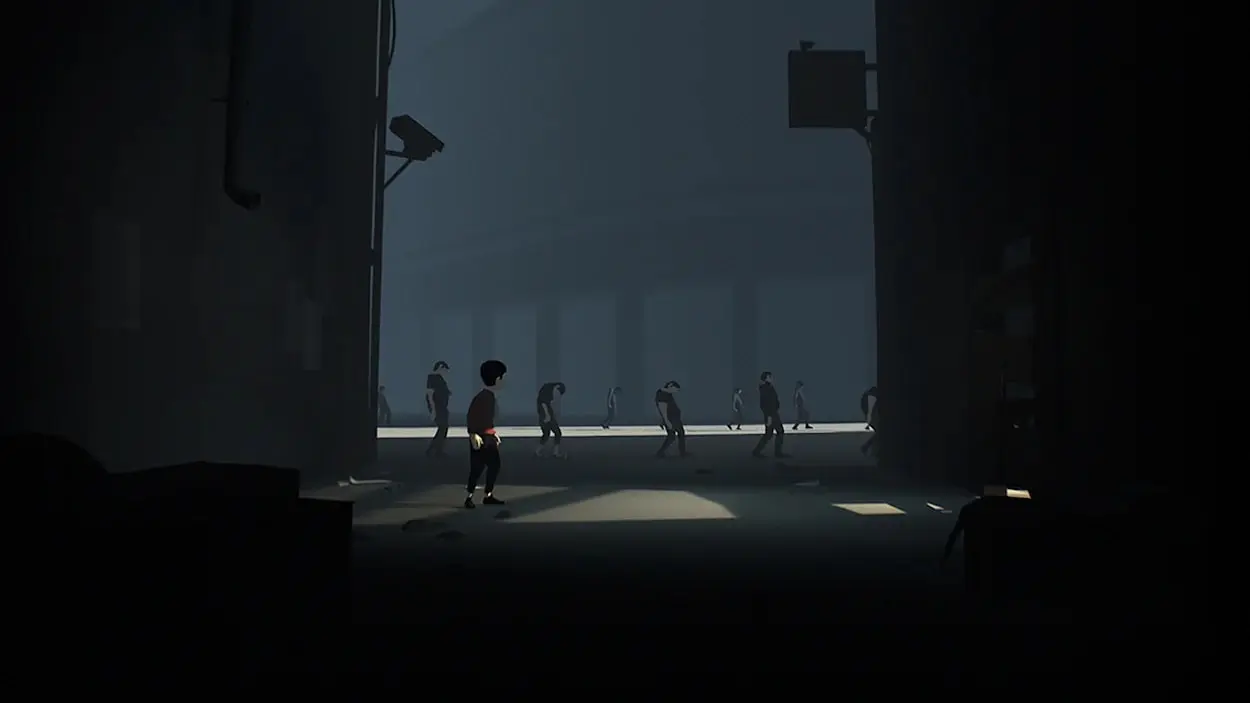
The INSIDE story is told through environmental storytelling. Silent figures, watchful surveillance, and unsettling experiments suggest a larger system operating beyond the boy’s understanding. Because the game does not spell out the meaning of these details, players are left to connect them in their own way.
This creates a dystopian mystery that remains open to interpretation. The boy’s escape is clear as an immediate objective, yet the reasons behind it are not. Each new area introduces images that can be read as clues, warnings, or fragments of a wider story. The effect is unsettling because the player is rarely given enough certainty to feel safe.
Visual details matter as much as major encounters. A background scene may imply that others have been caught, observed, or drawn into something deeply strange. Machinery and human activity are often presented without explanation, making the player an observer as well as a participant. The game’s narrative progression comes from that accumulation of impressions: each location adds another piece, but the full picture remains elusive.
From Forests to Industrial Complexes: The Game’s Oppressive Locations
INSIDE uses a 2.5D puzzle-platformer structure to move through sharply different environments while maintaining a consistent feeling of unease. Early stretches of dark forest establish isolation and vulnerability. Dense natural spaces do not offer comfort; they become places to hide, flee, and scan for threats.
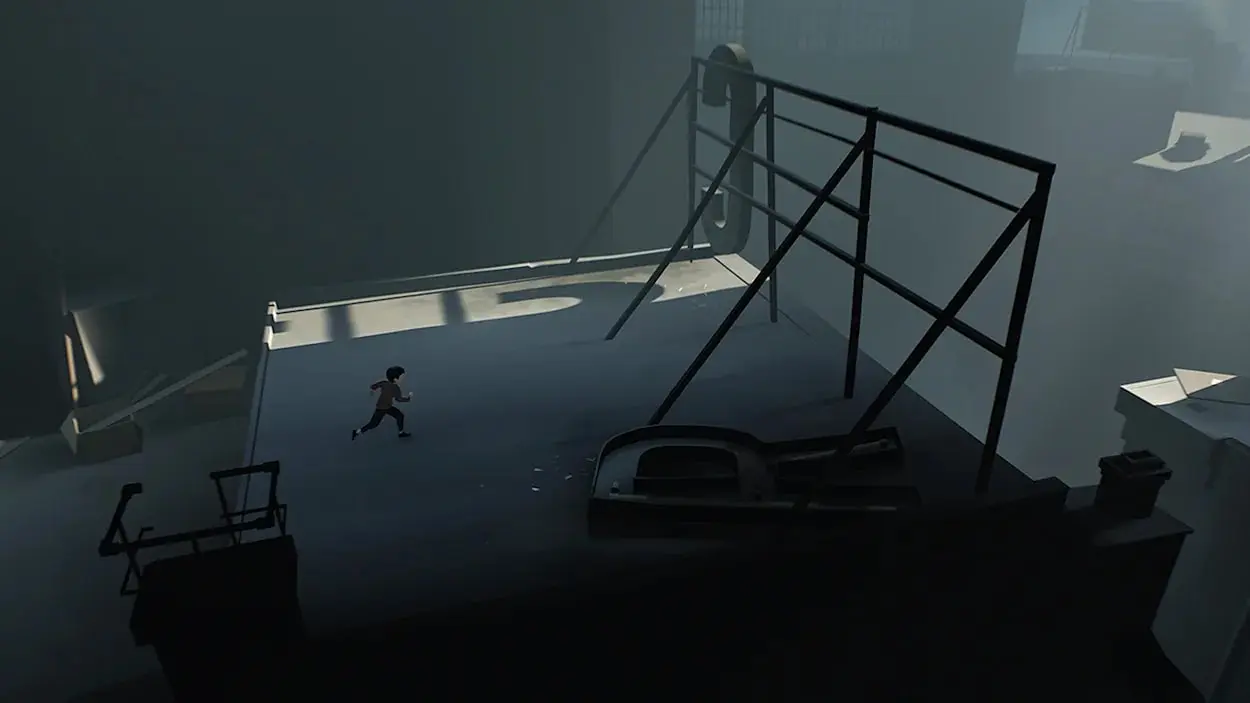
Later sections include submerged spaces, flooded ruins, and industrial facilities. Water changes the player’s relationship with movement and danger, while the industrial areas introduce larger machinery and a more controlled, oppressive atmosphere. The shift from forest to facility makes the world feel broader, but not freer. Every location seems shaped by forces the boy cannot control.
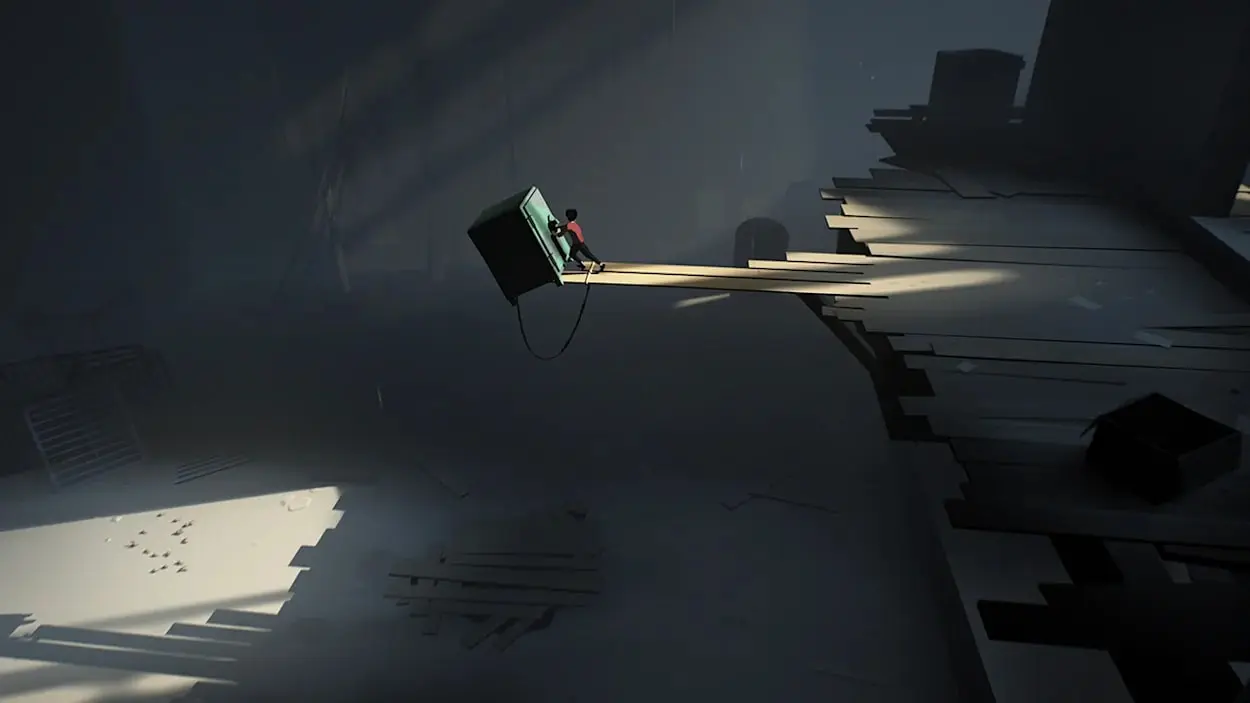
The settings also support puzzle design. Objects, water, gravity, mechanisms, and other entities can become parts of a route forward. A room may initially look like a barrier, only to reveal a solution through an overlooked lever, movable item, or change in the environment. The transitions between exploration, puzzles, and escape sequences are seamless, keeping the player alert even when no enemy is immediately visible.
Simple Controls, Constant Vulnerability
INSIDE gameplay centers on focused movement and interaction. The boy can move through the world, manipulate objects, operate machinery, and respond to the physical properties of each space. The controls are simple and precise, which is important because the game often asks for careful positioning, timing, and quick reactions.
His limited abilities are a major part of the tension. He is not presented as a powerful character who can overpower every danger. Hazards, pursuit sequences, and obstacles feel threatening because escape depends on reading the situation correctly. When a sequence becomes urgent, the player must act with the information gathered through prior observation.
Failure is frequent in places, but it has a useful role. A failed attempt can reveal the reach of a hazard, the timing of a moving object, or the weakness in an approach. Quick restarts keep these moments from becoming overly disruptive, encouraging experimentation without removing the pressure of the world. Progression is less about gaining new combat options and more about becoming better at understanding the spaces ahead.
5 Observation Habits for Solving INSIDE’s Challenges
INSIDE Switch NSP XCI rarely relies on explicit instructions. Its puzzles reward attention to the immediate scene, especially when a route seems blocked or a mechanism appears incomplete.
- Study both planes. Inspect the foreground and background for objects, figures, openings, and machinery that may relate to the next step.
- Watch the shadows. Subtle shapes and movement can reveal hazards, pathways, or elements that are easy to miss in the game’s dark presentation.
- Identify what can move. Boxes, mechanisms, and other interactive objects often change the layout of a room or create access to a new area.
- Try another route. If a direct approach fails, test a different position, timing, or sequence of interactions rather than assuming the obstacle is fixed.
- Learn from failure. A death or unsuccessful attempt can provide practical information about timing, danger, and the logic behind a puzzle.
These habits also support the game’s atmosphere. Looking closely is not only a way to solve a challenge; it is how players notice the strange details that shape the world. Hidden areas and collectibles provide further material to examine for those who want to search beyond the most direct route.
Release Details, Regions, and Language Support for INSIDE on Switch
INSIDE was released for Nintendo Switch on June 28, 2018. Playdead served as both developer and publisher. The listed regions are USA, EUR, and JPN.
Language support includes English, Japanese, Spanish, French, Italian, Russian, and Portuguese. Its wordless narrative approach makes its visual storytelling especially central across those language options: the boy’s danger, the world’s strange systems, and the meaning of what players see are communicated chiefly through play and presentation.
For players drawn to tense puzzle-platforming, environmental clues, and stories that resist easy explanation, INSIDE offers a compact but persistent descent through a hostile dystopian landscape. Its memorable force lies in the details left unexplained—and in the uneasy need to keep moving forward.