Captain Toad Treasure Tracker Switch NSP XCI
Report Link Error
Select the broken download file, then submit the report.
Screenshots
About Game
Captain Toad Treasure Tracker Switch NSP XCI frames its adventure around a small explorer facing oversized problems: a stolen Power Star, a captured friend, and a series of compact worlds whose secrets are rarely visible from just one angle. The result is a puzzle-platforming journey built less around speed and more around observation, careful movement, and the pleasure of turning a tiny scene over in the mind.
Captain Toad’s Quest to Rescue Toadette and the Power Star
The story begins with Captain Toad and Toadette admiring a Power Star. Their moment is interrupted when Wingo, a giant bird, swoops in and takes both the star and Toadette away. Captain Toad’s mission is direct: track down Wingo, recover the Power Star, and bring Toadette safely home.
That simple setup gives the game a clear forward pull while leaving room for its stages to do the real storytelling. New locations, foes, and obstacles make each portion of the rescue feel like another small expedition. Captain Toad is not presented as a conventional action hero. He is an explorer, and the adventure asks players to share that mindset: look closely, take the safe route, and search for a solution before moving ahead.
The Power Star is usually the focal reward of a stage, while three Super Gems provide additional objectives for players who want to inspect every corner. This makes progression approachable without making the stages feel disposable. Reaching the end moves the journey forward; finding the extra treasures invites a return visit.
Why Captain Toad Cannot Jump—and Why It Matters
Captain Toad cannot jump because of his heavy backpack, a limitation that defines the game’s puzzle-platforming design. In many platformers, a gap, a raised ledge, or an approaching enemy can be handled with a quick leap. Here, those same situations demand a different response. Players need to find another route, wait for an opening, use a level feature, or reconsider what the camera angle is hiding.
This turns strategic movement into the central skill. Captain Toad has to navigate narrow paths, avoid danger, and read the structure of a stage without relying on the usual freedom of jumping. A route that appears straightforward can become risky when moving platforms, enemies, or hazards begin to overlap. The game’s tension comes from deciding where to go and when to move rather than from demanding fast aerial control.
The restriction also gives the character a distinct identity. Captain Toad’s backpack is not merely visual decoration; it explains why the levels are designed as intricate navigation problems. His journey is about working within limits, and that makes each successful route feel earned.
Diorama Stages Built Around Perspective
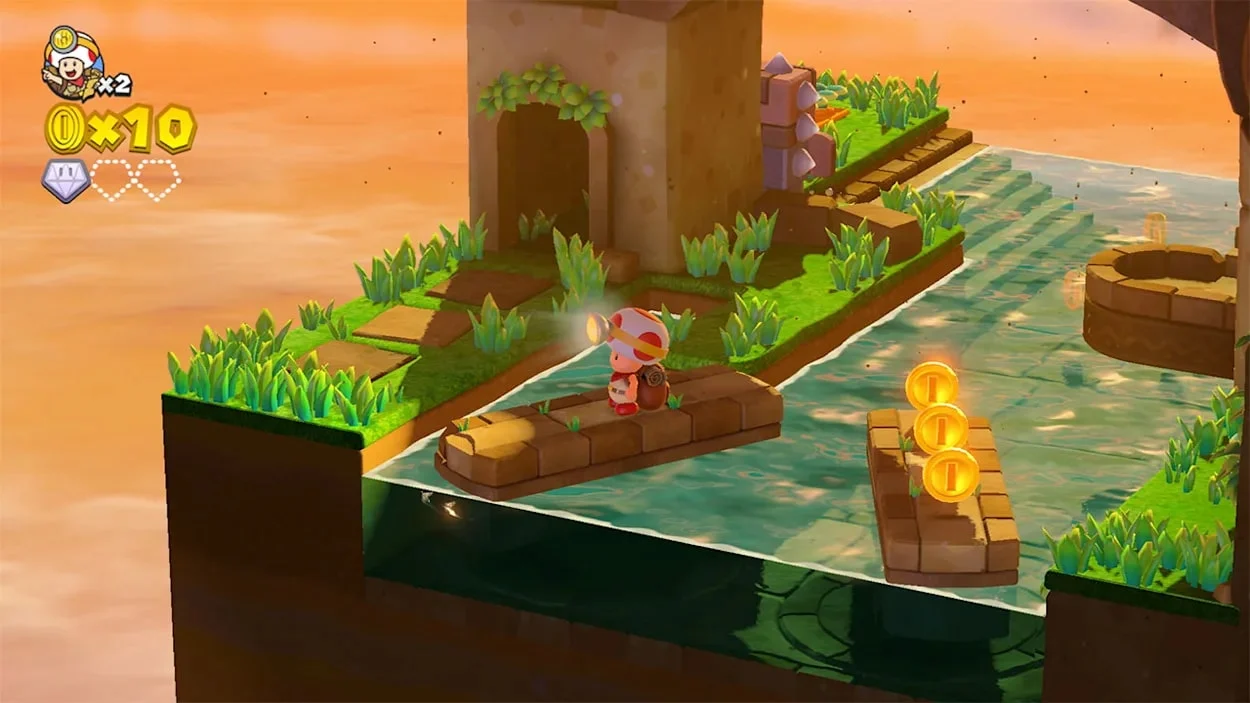
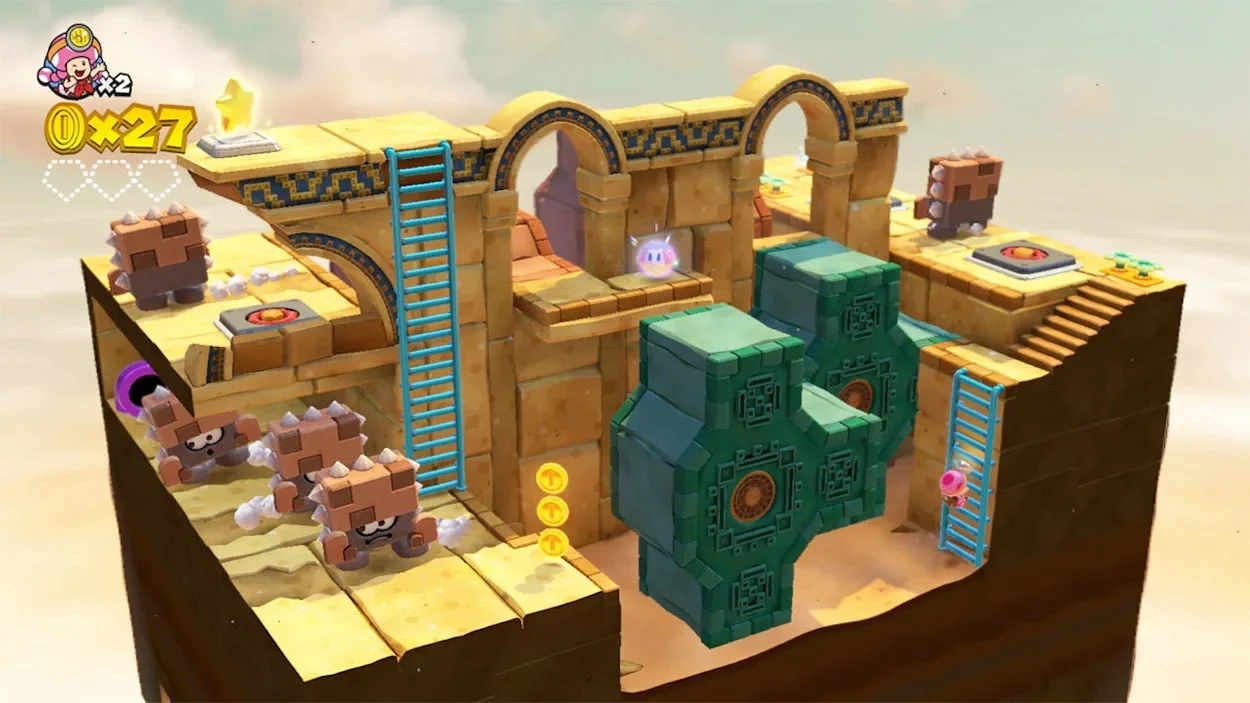
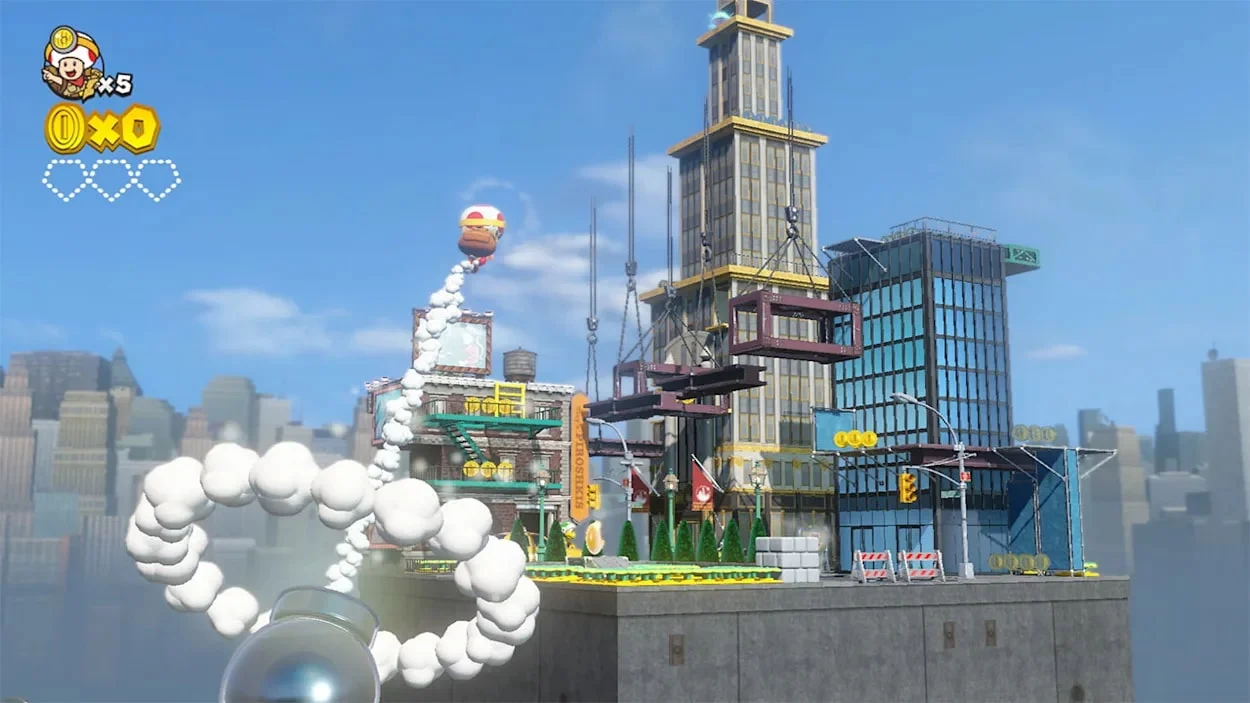
The stages are designed like miniature 3D dioramas: self-contained spaces filled with paths, objects, ledges, and concealed areas. Their small scale gives them a carefully arranged, toy-like presentation, but the puzzles inside can be surprisingly layered. A visible walkway may circle behind a wall. An object obscured from one side may become important when the viewpoint changes.
Players can rotate the camera to inspect these 3D puzzles from different angles. This is more than a visual flourish. Camera movement reveals alternate routes, hidden paths, and puzzle answers that cannot be understood from a fixed perspective. What looks like a dead end can be a passage concealed behind part of the scenery, while an unreachable item may have a route leading to it from another side.
That approach creates a calm, exploratory atmosphere. Rather than rushing through large spaces, players are encouraged to study each compact diorama closely. The satisfaction comes from recognizing how its parts connect: a path behind a structure, a platform that leads around an obstacle, or a new angle that changes the meaning of what was already in view.
Environmental Puzzles, Hazards, and Enemy Avoidance
Each stage mixes environmental puzzles with enemies, moving platforms, and level hazards. Since Captain Toad cannot jump over trouble, hazards must be read carefully. A player may need to wait for a platform, move around an enemy, or use the arrangement of the environment to reach a safe route.
Enemies are part of the stage layout as much as they are obstacles. Watching their positions and movement creates opportunities to pass safely. Moving platforms can create access to new areas, but they can also require timing and patience. The game’s challenges are built around understanding these relationships rather than forcing a single fast reaction.
Some stages also include special items such as pickaxes for breaking blocks and turnip launchers. These tools add another layer to the environmental puzzles, allowing players to interact with particular obstacles in ways Captain Toad’s normal movement cannot. Their presence reinforces the game’s focus on using what a level provides instead of trying to overcome every problem with a jump.
7 Smart Ways to Approach Captain Toad Treasure Tracker Stages
- Turn the view often. Rotate the camera whenever a route seems unclear; hidden passages and obscured objects may only appear from a particular angle.
- Question dead ends. An apparent stop may be a clue to inspect the diorama from another side rather than a sign that progress is impossible.
- Watch enemy patterns. Give enemies time to reveal their movement, then choose a safer moment to pass instead of forcing a risky approach.
- Plan around the backpack. Since Captain Toad cannot jump, identify ramps, walkways, platforms, and alternate paths before committing to a direction.
- Use stage elements. Moving platforms, pickaxes, turnip launchers, and other available features can provide solutions to blocked routes or environmental obstacles.
- Search for Super Gems. Revisit areas with the camera in mind, as the three hidden Super Gems in each level reward close observation and add replay value.
- Move with patience. Careful timing is often more useful than speed when hazards and enemies occupy the same narrow section of a stage.
These habits fit the game’s measured pace. Captain Toad Treasure Tracker Switch NSP XCI rewards players who treat each level as a puzzle box rather than a straight corridor. The route to the Power Star may be visible, but the fuller challenge lies in discovering what else the diorama contains.
Captain Toad Treasure Tracker on Nintendo Switch: Verified Game Details
Captain Toad Treasure Tracker on Nintendo Switch was released on July 13, 2018. Nintendo is listed as both publisher and developer. Its confirmed genres are Platformer and Puzzle, an accurate description of a game that combines character navigation with perspective-based problem solving.
The listed regions are Europe and USA, with English, Spanish, and French language support. Its compact diorama presentation and accessible story setup make it suitable for players interested in thoughtful exploration, environmental puzzles, and collectible-focused stage replay. Those looking for a platformer centered on jumps and rapid movement may find its approach unusual, but its heavy-backpack limitation is precisely what gives Captain Toad’s adventure its distinctive rhythm.