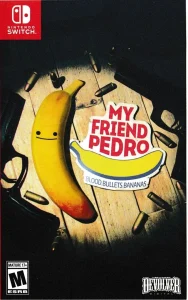
My Friend Pedro: Blood Bullets Bananas Switch NSP
Report Link Error
Select the broken download file, then submit the report.
Screenshots
About Game
My Friend Pedro: Blood Bullets Bananas Switch NSP is a fast, stylized arcade-platformer built around the pleasure of making a chaotic fight look deliberate. Gunfire, acrobatic movement, and slowed time combine to turn rooms full of enemies into brief action puzzles. The result is violent, absurd, and knowingly theatrical, with each encounter inviting players to find a cleaner line, a sharper shot, or a more spectacular escape.
A Bullet-Time Action Game Built Around Style
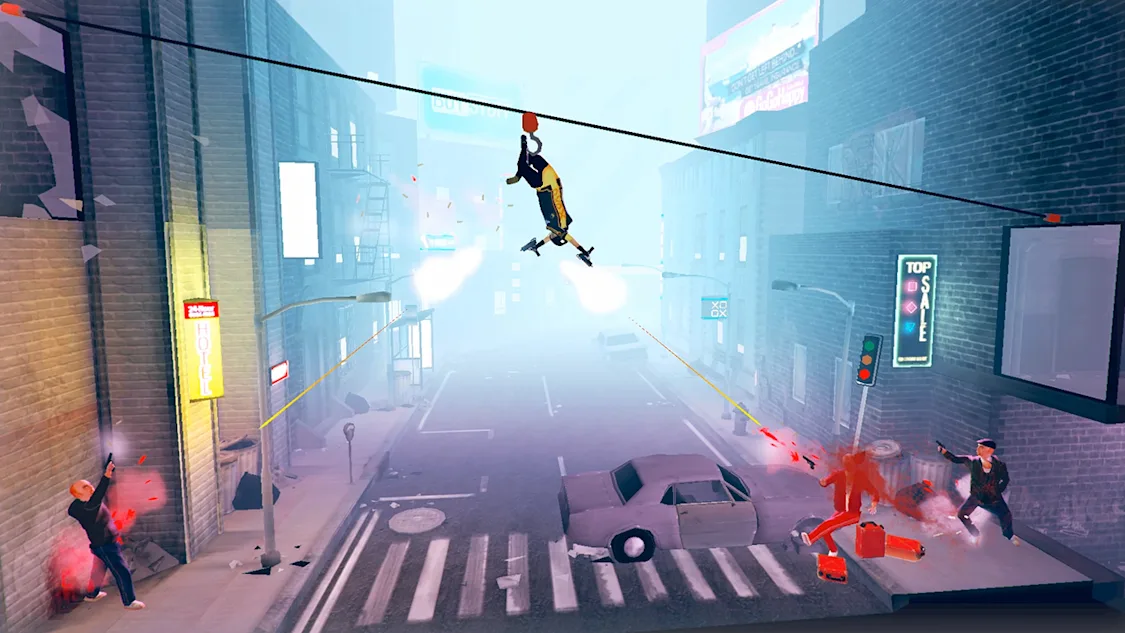
My Friend Pedro approaches action with the pace of an arcade game and the movement of a platformer. Its masked lead is not simply moving from one firefight to the next; he is flipping through danger, diving past bullets, and turning the architecture of each area into part of the attack. The action has a deliberately exaggerated quality, where a successful sequence can feel like a miniature stunt scene.
The game’s style comes from how its systems overlap. Shooting alone is only part of the picture. Players are encouraged to use momentum, timing, positioning, and nearby objects to keep a fight moving. A room may be cleared with direct gunfire, but it can also become a stage for ricochets, kicks, spins, and improvised movement. That emphasis gives the arcade platformer format a sense of showmanship without losing the urgency of a close-range encounter.
Its tone supports that approach. The violence is framed through surreal ideas and heightened action rather than realism, creating a presentation that is darkly comic as well as intense. The game asks players to embrace the ridiculousness of its premise while concentrating on precise play.
The Amnesiac Hero and the Talking Banana
The story begins with an amnesiac protagonist who has little understanding of his own past. His guide is Pedro, a talking banana with peculiar advice and an apparent desire to send the hero into a trail of destruction. It is an intentionally strange setup, but that strangeness is central to the game’s dark humor.
As the protagonist pushes through thugs, gangsters, and other dangerous figures, the search for lost memories begins to intersect with a wider story of crime and betrayal. Pedro’s presence keeps the journey off-balance: he is both companion and source of questions. His whimsical manner contrasts sharply with the brutal route the player takes through the game.
This premise gives the action a narrative thread without slowing its momentum. The hero is seeking answers, but the immediate problem is always the next group of enemies and the fastest way through them. The uncertainty around Pedro’s agenda adds an uneasy edge to a story that is otherwise willing to be bizarre.
How Slow Motion Changes Every Fight
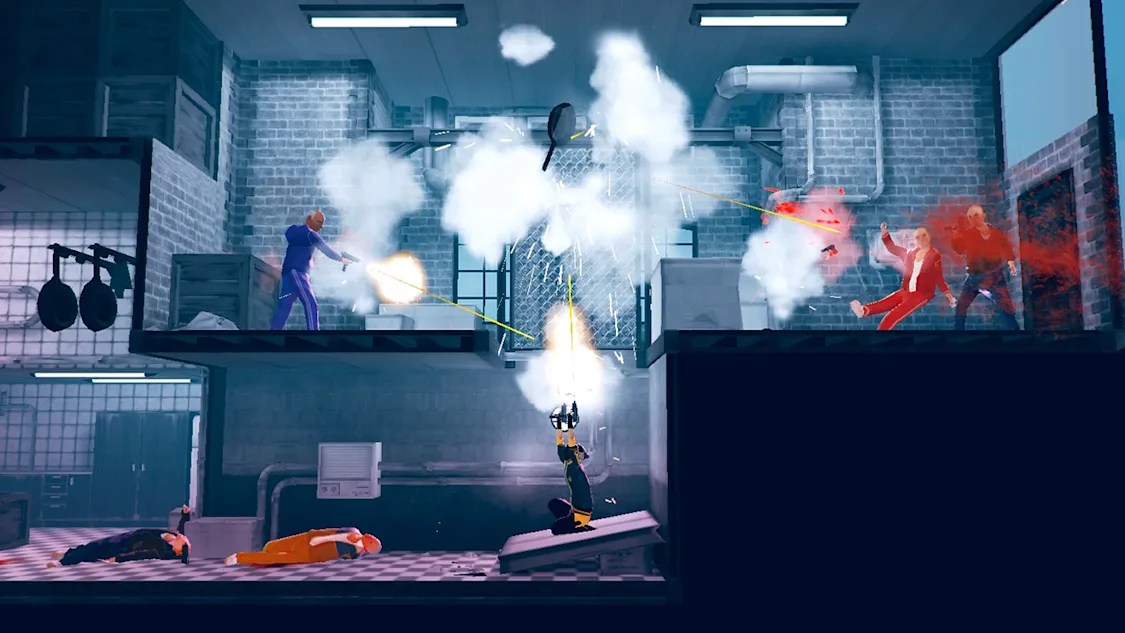
Bullet time is the key tool for turning panic into control. By slowing the action, players get the breathing room to line up shots, react to incoming fire, and navigate dangerous spaces with more intention. What might initially look like an overwhelming enemy encounter can become a sequence of manageable decisions.
Slow-motion aiming does more than make shots easier to place. It changes the rhythm of combat. A player can use the pause in speed to identify threats, shift toward cover, or set up a dramatic chain of attacks before normal pace returns. The system rewards awareness, especially when opponents are positioned at different heights or directions.
That controlled pacing is important because the game remains fast even when time is slowed. The player is still moving through an active space, often with little room for error. Bullet-time combat therefore feels less like a break from the action and more like a way to shape it. Used well, it turns a frantic gunfight into a composed and visually satisfying sequence.
- Slow the moment: Use reduced time to assess enemy positions and place shots more carefully.
- Keep moving: Rolls, flips, and jumps help avoid fire while preserving momentum.
- Split the pressure: Aim in different directions when enemies surround the character.
- Use the room: Objects and surfaces can create opportunities beyond straightforward shooting.
- Build a sequence: Chaining actions helps sustain the stylish flow encouraged by the scoring focus.
Dual-Wielding and Split-Aim Combat
Dual-wielding gives My Friend Pedro much of its visual identity. With two firearms in hand, the protagonist can direct shots toward separate targets rather than treating every fight as a single forward-facing exchange. Split aiming makes it possible to pressure enemies on opposite sides of the screen, opening up room-clearing solutions that would be impossible with a single line of fire.
The mechanic favors precision over random shooting. When opponents occupy different positions, players must decide where each weapon should be directed and when it is safer to focus attention on one threat. The most stylish kills come from reading that layout quickly: one enemy may need an immediate shot while another can be addressed during a jump, roll, or turn.
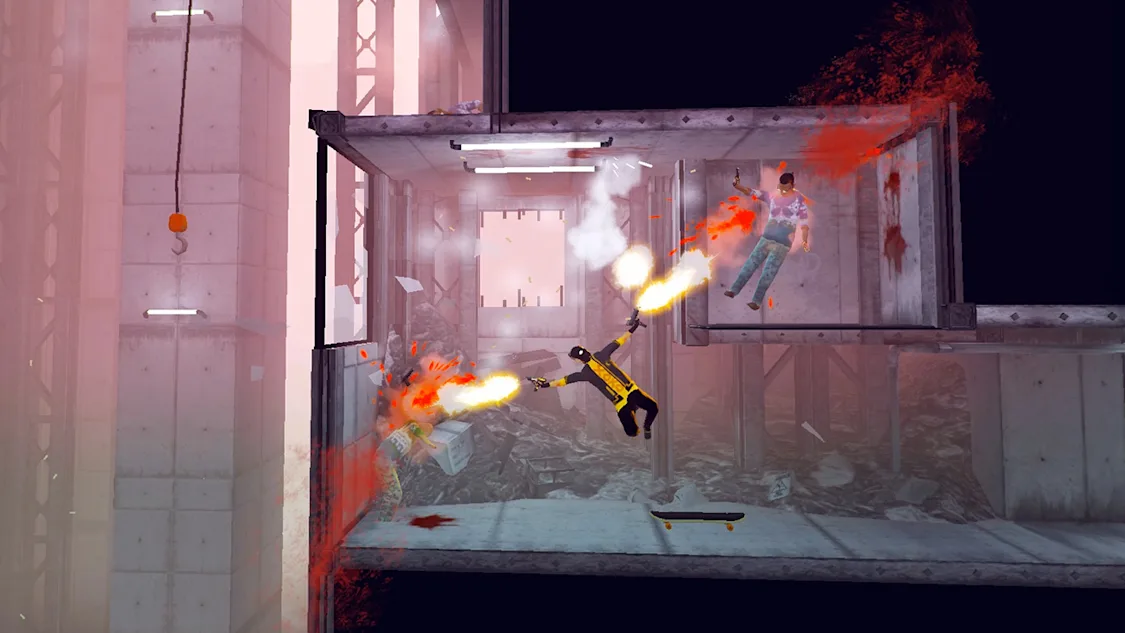
Environmental interactions add another layer. Bullets can ricochet from frying pans to reach enemies behind cover, while objects can be kicked for more forceful results. The game also includes moments involving skateboards and rope-based movement, reinforcing the sense that its spaces are meant to be played with rather than merely passed through. These systems encourage experimentation and can make repeat attempts worthwhile for players chasing more inventive clears.
Acrobatics, Wall Jumps, and Constant Mobility
Combat mobility is as important as weapon use. Flips, rolls, wall jumps, and other acrobatic moves allow the protagonist to avoid damage while staying engaged with the fight. Remaining still is rarely the appealing option; the game’s strongest sequences come from moving through an encounter instead of stopping in front of it.
Wall jumps are particularly useful when vertical space becomes part of the challenge. They help sustain momentum, alter the player’s angle of attack, and create a way out of a crowded position. Rolls and flips serve a similar purpose, allowing the player to shift through danger while continuing to plan the next shot.
This constant motion gives the game its action-film energy. It is not solely about survival, though survival matters. Players are also encouraged to make their routes look good, keeping a combo going and finding more fluid ways to connect movement with gunfire. Hazardous environments and boss battles add pressure to that process, asking for quick reflexes alongside strategic choices.
Nintendo Switch Release Details and Localization
Released for Nintendo Switch on June 20, 2019, My Friend Pedro: Blood Bullets Bananas Switch NSP was developed by Deadtoast and published by Devolver Digital. It is listed in the Arcade and Platformer genres, a fitting description for a game that combines score-minded action with movement-heavy stages.
The Nintendo Switch release is available across Europe, USA, Asia, and Japan. Its language options include English, German, Spanish, French, Japanese, Korean, Portuguese, Russian, and Chinese. That range suits a game whose appeal is driven strongly by immediate visual action and readable mechanical ideas: slow time, move decisively, and turn every encounter into a controlled mess of bullets and motion.
For players who enjoy dark humor, high-speed gunplay, and the satisfaction of refining an action sequence, My Friend Pedro offers a focused take on stylish combat. Its unusual Pedro talking banana premise supplies the personality; its movement and aiming systems provide the reason to keep pursuing a better run through each dangerous room.