Formula Retro Racing: World Tour Switch NSP
Report Link Error
Select the broken download file, then submit the report.
Screenshots
About Game
Formula Retro Racing: World Tour Switch NSP arrived on Nintendo Switch on March 31, 2023, bringing an action, arcade, and racing experience from CGA Studio Games, which served as both publisher and developer. Its approach is direct: fast cars, international circuits, sharp corners, and an intentionally retro visual style that recalls the energy of 1990s arcade racers while aiming for responsive modern play.
Formula Retro Racing: World Tour on Nintendo Switch at a Glance
Formula Retro Racing: World Tour is built around the immediate appeal of arcade racing. Rather than leaning on simulation-heavy detail, it places speed, accessible handling, and competitive events at the centre of the experience. The Nintendo Switch release supports a broad set of language options, including English, French, German, Italian, Japanese, Korean, Portuguese, Spanish, and Traditional Chinese, and is available across Europe, the USA, Asia, and Japan.
CGA Studio Games frames the game as a globe-spanning racing challenge with a compact, energetic identity. The genre labels—Action, Arcade, and Racing—fit its focus on rapid competition rather than a slow or technical motorsport simulation. Cars are made to feel quick, races are designed to begin without much delay, and the key appeal comes from learning how to take each circuit more cleanly and confidently.
The result is a racing game suited to players who enjoy immediate track action, short competitive runs, and repeated attempts to improve a result. Its retro-futuristic vehicles and stylised circuits give the World Tour premise a distinctive presentation without moving away from the simple goal of finishing ahead of rivals or beating the clock.
A Global Racing Journey Built Around Personal Progress
There is no elaborate character-led plot driving Formula Retro Racing: World Tour progression. Instead, its sense of journey comes from the player’s own racing career: entering championships, meeting new challenges, unlocking further opportunities, and proving capable across circuits in different parts of the world.
That structure keeps the focus on personal achievement. A strong finish is not merely a result screen; it is part of the push toward mastering more of the game’s events, locations, cars, and track demands. Rival racers create pressure during competitive events, while the clock becomes the central opponent in solo attempts to improve a lap or race time.
The global setting gives this progression a useful sense of movement. Advancing means encountering circuits with different surroundings and corner patterns rather than staying within a single venue. The racing career is therefore defined less by dialogue or story scenes than by performance: learning a course, selecting a vehicle that suits it, and returning with a better understanding of where time can be gained.
- Win championships: Grand Prix competition gives players a structured route through tournament racing.
- Chase the clock: Time Trials shift attention toward cleaner laps and more precise driving.
- Meet rival pressure: Competitive races demand awareness of opponents as well as the circuit itself.
- Unlock fresh challenges: Progress opens further reasons to revisit the worldwide racing journey.
- Refine the drive: Different vehicles have their own attributes, encouraging experimentation across events.
Retro-Inspired Presentation and Modern Arcade Energy
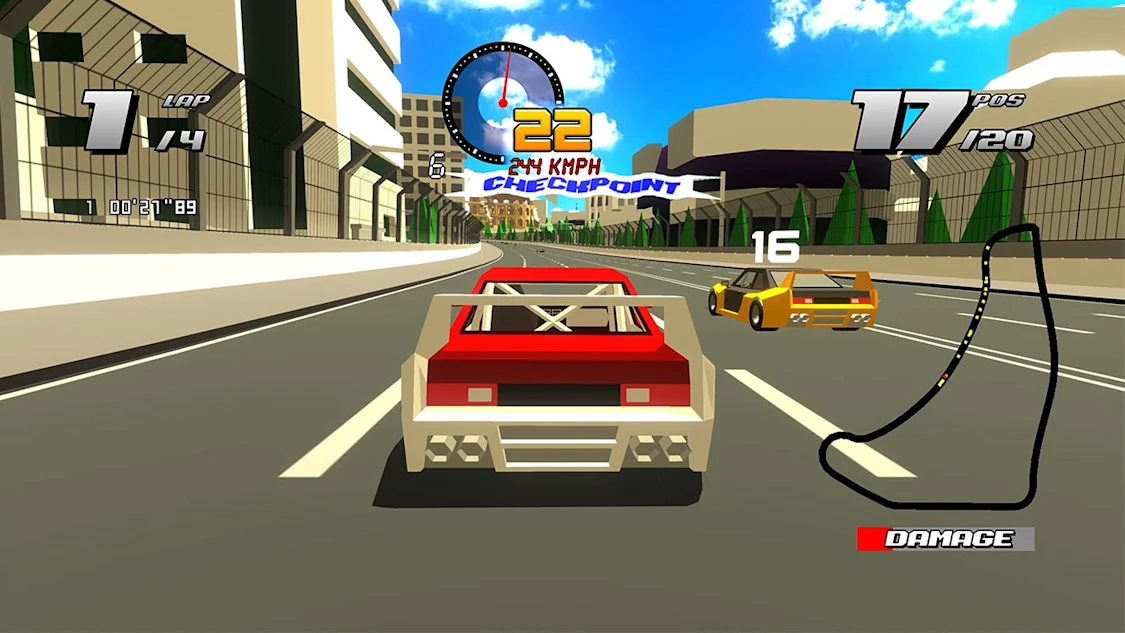
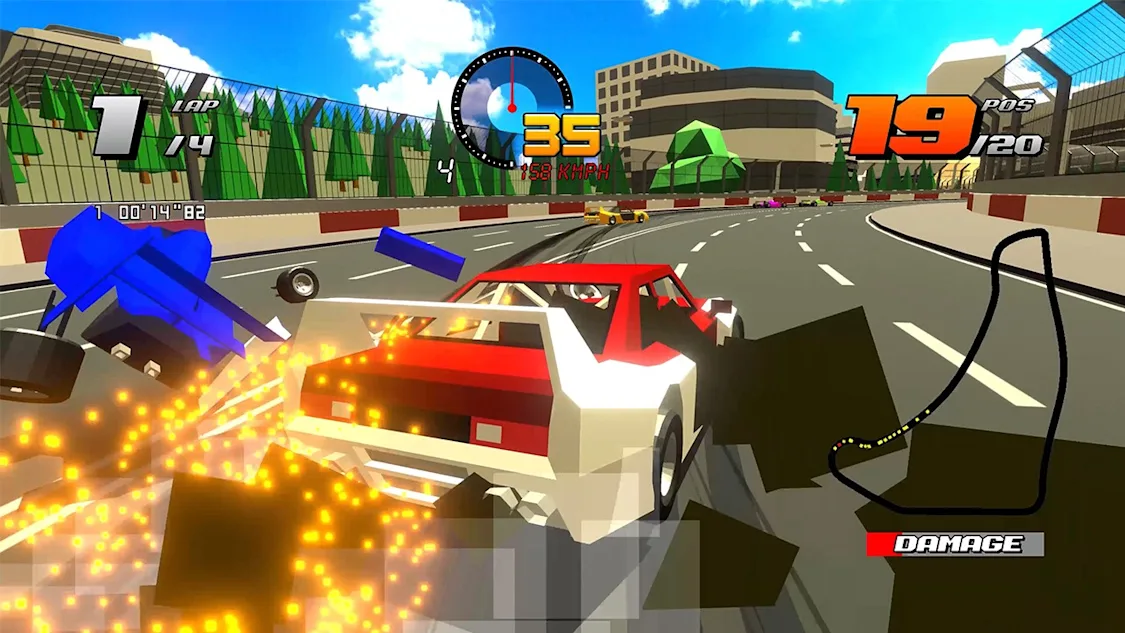
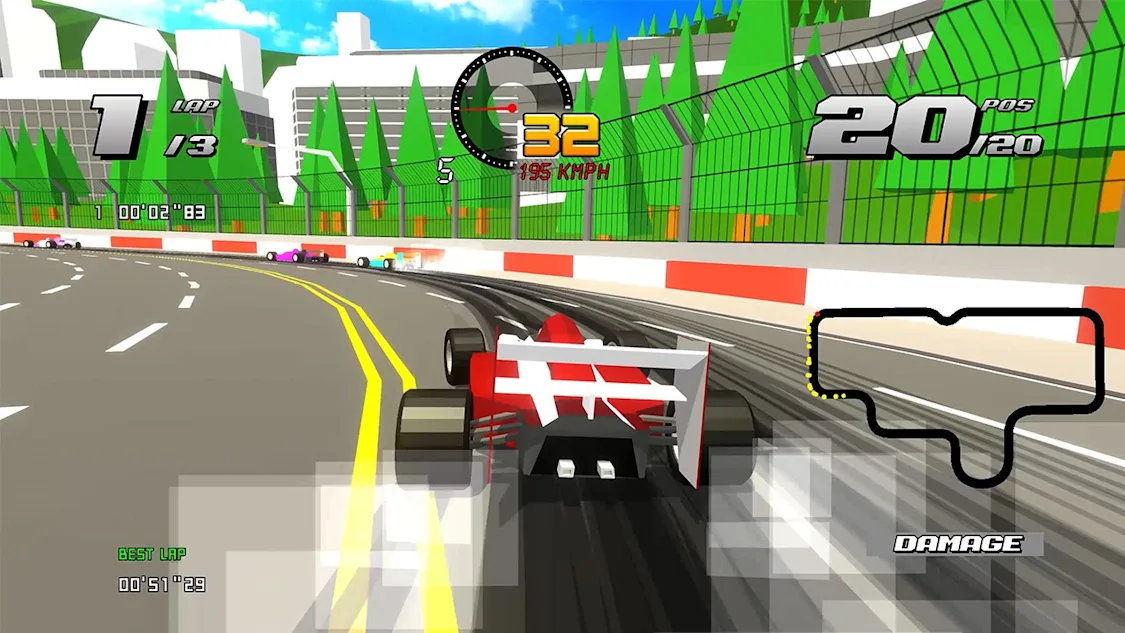
The game’s visual identity draws clearly from polygonal racing games of the 1990s. Its graphics favour angular forms and a deliberately nostalgic look, giving the cars and environments a period-inspired character rather than pursuing realism. That presentation is paired with a polished arcade racing engine intended to keep events lively and readable at speed.
This combination matters because the visual style does more than provide decoration. The old-school polygonal approach supports the game’s brisk, uncomplicated tone: circuits are places to attack, opponents are targets to pass, and the immediate line through a bend is more important than detailed simulation procedures.
Responsive controls are a central part of that appeal. Formula Retro Racing: World Tour Switch NSP is designed around quick reactions and accessible input, allowing players to get into a race quickly while still leaving room to improve. The difference between an adequate run and a strong one can come from braking at the right moment, choosing a better line, or carrying more speed through a corner.
The atmosphere is consequently more about bright arcade intensity than motorsport formality. Its appeal lies in the sensation of movement, close competition, and the satisfaction of bringing a difficult lap under control. Players looking for a nostalgic racing mood with modern responsiveness are the natural audience for that balance.
Racing Modes That Support Quick Sessions and Repeat Play
A range of modes gives the game different ways to present its racing challenges. Grand Prix tournaments provide the clearest competitive framework, asking players to take on a series of races in pursuit of championship success. This is where the broader progression theme has room to develop, as results build toward the goal of becoming a stronger competitor.
Time Trials offer a more solitary kind of pressure. With the clock in focus, players can concentrate on the details of a single circuit: where to brake, when to begin a drift, and how much momentum can be preserved from one turn to the next. They are well suited to repeat play because even a small improvement can make another attempt feel worthwhile.
Elimination races add another form of challenge, turning each event into a test of staying competitive under pressure. Free Race, meanwhile, offers a simpler route into the action for players who want to choose a circuit and drive without the structure of a tournament or time-focused objective.
These modes make the game appropriate for both brief sessions and longer stretches of practice. A player can run a quick event, then return later to pursue a stronger championship placing or a faster time. Local split-screen multiplayer also allows friends to race together on the same system, while AI opponents provide competition outside those shared sessions.
Why Drifting Matters in Formula Retro Racing: World Tour
Drifting is not presented as a purely visual flourish. It is a practical arcade racing technique, especially when a circuit demands a fast change of direction through a demanding bend. A well-timed drift can help a car turn stylishly while preserving the momentum that might otherwise be lost in a slower, more cautious corner.
That makes drifting an important skill to practise. Entering too early, too late, or at the wrong speed can compromise a line through the corner, but using the mechanic effectively can keep a race flowing. In Time Trials, those small decisions can affect a final result; against rivals, they can create the opening needed to hold position or make a pass.
The emphasis on maintaining momentum fits the game’s arcade character. Success comes from feeling the rhythm of a track and learning when aggressive cornering is worth the risk. It is approachable enough to encourage experimentation, yet demanding enough for repeated runs to reveal cleaner and faster routes.
From City Circuits to Countryside Routes
The World Tour identity is carried by its varied global locations. Races take place across environments that include bustling cities and scenic countryside, giving the circuit selection a sense of travel as players move through different challenges. These settings provide visual contrast while also supporting the idea of a worldwide racing career.
City circuits suggest close, high-energy competition, while countryside routes offer a different backdrop for the same rapid arcade action. Together, they prevent the game’s progression from feeling tied to one type of venue. Each new location is another opportunity to learn a circuit, test vehicle handling, and pursue a sharper result.
For players drawn to retro racing visuals, quick controls, drifting, tournament events, and the steady pursuit of better performances, Formula Retro Racing: World Tour offers a focused trip through international arcade competition.