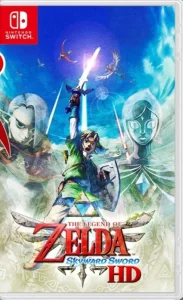
The Legend of Zelda: Skyward Sword HD Switch NSP XCI
Report Link Error
Select the broken download file, then submit the report.


Screenshots
About Game
The Legend of Zelda: Skyward Sword HD Switch NSP XCI is Nintendo’s 2021 Adventure and Action release for Nintendo Switch, arriving on July 16, 2021. It places a familiar heroic journey in a setting defined by altitude: a peaceful home among the clouds, a frightening world below them, and a search for Zelda that gradually reveals an ancient conflict.
Skyloft, the Surface, and the Quest to Find Zelda
Link begins as a student at the knight academy in Skyloft, where life is lived high above the clouds. His close friendship with Zelda gives the opening its emotional centre, but that calm does not last. During a ceremony involving their Loftwings, a dark tornado carries Zelda away, sending her toward the unknown land beneath Skyloft.
Link’s response is immediate: he sets out to find her. His route becomes clearer after meeting Fi, the spirit within the Goddess Sword. Fi guides Link toward the surface, where monsters, old ruins, and forgotten truths wait beyond the Cloud Barrier. The search is personal, but it grows into something larger as Link learns that the fate of Skyloft and the world below are connected.
The story’s momentum comes from this shift in scale. Zelda’s disappearance provides the purpose, while Link’s journey reveals why the Goddess Sword matters and what he must become to face the darkness ahead. Friendship, courage, and discovery remain closely tied together instead of feeling like separate plot threads.
A Skyborne Adventure Across Islands and Ancient Lands
The game divides its world between the open skies and more dangerous regions on the ground. Link travels between sky islands on his Loftwing, using the air above the clouds as a route to destinations and hidden points of interest. Skyloft serves as the familiar home in this airborne space, while other islands help make the sky feel like a place to investigate rather than merely pass through.
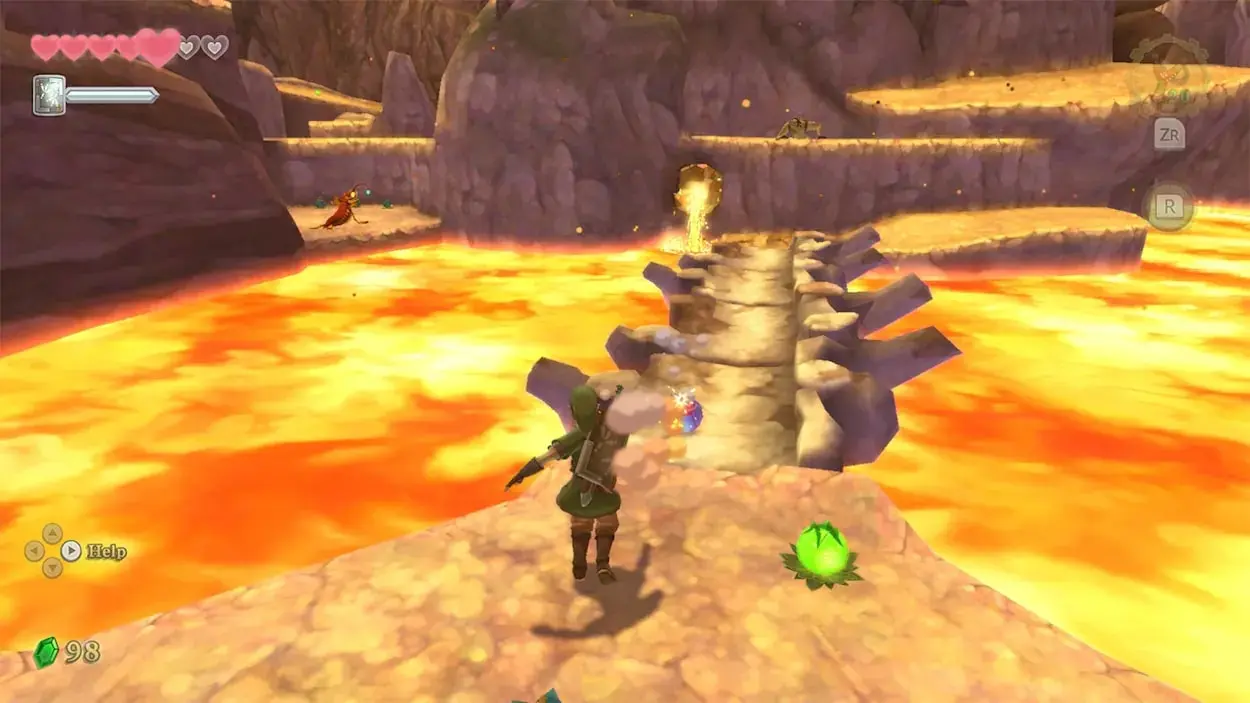
Descending through the Cloud Barrier changes the mood. The surface world is more hostile and more enclosed, built around themed overworld areas, ancient ruins, enemies, and dungeons. This contrast gives the adventure a useful rhythm: flying creates a sense of distance and freedom, while travelling on foot below the clouds puts attention on hazards, paths, puzzles, and combat.
The structure also makes progress feel tangible. A trip through the sky leads to a specific destination; a difficult surface route opens the way to a dungeon; a completed dungeon advances both the search for Zelda and Link’s understanding of the world. The result is an adventure that alternates between broad travel and focused exploration.
Sword Combat Built Around Directional Slashes
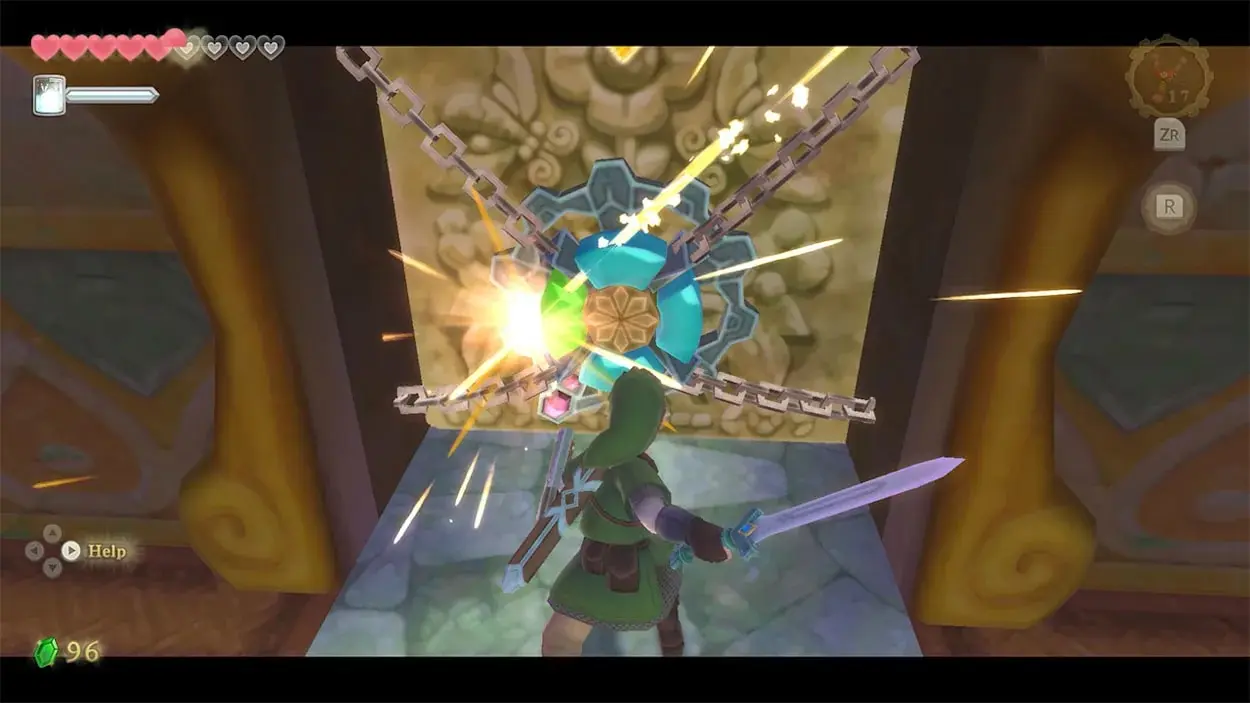
Combat in Skyward Sword HD asks players to look closely at opponents rather than simply attack without thought. Enemies can require slashes from particular angles, making directional sword fighting a central part of each encounter. Watching an enemy’s stance and choosing the right opening gives ordinary battles a deliberate pace.
Link also has more forceful options when space and stamina allow. Spin attacks can be useful against nearby threats, while sprinting and climbing draw from a stamina wheel. That same resource adds pressure during traversal: a hurried climb or dash may solve an immediate problem, but it needs to be managed carefully.
The system is designed around purposeful movement. Sword strikes, evasive positioning, item use, and stamina all interact, so success often comes from reading the situation first. This approach suits players who enjoy action with a problem-solving edge, where an enemy’s behaviour can be as important as speed.
- Read the guard: Observe how enemies position themselves before committing to a slash.
- Protect stamina: Save enough of the stamina wheel for climbs, sprints, and spin attacks when they matter most.
- Use every tool: Items are useful in combat as well as in exploration and puzzle-solving.
- Search beyond the route: Sky islands, surface paths, and ruins can reward careful investigation.
- Think before bosses: Boss battles often ask for observation and a creative response rather than repeated attacks.
Choosing Between Joy-Con Motion Controls and Button Controls
Skyward Sword HD offers two ways to handle Link’s swordplay on Nintendo Switch. Joy-Con motion controls preserve the physical, directional approach to sword swings, letting players make deliberate movements as they attack. For those who prefer a more traditional input method, button controls provide another route through the same adventure.
That choice matters because the game’s combat is closely tied to direction and timing. Players interested in the motion-based design can lean into the feeling of wielding the sword, while players who want to use buttons can still engage with the same enemy patterns, puzzles, dungeons, and story. The two approaches make the HD version more accommodating without changing the central focus on observation.
For an adventure with varied demands—flying, climbing, puzzle-solving, combat, and item use—control flexibility is practical. It allows the journey to suit different play preferences while keeping the intended tactical nature of sword encounters intact.
Dungeon Puzzles, Items, and Boss Challenges
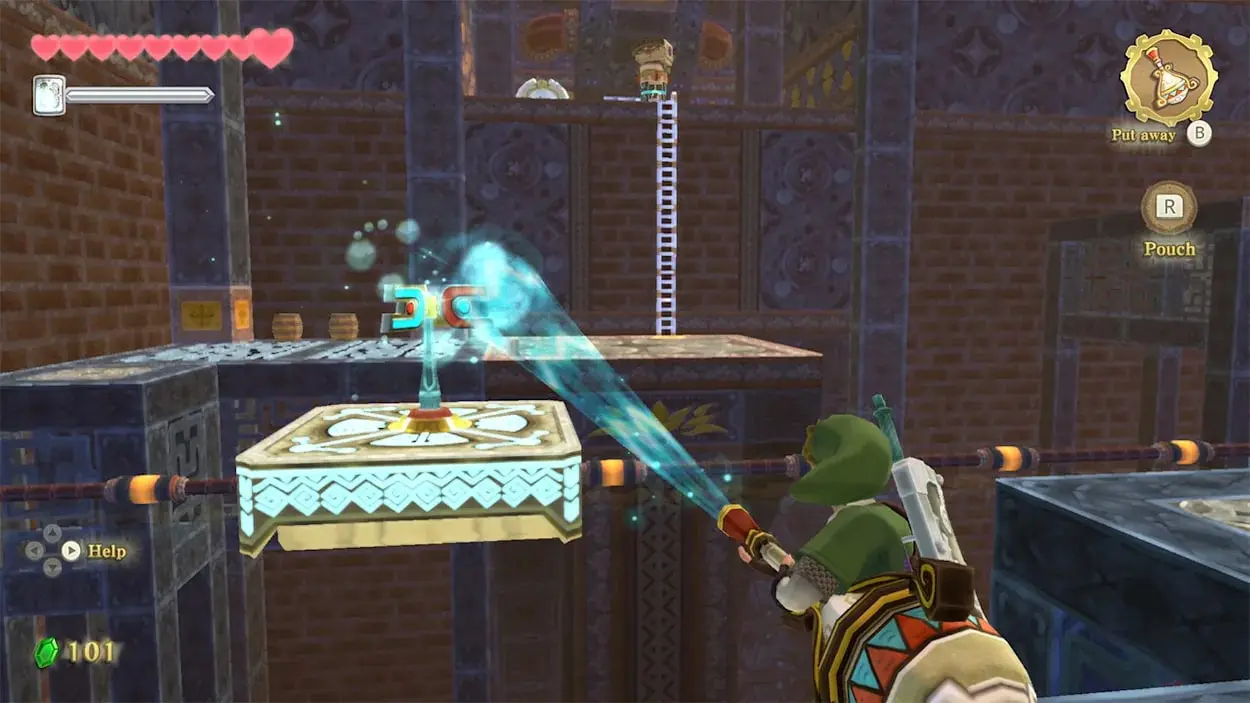
Dungeons bring the game’s main ideas together. They are spaces for navigation, puzzle-solving, combat, and discovery, with progression often depending on understanding how an item changes the environment. The Beetle, Slingshot, and Whip are part of Link’s arsenal, and their value extends beyond straightforward attacks.
Puzzles are not limited to dungeon rooms. They appear in surface exploration and can shape combat encounters as well, encouraging players to pay attention to objects, routes, and enemy behaviour. This creates a steady loop: find a tool, learn its possibilities, then apply it in increasingly demanding situations.
Boss battles are the clearest test of that learning. They ask players to study patterns and use equipment thoughtfully, often turning a familiar item into the answer to a larger challenge. Upgrade materials add another strand of progression, allowing shields, pouches, and other gear to be improved at the Bazaar. For players who enjoy revisiting an area with better understanding of their tools, the game’s mix of secrets, upgrades, and item-based challenges gives exploration lasting purpose.
Why Skyward Sword HD Matters to Zelda’s Origin Story
The Legend of Zelda: Skyward Sword HD Switch NSP XCI frames its adventure as an important chapter in the series’ mythology. Link’s path leads toward forging the Master Sword, transforming the significance of the Goddess Sword and connecting his personal rescue mission to a wider legend.
The journey also introduces the origins of the Triforce and the threat of Demise, presented as the ultimate evil behind the conflict. These discoveries give the story a foundational role: it examines the beginning of an enduring struggle between good and evil, while retaining the immediate human stakes of Link trying to reach Zelda.
Its atmosphere moves between bright skybound travel and ominous ancient lands, making it well suited to players who want an action adventure with directed sword combat, substantial dungeons, and a story focused on the early roots of Zelda’s legend. Nintendo lists the game across Europe, USA, Asia, and Japan, with language support including English, French, German, Italian, Spanish, Korean, Dutch, Russian, Japanese, and Chinese.